

1932 United States presidential election
Images

ElectoralCollege1932




Economic Catastrophe and Political Discontent
The 1932 United States presidential election unfolded against the devastating backdrop of the Great Depression, the most severe economic downturn in American history. The stock market crash of 1929 and its cascading effects had plunged the nation into widespread unemployment, poverty, and social unrest. Incumbent Republican President Herbert Hoover, despite his efforts, was widely perceived as unable to effectively address the crisis.
His administration's policies were seen by many as insufficient, leading to a deep well of public discontent. This widespread dissatisfaction created fertile ground for a political realignment, as voters sought a leader and a party offering a fundamentally different approach to governance and economic recovery.
Franklin D. Roosevelt's Rise and the 'New Deal' Vision
Franklin D. Roosevelt, the Democratic nominee and Governor of New York, emerged as the charismatic alternative. His path to the nomination was not without its challenges; he secured the Democratic presidential nomination on the fourth ballot at the party's convention after a spirited contest.
Roosevelt's campaign strategy was built around a compelling promise of a 'New Deal' for the American people. This was not a fully formed policy agenda at the outset but rather a broad vision of government intervention aimed at providing relief, recovery, and reform. He skillfully contrasted his optimistic and proactive stance with Hoover's perceived inaction, tapping into the public's yearning for decisive leadership and a renewed sense of hope.
His running mate, John Nance Garner, Speaker of the House, helped unite the Democratic Party.
A Landslide Election and the End of an Era
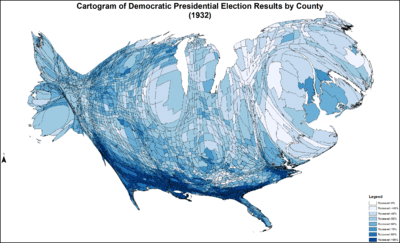
The election results on November 8, 1932, were a resounding repudiation of the incumbent administration and a clear mandate for change. Roosevelt won in a landslide, capturing both the popular vote and an overwhelming majority in the Electoral College. He carried every state outside of the Northeast, securing the highest percentage of the popular vote for any Democratic nominee up to that point.
This victory was particularly striking given Hoover's landslide win in 1928. The election effectively marked the end of the Fourth Party System, which had been dominated by the Republican Party since the Civil War era, and signaled the beginning of the Fifth Party System, characterized by Democratic ascendancy.
The Genesis of the New Deal Coalition and Lasting Political Shifts
Roosevelt's election was more than just a change in presidential leadership; it was a 'realigning election' that fundamentally reshaped American politics for decades. It ushered in the era of the 'New Deal Coalition,' a powerful alliance of diverse groups including urban workers, farmers, immigrants, and African Americans, who supported Roosevelt's policies and the Democratic Party. This coalition would dominate American politics for much of the 20th century.
The election also highlighted the significant role of economic crises in triggering major political shifts. Hoover became the only incumbent president to lose an election between 1912 and 1976, underscoring the profound impact of the Great Depression on the electorate's choices and the nation's political trajectory.
Statistical Breakdown and Historical Context
The 1932 election saw a dramatic shift in voter allegiances. Herbert Hoover, who had won over 58% of the popular vote in 1928, saw his support dwindle to just 39.6% in 1932. Franklin D.
Roosevelt, on the other hand, secured a commanding victory. The Socialist Party candidate, Norman Thomas, garnered 2.2% of the vote, indicating some dissatisfaction with the two major parties but not enough to challenge their dominance. Roosevelt's win was significant as he was the first Democrat elected president since 1916 and the first to win a clear majority of both the popular and electoral votes since 1852.
This electoral performance cemented the Democratic Party's position as the majority party and set the stage for subsequent Democratic victories in the 1934 midterms and the 1936 presidential election.
See also
Frequently Asked Questions
Who won the 1932 U.S. presidential election?+
Why did many people vote against Herbert Hoover in 1932?+
What was the "New Deal" that Franklin Roosevelt promised?+
Which groups of people joined the New Deal Coalition after the election?+
How did the 1932 election change the way American politics worked?+
Based on content from Wikipedia · Licensed under CC BY-SA 4.0