

Yamnaya culture
Images

Yamnaya metal artefacts




The Yamnaya Phenomenon
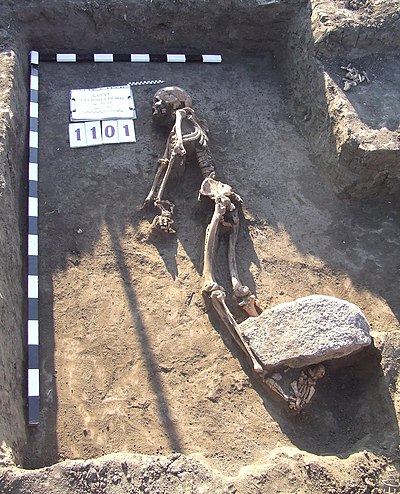
The Yamnaya culture, flourishing between approximately 3300 and 2600 BC, represents a significant archaeological horizon across the Pontic-Caspian steppe. Its designation as the 'Pit Grave' or 'Ochre Grave' culture stems from its characteristic burial tradition: the interment of the deceased in pit chambers, often covered by tumuli known as kurgans. Excavations, notably those by Vasily Gorodtsov in the early 20th century, revealed a distinct material culture, including distinctive pottery and tools.
Recent research points to the Mykhailivka site on the lower Dnieper River as a potential core area during an earlier phase (c. 3600–3400 BC). The Yamnaya economy was robust, built upon extensive animal husbandry, supplemented by fishing and foraging. Their nomadic lifestyle, facilitated by wheeled carts and wagons, allowed for the management of large mobile herds and the exploitation of the steppe's vast resources.
This mobility and resourcefulness were key to their expansion and influence across a wide geographical expanse.
The Kurgan Hypothesis and Linguistic Dispersal
The Yamnaya culture holds immense significance due to its central role in the widely accepted Kurgan hypothesis, proposed by Marija Gimbutas and further developed by others. This hypothesis posits that the Yamnaya people were the primary speakers of Proto-Indo-European (PIE), the reconstructed ancestor of the vast Indo-European language family. The Yamnaya's expansionist movements, enabled by their mobile pastoralism and likely socio-political organization (chiefdoms), are seen as the driving force behind the Indo-European migrations.
These migrations, radiating outwards from the steppe homeland, are believed to have dispersed PIE and its early descendants across Europe and into Asia. Consequently, the Yamnaya are considered foundational to the linguistic landscape of much of the modern world, linking diverse languages from English and Spanish to Hindi and Persian through a shared ancient linguistic root.
Genetic Footprints
Recent advancements in ancient DNA analysis have provided compelling evidence supporting the Yamnaya's pivotal role in population history. Genetic studies indicate that the Yamnaya population itself was a complex admixture, primarily formed from a blend of Eastern European Hunter-Gatherers (EHG) and Caucasus Hunter-Gatherers (CHG), with additional contributions from Anatolian or Early European farmer groups. This specific genetic profile, often termed 'Steppe Ancestry,' became highly influential.
Populations associated with subsequent major archaeological cultures, including the Corded Ware, Bell Beaker, Sintashta, and Andronovo cultures, show substantial genetic inheritance from the Yamnaya or closely related steppe populations. This genetic legacy underscores the profound demographic impact of Yamnaya migrations, demonstrating how their movements fundamentally reshaped the genetic makeup of large swathes of Eurasia.
Cultural Connections and Enduring Influence
The Yamnaya culture did not exist in a vacuum; it was deeply interconnected with contemporary and subsequent cultures. Its material culture bears strong resemblances to the Afanasievo culture of South Siberia, suggesting either a direct migration of Yamnaya groups or a shared ancestral source. Furthermore, the Yamnaya had significant interactions with Late Neolithic and Early Bronze Age cultures across Europe and Central Asia.
Their influence is evident in the spread of certain technologies, burial practices, and potentially social structures. The subsequent development of cultures like the Corded Ware and Bell Beaker in Europe, and the Sintashta and Andronovo cultures in the Steppe and Central Asia, shows a clear continuity or influence from Yamnaya traditions, both culturally and genetically. This complex web of interaction highlights the Yamnaya as a dynamic nexus of cultural exchange and transformation.
See also
Frequently Asked Questions
What was the Yamnaya culture and when did it exist?+
Why are the Yamnaya people called the "Pit Grave" or "Ochre Grave" culture?+
How did the Yamnaya people travel and move their animals?+
What is the Yamnaya connection to languages like English and Hindi?+
How did the Yamnaya people affect other cultures like the Corded Ware or Bell Beaker?+
Based on content from Wikipedia · Licensed under CC BY-SA 4.0