

Xumi Pagoda
Images

Xumi Pagoda 4


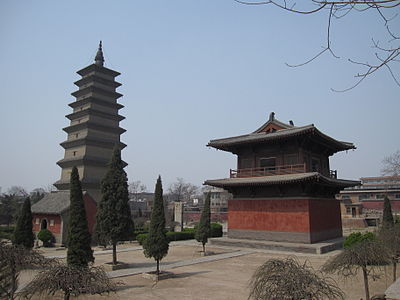
A Tang Dynasty Icon
The Xumi Pagoda, situated west of Zhengding in China's Hebei province, stands as a monumental testament to the architectural prowess of the Tang Dynasty. Constructed in 636 AD, during the reign of Emperor Taizong, it has withstood the ravages of time for over 1,300 years, a remarkable feat of engineering and preservation. Standing at an impressive 48 meters (157 feet), its square-based form is characteristic of many Tang pagodas, designed with a deliberate aesthetic that emphasized verticality and spiritual aspiration.
The pagoda's nine tiers of eaves, a signature element of Tang architecture, create a dynamic visual rhythm, drawing the eye upward towards the crowning spire. While the surrounding Kaiyuan Monastery has largely succumbed to history, the pagoda's robust stone and brick construction has ensured its survival, making it a crucial artifact for understanding the religious and architectural landscape of the era. Its enduring presence offers a tangible connection to a period of significant cultural and artistic flourishing in Chinese history.
Intricacies of Design
Beyond its imposing height, the Xumi Pagoda reveals fascinating details about its design and intended purpose. The pagoda's exterior is adorned with stone carvings at the corners of its base, showcasing the meticulous craftsmanship and artistic sensibilities of its creators. These decorative elements likely held symbolic meaning, contributing to the pagoda's spiritual significance.
Intriguingly, the interior of the pagoda is hollow, a common feature in many pagodas, but it notably lacks any internal staircase or means of access to the upper levels. This design suggests that the pagoda's primary function was not as a place for ascent or habitation, but rather as a symbolic representation of Buddhist cosmology or a reliquary. The gradual tiers of eaves are not merely decorative; they are functional elements that help to channel rainwater away from the structure, contributing to its longevity.
This blend of aesthetic beauty, structural integrity, and symbolic depth underscores the sophisticated understanding of architecture and spirituality during the Tang Dynasty.
The Bixi Guardian
A striking feature associated with the Xumi Pagoda is the colossal stone statue of a bixi, a mythical beast that combines the attributes of a dragon and a tortoise. Positioned near the pagoda's arched doorway, this imposing sculpture served as a powerful guardian figure, embodying strength and longevity. The bixi statue's presence is indicative of the rich tapestry of Chinese mythology and its integration into architectural and religious contexts.
For an extended period, a significant portion of the bixi statue was missing, a casualty of time or historical events. However, a remarkable discovery occurred in 2000 during an archaeological excavation conducted in a nearby street. The missing left side of the bixi was unearthed, a thrilling find that allowed for the near-complete restoration of this ancient guardian.
This event underscores the ongoing importance of archaeological research in uncovering and preserving cultural heritage, piecing together fragmented histories and bringing lost artifacts back to light.
Enduring Legacy
The Xumi Pagoda's significance extends far beyond its age and architectural form. As one of the best-preserved pagodas from the Tang Dynasty, it serves as an invaluable resource for scholars studying ancient Chinese Buddhism, art history, and architectural evolution. Its style, mirroring that of other prominent Tang pagodas like the Small Wild Goose and Giant Wild Goose pagodas, allows for comparative analysis, illuminating regional and stylistic variations within a unified cultural context.
The pagoda's continued existence prompts reflection on the enduring nature of human endeavor and the spiritual beliefs that motivated such monumental constructions. Furthermore, the story of the bixi statue's recovery highlights the dynamic relationship between historical sites and modern preservation efforts. It demonstrates how contemporary archaeology and conservation can actively engage with the past, not just passively observe it.
The Xumi Pagoda, therefore, remains a vital cultural touchstone, connecting contemporary audiences to the rich historical and spiritual legacy of China and emphasizing the importance of safeguarding such irreplaceable heritage for future generations.
See also
Frequently Asked Questions
What is the Xumi Pagoda?+
How tall is the Xumi Pagoda?+
Why does the pagoda have nine tiers of eaves?+
Where is the Xumi Pagoda located?+
What is the bixi statue and why is it near the pagoda?+
Based on content from Wikipedia · Licensed under CC BY-SA 4.0