

World Bank high-income economy
Images
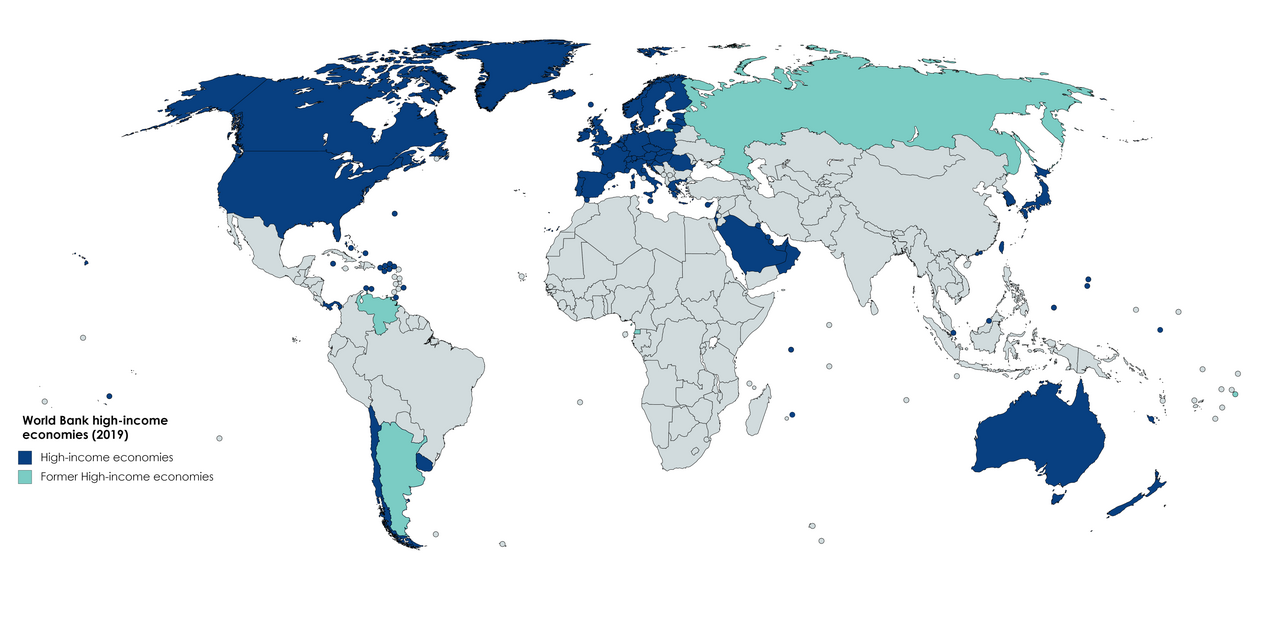
High-income economies 2019


The Threshold of Prosperity
The World Bank defines a high-income economy as a nation where the gross national income (GNI) per capita, calculated using the Atlas method, reaches or exceeds US$13,935 as of 2024. This metric is a crucial benchmark, serving as a primary indicator of a country's economic standing and its capacity to provide a high standard of living for its citizens. The Atlas method itself is designed to smooth out currency fluctuations and inflation, offering a more stable comparison between economies over time.
Reaching this threshold signifies a robust economic engine, often characterized by advanced industrialization, strong service sectors, and significant integration into global markets.
Drivers of High-Income Status
Countries achieve high-income status through a confluence of factors, primarily driven by their ability to generate substantial wealth. This often involves a strategic focus on innovation, technological advancement, and the development of high-value industries. Nations that excel in sectors like advanced manufacturing, information technology, finance, and specialized services tend to accumulate wealth more rapidly.
Furthermore, deep integration into the global economy, through trade agreements and foreign investment, allows these economies to leverage international demand for their goods and services, thereby boosting national income and per capita earnings.
Beyond Income
While 'high-income economy' is often used interchangeably with terms like 'First World' or 'developed country,' the World Bank's definition is strictly economic. This can lead to interesting classifications. For instance, the term 'First World' historically referred to nations aligned with the US during the Cold War, a geopolitical distinction.
Other institutions, like the IMF or CIA, consider broader factors such as industrialization, infrastructure, and human development indices when classifying economies as 'developed' or 'advanced.' Consequently, a country can be a high-income economy yet still be categorized as 'developing' by organizations like the UN. This is often the case for resource-rich nations, such as some Gulf Cooperation Council (GCC) countries, which have high per capita incomes but may be working to diversify their economies and develop other sectors.
Global Implications
High-income economies are pivotal players in the global arena. They are often centers of innovation, driving technological progress and setting global economic trends. Their substantial purchasing power influences international trade patterns, creating demand for goods and services worldwide.
Moreover, these nations typically possess the financial capacity and resources to engage in significant foreign direct investment and provide development assistance to lower-income countries, contributing to global poverty reduction and sustainable development goals. Understanding the dynamics of high-income economies is therefore essential for comprehending global economic interdependence, international relations, and the ongoing challenges of worldwide economic equity.
The Edge Cases
It's important to note that the World Bank's classification system has specific exclusions. For example, Vatican City, despite being a sovereign state, is not classified under the World Bank's high-income economy definition. This highlights that the classification is a technical economic measure, and certain unique entities may fall outside its standard application due to their specific nature or size, even if they possess characteristics of wealth.
See also
Based on content from Wikipedia · Licensed under CC BY-SA 4.0