

West Frisian Language
Images

Anglo-Frisian distribution map


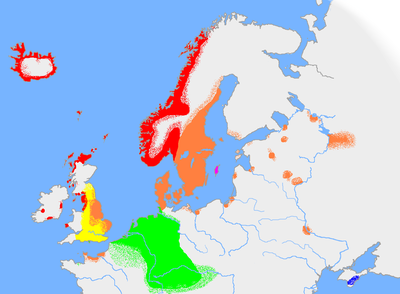


The Linguistic Landscape of Friesland
West Frisian, or Westerlauwersk Frysk, is the predominant language spoken in the province of Friesland in the northern Netherlands. It holds the distinction of being the most widely spoken of the Frisian languages, a small group of West Germanic languages spoken on the coasts of the North Sea. The speakers are overwhelmingly of Frisian descent, indicating a deep-rooted linguistic and cultural heritage.
While Dutch is the official language of the Netherlands, West Frisian enjoys a recognized status and is used in various domains, including education, media, and local government, underscoring its importance as a living language and a symbol of regional identity. Its survival and continued use are a testament to the resilience of minority languages in the face of dominant national tongues.
The Anglo-Frisian Divide
The most striking aspect of West Frisian from a historical linguistics perspective is its unparalleled closeness to the various dialects of Old English. This relationship places it firmly within the Anglo-Frisian subgroup of West Germanic languages. Old English, the language of Anglo-Saxon England, is the direct ancestor of modern English.
West Frisian serves as a crucial living link, offering invaluable insights into the phonological, morphological, and lexical features of Old English that might otherwise be lost. Studying West Frisian allows linguists to reconstruct hypothetical forms and understand the processes of linguistic divergence and change that occurred after the Anglo-Saxon migrations to Britain. It's akin to having a contemporary witness to the linguistic evolution of English.
Historical Roots and Divergence
The history of West Frisian is intertwined with the broader movements of Germanic tribes. The Frisians were a seafaring people who inhabited the coastal regions of what is now the Netherlands and Germany. Their language, like Old English, evolved from a common ancestral West Germanic dialect.
However, over centuries, geographical separation and different historical influences led to distinct developments. While Old English underwent significant changes, particularly after the Norman Conquest, West Frisian retained more archaic features, making it a conservative language. This divergence highlights how languages can evolve differently even when sharing a common origin, influenced by external contact, political events, and internal linguistic pressures.
Understanding this divergence is key to appreciating the unique trajectory of West Frisian.
Modern Relevance and Cultural Significance
In contemporary society, West Frisian is more than just a communication tool; it is a vital component of Frisian cultural identity. Its recognition and promotion reflect a broader trend of valuing linguistic diversity. The language is taught in schools, appears in literature and music, and is used in public administration, ensuring its transmission to future generations.
This active promotion is crucial for its survival, especially in an era of globalization where dominant languages can overshadow smaller ones. The continued vitality of West Frisian demonstrates the power of language to foster a sense of belonging, preserve cultural heritage, and contribute to the rich tapestry of European linguistic landscapes. It stands as a powerful example of language revitalization and maintenance.
Linguistic Features and Comparisons
West Frisian exhibits several features that are particularly interesting when compared to English and Dutch. For instance, it retains certain sounds and grammatical structures that are absent in modern English but present in Old English. Its vocabulary also shows a significant overlap with English, often in words that have been lost or substantially altered in English over time.
While it shares many cognates with Dutch due to geographical proximity and historical interaction, its core structure and many fundamental words are more closely aligned with English. This unique position makes it a fascinating subject for comparative linguistics, offering a distinct perspective on the West Germanic language family and the specific evolution of the Anglo-Frisian branch.
See also
Frequently Asked Questions
What is West Frisian language?+
Where is West Frisian spoken?+
Why is West Frisian important for learning about English?+
How do people use West Frisian today?+
How can West Frisian be kept alive?+
Based on content from Wikipedia · Licensed under CC BY-SA 4.0