

The Super-Secret Welrod!
Images

Welrod Mk II
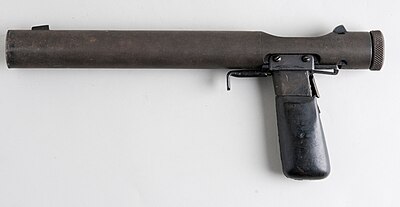


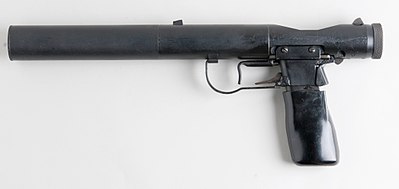

Conception and Genesis of a Silent Weapon
The Welrod pistol emerged from the crucible of World War II, a period demanding innovative solutions for unconventional warfare. Major Hugh Reeves, operating under the auspices of the Inter-Services Research Bureau (later Station IX), was tasked with developing specialized equipment for covert operations. The Welrod was his ingenious response to the need for a firearm that could be used with minimal acoustic signature.
The name 'Welrod' itself is a testament to its clandestine origins, combining 'Wel' from its birthplace in Welwyn with 'rod,' a piece of British gangland slang for a gun. This nomenclature was a deliberate obfuscation, designed to conceal the weapon's true purpose and origin from potential adversaries. The pistol was conceived not as a frontline combat weapon, but as a precision instrument for agents and resistance fighters who required discretion above all else.
The Engineering of Silence
The defining characteristic of the Welrod is its highly effective integrated silencer. Unlike detachable suppressors, the Welrod's silencer is an integral part of the barrel assembly. This design choice offers several advantages, including increased durability and a more compact overall profile.
The silencer functions by creating a series of expansion chambers that trap and cool the rapidly expanding propellant gases expelled from the muzzle upon firing. As these gases are slowed and dispersed, the sharp crack of the gunshot is significantly reduced, transforming it into a much quieter, muffled sound. The bolt-action mechanism also contributes to the weapon's stealth; it is inherently quieter and less complex than semi-automatic actions, requiring manual cycling of the bolt for each shot, which minimizes mechanical noise and allows for controlled, deliberate firing.
Strategic Significance and Operational Deployment
The Welrod's strategic importance lay in its ability to empower irregular forces and resistance groups operating deep within enemy territory. In scenarios where detection could mean capture, torture, or death, the Welrod offered a critical advantage. Its extreme quietness allowed for silent elimination of sentries, sabotage operations, and the discreet disposal of threats without compromising the mission or the operator's safety.
The pistol was designed for ease of use and reliability under duress, making it suitable for individuals who might not have extensive firearms training. Approximately 2,800 Welrod pistols were manufactured during the war, a number that reflects its specialized, rather than mass-produced, role. The continued production of an estimated 14,000 units post-war suggests its utility was recognized beyond the immediate conflict.
Legacy and Enduring Fascination
The Welrod pistol stands as a remarkable example of wartime innovation, embodying the ingenuity required for clandestine operations. Its design prioritized function and discretion, resulting in a weapon that was both effective and remarkably quiet. The pistol's unique blend of a bolt-action mechanism and an integrated silencer made it a specialized tool for a specific, high-stakes environment.
Today, the Welrod is highly sought after by collectors and historians, representing a tangible link to the secret world of espionage and special operations during World War II. It serves as a potent reminder of the often-unseen efforts and specialized equipment that played a crucial role in the broader conflict, showcasing how technological advancements were adapted for the shadows.
Technical Specifications and Design Philosophy
The Welrod pistol is a bolt-action firearm, typically chambered in calibers such as .32 ACP or .45 ACP, though variations existed. Its construction prioritized simplicity and robustness, essential for reliability in harsh conditions. The integrated silencer, a key design element, was engineered to maximize sound reduction while maintaining a manageable size and weight.
The bolt-action operation, while slower than semi-automatic fire, offered superior control over each shot and contributed to the weapon's overall quietness by eliminating the noise of a cycling slide or bolt carrier. The pistol's design philosophy was centered on providing a covert operative with a discreet, reliable, and effective means of self-defense or targeted neutralization, rather than engaging in sustained combat. This focus on specialized application cemented its unique place in the history of firearms development.
See also
Frequently Asked Questions
What is the Welrod pistol?+
Why was the Welrod made so quiet?+
How does the Welrod's silencer work?+
Who used the Welrod during World War II?+
How many Welrod pistols were made?+
Based on content from Wikipedia · Licensed under CC BY-SA 4.0