

Wellington Arch
Images

Wellington Arch - Hyde Park Corner


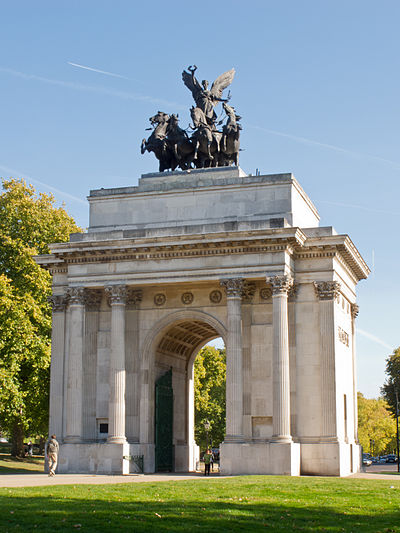


Architectural Ambition and Strategic Relocation
Wellington Arch, originally conceived as Constitution Arch and later known as Green Park Arch, is a Grade I-listed triumphal arch designed by Decimus Burton. Erected between 1826 and 1830, its initial placement was intended to align with Burton's Ionic screen entrance to Hyde Park, creating a grand vista. However, by the late 19th century, urban development and traffic management needs necessitated a significant relocation.
In 1882-1883, the entire structure was meticulously dismantled and reassembled at its current prominent site at Hyde Park Corner, marking the head of Constitution Hill. This monumental undertaking reflects the evolving urban planning of London and the enduring value placed on such historical monuments. The arch's substantial stone construction and classical proportions speak to the Neoclassical architectural style prevalent at the time, aiming to evoke grandeur and imperial power.
Evolving Iconography
The sculptural program atop Wellington Arch has undergone a significant transformation, mirroring shifts in national sentiment and artistic expression. Initially, it bore a colossal equestrian statue of Arthur Wellesley, the 1st Duke of Wellington, a hero of the Battle of Waterloo. This powerful representation solidified the arch's association with military triumph and national pride, leading to its common name.
However, this statue was eventually removed. Since 1912, the arch has been surmounted by Adrian Jones's dynamic bronze sculpture, 'Peace descending on the Quadriga of War.' This artwork features the winged Goddess of Victory, Nike, commanding a four-horse chariot, symbolizing the cessation of hostilities and the triumph of peace. The change from a singular military hero to a more allegorical representation of victory and peace signifies a broader historical and cultural narrative.
Symbolism and Significance in the Urban Fabric
As a triumphal arch, Wellington Arch is intrinsically linked to the commemoration of national achievements and figures. Its very form is derived from ancient Roman arches, designed to celebrate military victories and the return of triumphant generals. The association with the Duke of Wellington places it firmly within the context of British military history and imperial legacy.
The arch's prominent position at Hyde Park Corner, a major London thoroughfare, ensures its visibility and reinforces its role as a national symbol. It serves not only as a historical marker but also as an integral part of London's iconic cityscape, a point of reference for both residents and tourists, and a backdrop for national events and commemorations. Its enduring presence speaks to the continuity of historical memory within a rapidly changing metropolis.
The Arch as a Traffic Management Feature and Public Space
The arch's current location on a large traffic island at Hyde Park Corner underscores its dual role as a monument and an element of urban infrastructure. The surrounding area has been continuously adapted to manage the complex flow of traffic and pedestrians. While the arch itself is not accessible to the public in the way some other monuments are, its imposing presence shapes the public realm.
It stands as a silent witness to over a century of London's development, from the era of horse-drawn carriages to the complexities of modern urban transport. The arch’s placement, while grand, also highlights the challenges of integrating historical structures into contemporary urban environments, balancing aesthetic considerations with functional necessities.
See also
Frequently Asked Questions
What is Wellington Arch?+
Why was the arch moved?+
Who was the arch named after?+
What is on top of the arch now?+
Can people walk through the arch?+
Based on content from Wikipedia · Licensed under CC BY-SA 4.0