

Wave–particle duality
Images

Air Guitar




From Classical Waves to Quantum Packets
The journey to understanding wave-particle duality began with light. For centuries, scientific thought oscillated between viewing light as a stream of particles (corpuscular theory, championed by Newton) and as a wave phenomenon (undulatory theory, supported by Huygens and later Fresnel). By the late 19th century, experiments like the interference and diffraction patterns observed by Thomas Young and Augustin-Jean Fresnel seemed to definitively establish light's wave nature.
Maxwell's theory of electromagnetism further solidified this, describing light as electromagnetic waves. However, the early 20th century brought new experimental evidence that contradicted this purely wave-based view. The photoelectric effect, explained by Albert Einstein in 1905, demonstrated that light energy is absorbed and emitted in discrete packets, or quanta, called photons.
This particle-like behavior of light, particularly its energy being proportional to frequency (E=hf), was a crucial step in recognizing duality.
De Broglie's Hypothesis and the Wave Nature of Matter
The concept of duality was initially applied to light, but Louis de Broglie, in his 1924 doctoral thesis, boldly proposed that this duality was not exclusive to light but a universal property of all matter. He hypothesized that particles, such as electrons, also possess wave-like characteristics. He proposed a relationship where the wavelength (λ) of a particle is inversely proportional to its momentum (p), given by the equation λ = h/p, where 'h' is Planck's constant.
This revolutionary idea was experimentally confirmed in 1927 by Clinton Davisson and Lester Germer, and independently by George Paget Thomson, who observed diffraction patterns when electrons were scattered by crystals. These experiments unequivocally showed that electrons, previously considered purely particles, exhibit wave behavior, thus extending the principle of duality to matter itself.
The Philosophical and Experimental Implications of Duality
Wave-particle duality fundamentally challenges our classical intuition about the nature of reality. It implies that entities like photons and electrons do not possess fixed properties of being solely a wave or solely a particle. Instead, their observed behavior is contingent upon the experimental setup used to measure them.
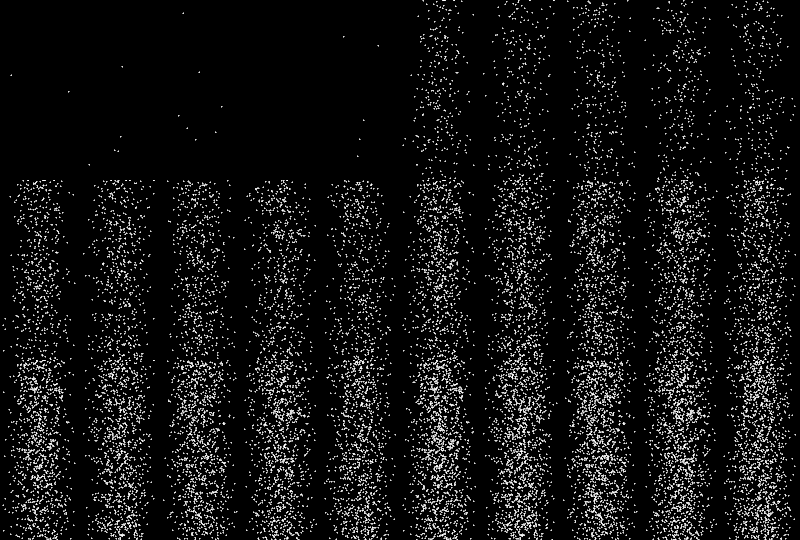
This is often interpreted through the lens of the Copenhagen interpretation, which suggests that a quantum system exists in a superposition of states until measured, at which point it collapses into a definite state. The double-slit experiment remains the quintessential demonstration of this duality, showing that even single particles, sent one at a time, can produce an interference pattern characteristic of waves, implying they somehow pass through both slits simultaneously. This inherent probabilistic nature and the observer effect are central to quantum mechanics.
Technological Manifestations and Modern Relevance
The understanding of wave-particle duality is not merely an abstract theoretical concept; it is the cornerstone of numerous modern technologies that shape our world. The electron microscope, for instance, leverages the wave nature of electrons to achieve resolutions far beyond what is possible with light microscopes. The development of semiconductor devices, transistors, and integrated circuits, which form the basis of all modern electronics, relies heavily on quantum mechanical principles, including the wave nature of electrons in solids.
Lasers, ubiquitous in telecommunications, medicine, industry, and consumer electronics, operate based on the quantum behavior of photons. Furthermore, ongoing research in quantum computing and quantum cryptography directly exploits the peculiar properties of quantum entities, including their dual nature, to perform computations and secure communications in ways previously unimaginable.
The Unresolved Questions and Future Frontiers
Despite its profound success, wave-particle duality continues to provoke deep philosophical questions about the nature of reality, measurement, and consciousness. While the mathematical framework of quantum mechanics is incredibly predictive, the interpretation of what it truly means for the underlying reality remains a subject of ongoing debate among physicists and philosophers. Is the duality an inherent property, or an artifact of our interaction with the quantum world?
How does this duality reconcile with general relativity, our theory of gravity and large-scale structures? The quest to unify quantum mechanics with gravity, often referred to as a theory of 'everything,' may require a deeper understanding of duality or even a paradigm shift beyond it. Future research into quantum entanglement, quantum field theory, and the fundamental structure of spacetime will undoubtedly build upon and potentially transcend our current comprehension of wave-particle duality.
See also
Frequently Asked Questions
What is wave-particle duality?+
Why does light sometimes act like a particle and sometimes like a wave?+
How did scientists discover that electrons can act like waves?+
What is the double-slit experiment and why is it important?+
How does wave-particle duality help make modern technology like computers and microscopes?+
Based on content from Wikipedia · Licensed under CC BY-SA 4.0