

Christopher Columbus's Big Adventures!
Images

Nicely Posed (EXPLORE)





Ambition, Patronage, and the Quest for the East
Christopher Columbus, an Italian navigator hailing from the Republic of Genoa, harbored a profound ambition to establish a westward maritime route to the lucrative markets of East Asia. This aspiration was fueled by the immense demand for spices, silks, and other exotic goods that were then transported via arduous and costly overland routes, such as the Silk Road.
Columbus was influenced by contemporary geographical theories and the accounts of earlier travelers like Marco Polo, who had documented the wealth and wonders of the East. His proposal, however, was met with skepticism by several European monarchs due to the perceived vastness of the Atlantic and the technological limitations of the era. After years of seeking patronage, he finally secured the backing of the Catholic Monarchs of Spain, Isabella I of Castile and Ferdinand II of Aragon, who saw strategic and economic advantages in sponsoring his audacious venture.
This quest was emblematic of the burgeoning Age of Exploration, a period characterized by intense European maritime exploration and expansion.
The Four Expeditions
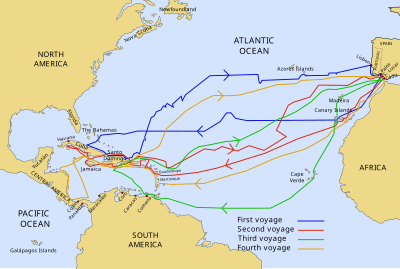
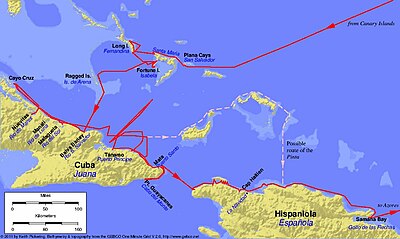
Between 1492 and 1504, Columbus undertook four pivotal transatlantic voyages. His inaugural expedition in 1492, famously comprising the caravels Niña and Pinta and the carrack Santa María, departed from Palos de la Frontera, Spain. Contrary to his persistent belief that he had reached the East Indies, Columbus made landfall on an island in the Bahamas, marking his first encounter with the Americas.
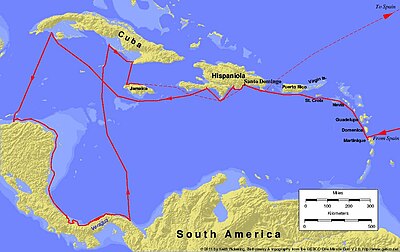
His subsequent voyages, from 1493 to 1504, explored further into the Caribbean and along the coasts of Central and South America. These expeditions were not merely voyages of discovery but also the initial steps in European engagement with the Americas, leading to the establishment of Spanish settlements and the beginning of European colonization. It is crucial to acknowledge that these lands were already inhabited by diverse Indigenous populations with complex societies and cultures that predated Columbus's arrival.
The Columbian Exchange and the Dawn of a New Era
The consequences of Columbus's voyages were monumental, fundamentally reshaping global history and ushering in the modern era. His expeditions facilitated the Columbian Exchange, a vast and complex process of intercontinental transfer of biological and cultural elements. This exchange involved the movement of plants (like potatoes, maize, and tomatoes from the Americas to Europe, and wheat, sugar, and coffee from Europe to the Americas), animals (like horses, cattle, and pigs from Europe to the Americas, and turkeys from the Americas to Europe), diseases (such as smallpox and measles devastating Indigenous populations, and syphilis possibly traveling to Europe), technology, and ideas.
This biological and cultural cross-pollination had profound demographic, economic, and social impacts worldwide. The initial misnomer of reaching the 'Indies' led to the naming of the Caribbean islands as the 'West Indies,' while the broader discovery of the continent was later recognized by Amerigo Vespucci, after whom the Americas were named.
Enduring Legacies and Historical Re-evaluation
The voyages of Christopher Columbus represent a critical juncture in world history, initiating a period of unprecedented global interaction and transformation. They laid the groundwork for European dominance in the Americas, leading to centuries of colonization, exploitation, and the profound disruption of Indigenous societies. The establishment of transatlantic trade routes and the subsequent development of global economies are direct outcomes of these expeditions.
While historically celebrated as a heroic discoverer, contemporary scholarship increasingly emphasizes the devastating impact of his arrival on Indigenous peoples, including disease, enslavement, and cultural destruction. Understanding these voyages requires a nuanced perspective that acknowledges both the expansion of geographical knowledge and the immense human cost associated with this era of exploration and conquest. The completion of the westward route to Asia was eventually achieved by Ferdinand Magellan's expedition, which circumnavigated the globe between 1519 and 1521.
See also
Frequently Asked Questions
What was Christopher Columbus's main goal on his voyages?+
Why did Columbus think he reached the East Indies?+
How many voyages did Columbus make across the Atlantic?+
What were the names of the ships on Columbus's first voyage?+
What was the Columbian Exchange?+
Based on content from Wikipedia · Licensed under CC BY-SA 4.0