

Volcano Tectonics: Earth's Shaky Secrets!
Images

Sea Ice Surrounds Shikotan


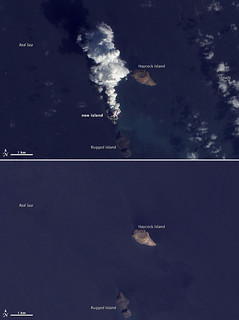


The Nexus of Magma and Lithosphere
Volcano tectonics is a multidisciplinary field that meticulously examines the physical processes governing volcanic areas, integrating principles from structural geology, tectonics, and physics. It operates on the premise that volcanic phenomena are intrinsically linked to the deformation of the Earth's crust and upper mantle. These processes can be broadly categorized: firstly, magma-induced deformation, where the movement and pressure of magma itself cause the surrounding rock to deform, leading to features like caldera collapse, flank uplift, and the formation of volcanic edifices.
Secondly, tectonic control, where regional geological structures and plate boundary forces dictate the propagation and emplacement of magma. This includes the influence of regional faults, seismic activity along convergent, divergent, and transform plate margins, and the development of rift zones and magmatic arcs. Understanding this intricate interplay is crucial for comprehending volcanic behavior, from the subtle subsurface shifts to the dramatic surface expressions of eruptions.
It requires analyzing stress-strain relationships between the magma and its host rock across various scales, from individual fractures to entire tectonic provinces.
Mapping the Subsurface
The study of volcano tectonics extends far beyond the visible volcanic cone, delving deep into the subsurface to understand the complex 'plumbing systems' that feed volcanoes. This includes the deeper magma reservoirs and the intricate network of conduits, dikes, and sills that transport molten rock towards the surface. Eroded volcanoes, both active and extinct, offer invaluable windows into these subsurface structures, revealing the geological history and mechanics of magma emplacement.
Furthermore, volcano tectonics analyzes how regional tectonic settings, such as continental rifts, oceanic spreading centers, and subduction zones, influence volcanism. For instance, magmatic arcs form above subducting plates, where melting occurs in the mantle wedge, and the resulting magma rises through the overriding plate, often guided by pre-existing fault systems. Back-arc basins, located behind magmatic arcs, can also exhibit significant volcanic activity.
By integrating geophysical data (seismicity, gravity), geodetic measurements (GPS, InSAR), and remote sensing, scientists can map these subsurface features and tectonic controls, providing a comprehensive understanding of a volcano's structural framework and its relationship to broader geological forces.
Extraterrestrial Volcanism
The principles of volcano tectonics are not limited to Earth; they provide a framework for understanding volcanic activity across the solar system. Planetary bodies like Venus exhibit extensive volcanic features, including vast lava plains and shield volcanoes, suggesting significant internal heat and crustal dynamics. Mars hosts colossal volcanoes, such as Olympus Mons, which dwarf terrestrial counterparts, indicating different tectonic regimes and magma eruption styles, possibly related to stationary mantle plumes and a thicker crust. Jupiter's moon Io presents an extreme case of volcanism, driven by intense tidal heating from Jupiter's gravity, resulting in constant volcanic resurfacing.
Studying these extraterrestrial examples allows scientists to test and refine models of volcanic processes under diverse gravitational, atmospheric, and compositional conditions. It highlights that while the specific manifestations of volcanism vary, the fundamental interplay between internal heat, magma generation, crustal deformation, and tectonic forces appears to be a universal aspect of planetary evolution.
Predictive Power
A primary objective of volcano tectonics is to enhance our ability to forecast volcanic behavior, particularly during periods of unrest and potential eruption. By understanding the underlying tectonic stresses and the dynamics of magma movement, scientists can interpret subtle changes in a volcano's behavior. For example, ground deformation detected by GPS or InSAR can indicate magma accumulation or movement.
Seismic swarms can signal fracturing of rock as magma ascends. Gravity changes might reveal shifts in magma density. Integrating these observations with physical models derived from continuum mechanics-specifically solid mechanics (rock and fracture mechanics) and fluid mechanics-allows for the development of testable hypotheses about future eruptive scenarios.
This quantitative approach is essential for hazard assessment and mitigation, enabling authorities to issue timely warnings and implement protective measures for populations living in volcanic regions. The ultimate goal is to transition from merely observing volcanoes to predicting their actions with greater reliability.
See also
Frequently Asked Questions
What is volcano tectonics?+
How does magma make volcanoes change shape?+
Why do volcanoes erupt near plate boundaries?+
How do scientists find hidden volcano plumbing?+
Are volcanoes on other planets like Earth?+
Based on content from Wikipedia · Licensed under CC BY-SA 4.0