

Volapük: The Secret World Language!
Images
![<div class='fn'> Debury. Menus-Plaisirs. Volapük-Revue : [photographie, tirage de démonstration] / [Atelier Nadar]</div>](https://upload.wikimedia.org/wikipedia/commons/thumb/c/c0/Debury._Menus-Plaisirs._Volap%C3%BCk-Revue_-_photographie%2C_tirage_de_d%C3%A9monstration_-_Atelier_Nadar_-_btv1b53151290v.jpg/1280px-Debury._Menus-Plaisirs._Volap%C3%BCk-Revue_-_photographie%2C_tirage_de_d%C3%A9monstration_-_Atelier_Nadar_-_btv1b53151290v.jpg)
<div class='fn'> Debury. Menus-Plaisirs. Volapük-Revue : [photographie, tirage de démonstration] / [Atelier Nadar]</div>
![<div class='fn'> Lhéry. Menus-Plaisirs. Volapük-Revue : [photographie, tirage de démonstration] / [Atelier Nadar]</div>](https://upload.wikimedia.org/wikipedia/commons/thumb/1/1d/Lh%C3%A9ry._Menus-Plaisirs._Volap%C3%BCk-Revue_-_photographie%2C_tirage_de_d%C3%A9monstration_-_Atelier_Nadar_-_btv1b53151319z.jpg/400px-Lh%C3%A9ry._Menus-Plaisirs._Volap%C3%BCk-Revue_-_photographie%2C_tirage_de_d%C3%A9monstration_-_Atelier_Nadar_-_btv1b53151319z.jpg)



![<div class='fn'> Lhéry. Menus-Plaisirs. Volapük-Revue : [photographie, tirage de démonstration] / [Atelier Nadar]</div>](https://upload.wikimedia.org/wikipedia/commons/thumb/a/ab/Lh%C3%A9ry._Menus-Plaisirs._Volap%C3%BCk-Revue_-_photographie%2C_tirage_de_d%C3%A9monstration_-_Atelier_Nadar_-_btv1b531513227.jpg/400px-Lh%C3%A9ry._Menus-Plaisirs._Volap%C3%BCk-Revue_-_photographie%2C_tirage_de_d%C3%A9monstration_-_Atelier_Nadar_-_btv1b531513227.jpg)


The Genesis of a Global Lingua Franca
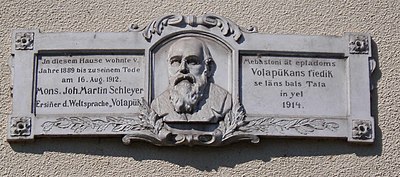
In an era of burgeoning global trade and communication, the need for a universal language became a compelling idea. Johann Martin Schleyer, a Roman Catholic priest from Baden, Germany, responded to this perceived need by creating Volapük between 1879 and 1880. Schleyer's motivation was deeply rooted in his belief that God had inspired him to develop an international auxiliary language (IAL).
This wasn't merely an academic exercise; it was envisioned as a tool to foster peace and understanding among diverse peoples. Volapük's significance lies in its status as the first major constructed language to achieve substantial international recognition and adoption, demonstrating the feasibility of such linguistic projects and setting a precedent for future endeavors like Esperanto.
Linguistic Architecture
The linguistic foundation of Volapük was built upon existing European languages, primarily English, with contributions from German and French. However, Schleyer's methodology involved significant phonetic and morphological alterations, often distorting the source words to the point of being unrecognizable to native speakers. This approach aimed to create a language that was relatively easy to learn for speakers of various European tongues while maintaining a degree of neutrality.
The grammar, too, was structured based on European linguistic patterns. While this made it accessible to a large segment of the potential audience, the radical transformations of vocabulary presented a unique learning curve, distinguishing it from languages that retain more transparent etymologies.
The Meteoric Rise
Volapük experienced an extraordinary surge in popularity during the late 1880s. By 1889, estimates placed the number of adherents at nearly one million, a remarkable figure for a constructed language at that time. This widespread adoption was supported by a robust infrastructure: 283 dedicated clubs, 25 periodicals published in or about Volapük, and 316 textbooks translated into 25 different languages.
The language's momentum was further fueled by international conventions held in Friedrichshafen (1884), Munich (1887), and Paris (1889). The 1889 Paris convention, conducted entirely in Volapük, symbolized the language's peak influence and the fervent belief in its potential as a global communication tool.
The Shifting Tides
Despite its initial triumph, Volapük's dominance proved ephemeral. The late 19th and early 20th centuries witnessed the rise of Esperanto, a rival constructed language that offered a simpler grammatical structure and more transparent vocabulary. Esperanto's perceived ease of learning gradually eclipsed Volapük's popularity, leading to a significant decline in its usage.
However, Volapük's historical importance is undeniable. It served as a crucial proof of concept, demonstrating that a constructed language could indeed capture the imagination and loyalty of a global community. Its pioneering efforts laid the groundwork for subsequent IAL projects, influencing their design and highlighting the challenges and opportunities inherent in creating a truly universal language.
Volapük remains a significant case study in linguistic innovation and the complex dynamics of language adoption.
See also
Frequently Asked Questions
What is Volapük and why was it created?+
How did Volapük become so popular in the 1880s?+
Why did Volapük stop being popular?+
What languages helped make Volapük?+
How is Volapük important today?+
Based on content from Wikipedia · Licensed under CC BY-SA 4.0