

Your Amazing Eyes: The Visual System
Images
Visual system
From Phototransduction to Retinal Processing
The human visual system is a complex sensory apparatus responsible for processing light stimuli and constructing our perception of the visual world. The process begins with phototransduction, where light energy is converted into neural signals within the retina. Light strikes photoreceptor cells-rods and cones-triggering a cascade of biochemical reactions.
Rods, highly sensitive to low light levels, are crucial for scotopic vision, enabling us to see in dim conditions and detect motion, though they do not contribute to color perception. Cones, concentrated in the fovea, are responsible for photopic vision, providing high acuity and color discrimination. There are three types of cones, sensitive to different wavelengths of light (red, green, and blue), allowing for trichromatic color vision.
Beyond photoreceptors, the retina contains a network of interneurons, including bipolar cells, horizontal cells, and amacrine cells, which perform initial processing. These cells modulate the signals from photoreceptors, enhancing contrast, detecting edges, and beginning the process of feature extraction before the information is relayed to the ganglion cells.
Information Superhighways
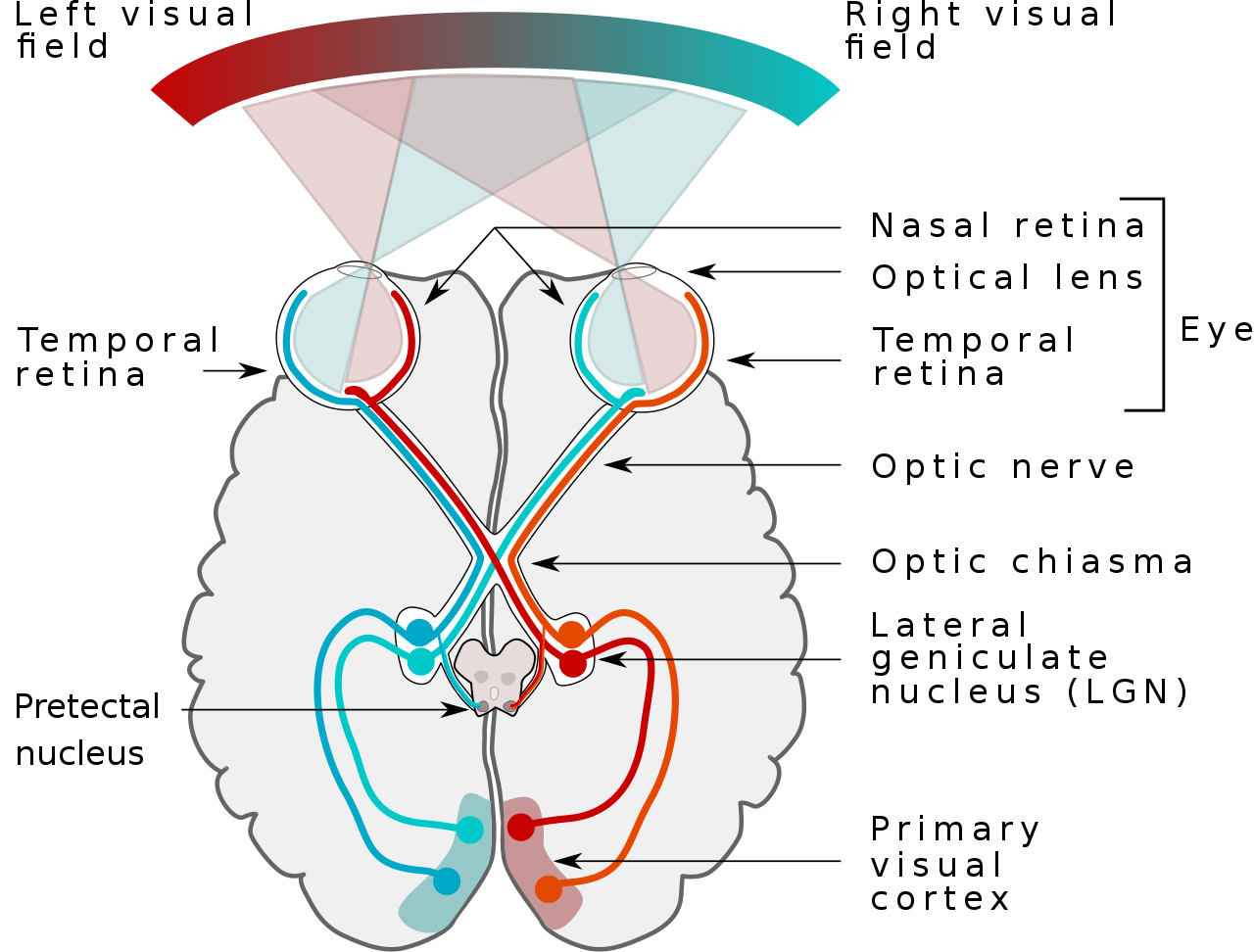
The axons of the retinal ganglion cells converge to form the optic nerve, which carries approximately one million nerve fibers. This optic nerve transmits the processed visual information out of the eye. A crucial crossover occurs at the optic chiasm, where fibers from the nasal (inner) half of each retina cross over to the opposite hemisphere of the brain, while fibers from the temporal (outer) half remain ipsilateral.
This arrangement ensures that each hemisphere receives visual input from the contralateral visual field. After the optic chiasm, the visual pathway continues as the optic tract, most of which projects to the lateral geniculate nucleus (LGN) of the thalamus. The LGN acts as a relay station, further processing and organizing visual information before sending it to the primary visual cortex (V1) in the occipital lobe.
From V1, information is then processed through a series of interconnected visual areas, forming two main pathways: the dorsal stream (the 'where' or 'how' pathway), which extends into the parietal lobe and is involved in spatial processing and guiding actions, and the ventral stream (the 'what' pathway), which extends into the temporal lobe and is crucial for object recognition and identification.
The Significance of Vision
The visual system is arguably the most dominant sensory modality for humans, profoundly influencing our survival, cognition, and interaction with the environment. It is fundamental for spatial navigation, allowing us to perceive distances, identify obstacles, and move safely through complex terrains. In terms of cognition, vision is integral to learning, particularly through reading and visual aids, which are central to modern education.
Social cognition is heavily reliant on visual cues, such as facial expressions, gestures, and body language, which convey emotional states and intentions. The appreciation of art, music (through visual representations like sheet music), and the natural world is also mediated by our visual capacity. Furthermore, the visual system is intricately linked with other cognitive functions, including memory, attention, and decision-making.
Disruptions to the visual system, whether through disease, injury, or congenital conditions, can have significant impacts on an individual's quality of life, independence, and overall well-being, underscoring its critical importance.
Evolutionary Trajectories and Comparative Vision
The evolution of the visual system is a testament to adaptive radiation, with diverse forms of eyes and visual processing emerging across the animal kingdom. The earliest visual structures were likely simple photoreceptive spots, capable of detecting light intensity and direction, found in organisms like Euglena. Over geological time, these evolved into more complex structures, such as the compound eyes of arthropods, which are composed of numerous individual ommatidia, each contributing a small part to the overall image, providing a wide field of view and excellent motion detection. Vertebrate eyes, like our own, developed a camera-like structure with a single lens for focusing light onto a retina.
Comparative studies of visual systems reveal fascinating adaptations: deep-sea creatures possess eyes optimized for low light and specific wavelengths, while birds of prey have exceptionally high visual acuity and color perception. The evolution of binocular vision and stereopsis in predators allows for precise depth perception crucial for hunting. Studying these variations provides insights into the selective pressures that have shaped visual capabilities and the underlying neural mechanisms.
Modern Applications and Future Directions in Vision Science
Our understanding of the visual system has led to numerous technological advancements and therapeutic interventions. Ophthalmological advancements, such as LASIK surgery and intraocular lens implants, correct refractive errors and treat conditions like cataracts, restoring sight for millions. Prosthetic devices, like retinal implants and bionic eyes, are being developed to restore vision for individuals with severe retinal degeneration, offering hope where previously there was none.
In the field of artificial intelligence, computational models of the visual system inspire the development of sophisticated computer vision algorithms used in self-driving cars, facial recognition software, and medical image analysis. Neuroscience continues to explore the neural basis of visual perception, consciousness, and visual disorders like amblyopia and glaucoma. Future research aims to further refine these technologies, deepen our understanding of visual processing, and develop more effective treatments for a wide range of visual impairments, potentially leading to even more advanced visual prosthetics and AI capabilities.
Go deeper
Frequently Asked Questions
What happens when light enters our eyes?+
How do we see colors?+
Why can we see in the dark?+
How does the brain know where objects are?+
Why do we need both eyes?+
Based on content from Wikipedia · Licensed under CC BY-SA 4.0