

USS Hornet (CV-12)
Images
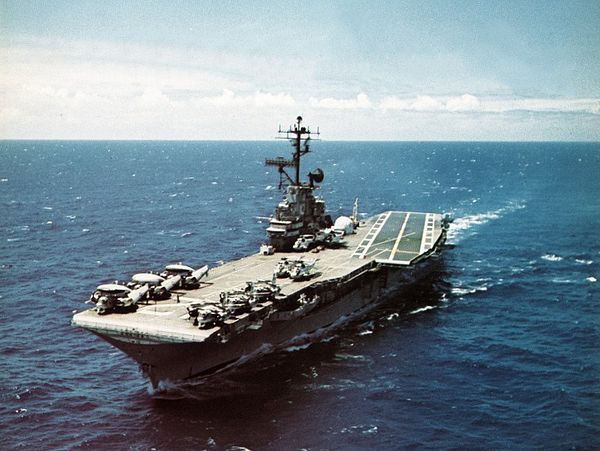
USS Hornet (CV-12)


Forged in War
The USS Hornet (CV-12) was a product of necessity and innovation during the crucible of World War II. As an Essex-class aircraft carrier, it represented a significant evolution in naval aviation technology and strategy. Laid down in September 1941 and commissioned in November 1943, the Hornet was built to counter the growing threat of the Imperial Japanese Navy.
The Essex class was designed for greater speed, enhanced protection, and a larger air group capacity compared to earlier carriers. Its construction involved advanced shipbuilding techniques, utilizing massive steel structures and powerful propulsion systems to achieve speeds exceeding 30 knots. The flight deck was optimized for launching and recovering a high volume of aircraft, supported by powerful steam catapults and a robust arresting gear system.
Below decks, extensive compartmentalization and improved armor plating were incorporated to enhance survivability against aerial and torpedo attacks. The Hornet was more than just a warship; it was a mobile airbase capable of projecting American air power across vast oceanic distances, a critical advantage in the Pacific theater.
A Pillar of Victory
The USS Hornet's combat career during World War II was marked by relentless action and significant contributions to Allied victories. After shakedown cruises, it joined Task Force 58, the fast carrier striking force, and participated in nearly every major offensive in the Pacific. Its aircraft played a pivotal role in the Battle of the Philippine Sea (June 1944), a decisive engagement that decimated the Japanese naval air arm.
The Hornet's Hellcat fighters and Avenger torpedo bombers were instrumental in sinking enemy carriers and crippling their naval capabilities. It provided crucial air support for amphibious assaults on islands like Saipan, Guam, the Philippines, Iwo Jima, and Okinawa. During these operations, the Hornet and its crew faced intense enemy fire, including numerous kamikaze attacks.
Despite sustaining damage, the ship's resilience and the crew's determination allowed it to remain operational, earning it numerous battle stars and a reputation as a veteran warship. Its sustained operational tempo and effectiveness underscored the vital role of carrier aviation in achieving victory.
Projecting Power
The operational effectiveness of the USS Hornet hinged on the intricate coordination of its air wing and the ship's advanced systems. The flight deck served as the primary operational area, a dynamic space where aircraft were launched, recovered, and serviced. Steam catapults, powered by high-pressure steam from the ship's boilers, accelerated aircraft to takeoff speed in mere seconds, enabling even heavily laden planes to become airborne.
The arresting gear, a system of wires stretched across the deck, snagged the tailhook of returning aircraft, bringing them to a rapid halt. Below the flight deck, the hangar bay housed the aircraft when not in use, protected from the elements and enemy fire. A complex system of elevators allowed for the swift vertical transfer of aircraft between the hangar and flight decks, facilitating rapid rearming and refueling.
The ship's air group, comprising fighter, bomber, and torpedo squadrons, provided offensive and defensive capabilities, acting as the carrier's primary weapon system. This integrated system allowed the Hornet to sustain continuous air operations, a critical factor in naval warfare.
Beyond Combat
Following its distinguished service in World War II, the USS Hornet underwent modernization and continued its naval career. It participated in the Korean War, again projecting air power in a new conflict. However, perhaps its most unique and celebrated role came during the Space Race.
In 1968, the Hornet was designated as the prime recovery vessel for the Apollo 11 mission, the historic endeavor that would land the first humans on the Moon. On July 24, 1969, the Hornet triumphantly recovered the Apollo 11 command module, Columbia, and its crew, including Neil Armstrong, Buzz Aldrin, and Michael Collins, as they splashed down in the Pacific Ocean. This marked a profound transition from a vessel of war to a symbol of human achievement and exploration.
Today, the USS Hornet is preserved as a museum ship at Alameda Point, California, offering a tangible link to pivotal moments in 20th-century history, from the intense battles of World War II to the triumphant return of humanity's first lunar explorers.
See also
Frequently Asked Questions
What was the USS Hornet (CV-12) and why was it important?+
How fast could the USS Hornet go and what made it special?+
What battles did the USS Hornet fight in during World War II?+
How did the USS Hornet launch and recover its planes?+
Did the USS Hornet ever get damaged and how did it survive?+
Based on content from Wikipedia · Licensed under CC BY-SA 4.0