

Ur-Nammu
Images

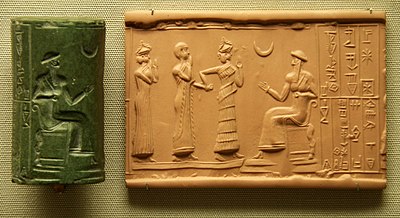
Ur-Nammu dedication tablet for the Temple of Inanna in Uruk (horizontal)



Forging the Third Dynasty of Ur
Ur-Nammu emerged as a pivotal figure in the complex political landscape of ancient Mesopotamia, specifically in Sumer. Following periods of Akkadian and Gutian dominance, his ascension marked the establishment of the Third Dynasty of Ur, a period often referred to as the Sumerian Renaissance. His reign was characterized by a strategic blend of military conquest and administrative reform.
Ur-Nammu was not merely a warrior king; he was a shrewd strategist who consolidated power, unified disparate regions under his rule, and laid the groundwork for a centralized empire. His military campaigns were instrumental in expelling foreign influence and reasserting Sumerian sovereignty. The titles he bore, 'King of Ur' and 'King of Sumer and Akkad,' underscore the extent of his authority and his ambition to restore a unified Mesopotamian state, echoing the grandeur of earlier empires.
Monumental Ambitions
Beyond his political achievements, Ur-Nammu was a prodigious builder whose architectural projects significantly shaped the urban landscape of his kingdom. His most celebrated endeavor was the initiation of the Great Ziggurat of Ur. This colossal structure, a testament to sophisticated engineering and religious devotion, was designed as a massive stepped platform, likely serving as a temple complex dedicated to the moon god Nanna.
The scale and ambition of the ziggurat reflect Ur-Nammu's desire to glorify his gods and solidify his reign through monumental architecture. Furthermore, his reign saw the construction of numerous other temples and the vital development of extensive canal systems. These canals were not just for irrigation; they facilitated trade, transportation, and urban growth, demonstrating a holistic approach to state development that integrated religious, economic, and civic needs.
The Genesis of Justice
Ur-Nammu's most profound and lasting contribution to human civilization is undoubtedly the Code of Ur-Nammu. This legal document, predating Hammurabi's Code by several centuries, represents the earliest known comprehensive legal system. It provides invaluable insights into Sumerian society, its values, and its methods of justice.
The code addresses a range of offenses, including property crimes, personal injury, and family law, often prescribing monetary compensation rather than the 'eye for an eye' principle found in later codes. This focus on restitution suggests a more developed concept of social order and economic fairness. The very existence of a written legal code signifies a move towards standardized justice, reducing arbitrary judgments and fostering stability within the burgeoning empire.
It is a cornerstone in the history of law and governance.
Enduring Significance
The legacy of Ur-Nammu is multifaceted and deeply significant for understanding the development of civilization. As the founder of the Third Dynasty of Ur, he ushered in a period of renewed Sumerian cultural and political dominance, often considered a golden age. His architectural projects, particularly the Ziggurat of Ur, remain iconic symbols of ancient Mesopotamian achievement and continue to inspire awe.
However, it is his pioneering legal code that offers the most enduring impact. The Code of Ur-Nammu demonstrates the early human drive to establish order, fairness, and predictability through written laws. This foundational step in legal history influenced subsequent legal traditions and highlights the sophisticated administrative capabilities of early states.
Ur-Nammu’s reign exemplifies how strong leadership, coupled with visionary projects and a commitment to justice, can profoundly shape the trajectory of human society for millennia.
The Personal Faith and Royal Titles of Ur-Nammu
Beyond his public achievements, understanding Ur-Nammu requires acknowledging his personal beliefs and the symbolic weight of his royal titles. His personal goddess was Ninsuna, a prominent deity in the Sumerian pantheon, often associated with wisdom and protection. This personal devotion likely influenced his policies and his approach to kingship, imbuing his rule with a sense of divine mandate.
The titles he claimed, 'King of Ur' and 'King of Sumer and Akkad,' were not mere honorifics; they were powerful declarations of his dominion over a significant portion of Mesopotamia. 'King of Ur' signified his direct authority over the capital city and its immediate surroundings, while 'King of Sumer and Akkad' asserted his claim to rule over the broader cultural and geographical regions of southern Mesopotamia. This dual claim reflected a desire to emulate and perhaps surpass the achievements of earlier unified Mesopotamian rulers, positioning him as a restorer of ancient glory and a formidable sovereign in his own right.
See also
Frequently Asked Questions
Who was Ur‑Nammu?+
What is the Great Ziggurat of Ur?+
What is the Code of Ur‑Nammu?+
Why did Ur‑Nammu build canals?+
How did Ur‑Nammu change life for people?+
Based on content from Wikipedia · Licensed under CC BY-SA 4.0