

Upsala Glacier
Images

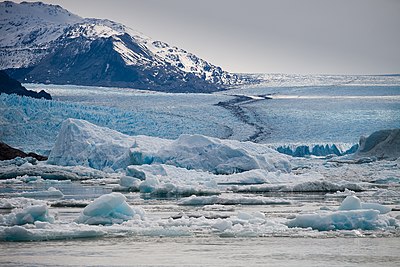
Lago Argentino - Upsala Glacier




Geographical Context and Hydrological Significance
Upsala Glacier is a prominent outlet glacier situated on the eastern flank of the Southern Patagonian Ice Field, a vast ice mass that straddles the border between Chile and Argentina. While its upper reaches lie within a disputed territory, its primary flow is directed southward, culminating in the Upsala channel of Lago Argentino. This glacial terminus is a dynamic interface where immense volumes of ice calve into the freshwater lake.
The glacier is fed by a complex network of tributaries, notably Bertacchi, Cono, and Murallón, which contribute significantly to its overall mass balance and flow dynamics. The landscape here is characterized by dramatic fjords, rugged mountains, and the pervasive influence of glacial erosion, shaping a unique Patagonian environment. The climate is subpolar oceanic, marked by strong westerly winds and significant precipitation, primarily as snow at higher elevations, which sustains the ice field.
Historical Recession and Contributing Factors
The documented history of Upsala Glacier reveals a persistent and accelerating pattern of retreat since at least 1810. This recession is not merely a passive melting but involves complex glaciological processes. Prior to 1999, an acceleration in ice motion was observed, potentially linked to the release of backstress as the glacier retreated beyond submerged islands in Brazo Upsala.
This unburdening allowed the ice to flow more freely. A more dramatic phase of retreat began around 2008, with rates reported to be approximately ten times faster than in the preceding eight years. This accelerated melting and flow is a critical area of study, with researchers investigating the interplay of atmospheric warming, oceanographic influences on the lake, and internal glacial dynamics.
The glacier's response is a stark illustration of how sensitive large ice masses are to subtle environmental shifts.
The 'Upsala' Moniker
The nomenclature of Upsala Glacier is rooted in the history of glaciological research. The name derives from the historical spelling of Uppsala University in Sweden. This esteemed institution was instrumental in sponsoring the earliest glaciological expeditions and studies in the Patagonian region.
The scientists from Uppsala were among the first to systematically document and analyze these immense ice bodies, laying the groundwork for future research. Naming the glacier after the university serves as a tribute to this foundational scientific endeavor and highlights the international nature of polar and glacial research. It connects a remote South American landmark to a European center of learning, underscoring the global pursuit of knowledge about Earth's cryosphere.
Upsala Glacier as a Climate Change Sentinel
Upsala Glacier's rapid and well-documented retreat has positioned it as a crucial sentinel for global climate change. Environmental organizations frequently cite its shrinking as compelling evidence of anthropogenic warming. The glacier's response to rising temperatures has profound implications.
By 2018, its retreat had progressed to the point where it no longer exerted significant control over its tributary, Bertacchi Glacier. This decoupling has led to increased flow rates and stretching in Bertacchi, demonstrating how the dynamics of individual glaciers are interconnected and sensitive to changes in their neighbors and the broader climate. The accelerated thinning and stretching of Bertacchi, potentially due to increased flow velocity near its near-separation from Upsala, offers a tangible example of how glacial systems respond to destabilization.
Studying Upsala provides invaluable data for climate models and projections.
Socio-Political and Environmental Ramifications
The location of Upsala Glacier, partially within a disputed territory between Chile and Argentina, adds a layer of geopolitical complexity to its study. While the scientific focus remains on its glacial dynamics and climate implications, the border dispute underscores the importance of international cooperation in managing shared natural resources and environments. The rapid retreat also has significant environmental consequences beyond the immediate glacial system.
Increased meltwater discharge into Lago Argentino can alter lake salinity, temperature, and sediment load, impacting aquatic ecosystems and potentially downstream hydrological regimes. Furthermore, the visual impact of a dramatically shrinking glacier serves as a powerful educational tool, raising public awareness about climate change and the urgent need for mitigation and adaptation strategies. The ongoing changes at Upsala highlight the interconnectedness of Earth's systems and the far-reaching effects of global warming.
See also
Frequently Asked Questions
What is the Upsala Glacier?+
Why is the Upsala Glacier shrinking?+
How fast is the Upsala Glacier retreating?+
Where does the Upsala Glacier flow into?+
Why is the glacier named Upsala?+
Based on content from Wikipedia · Licensed under CC BY-SA 4.0