

Unmanned Ground Vehicles: Robots That Roll!
Images
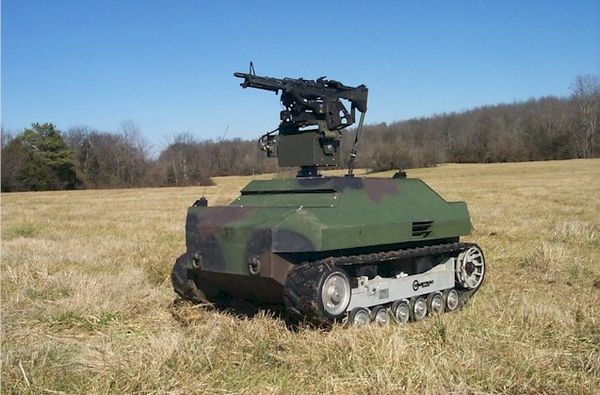
Unmanned ground vehicle
Defining the Unmanned Ground Vehicle (UGV) Landscape
An Unmanned Ground Vehicle (UGV) is fundamentally defined by its terrestrial mobility and the absence of an onboard human operator. This classification encompasses a broad spectrum of machines, ranging from simple remote-controlled rovers to highly sophisticated autonomous platforms. UGVs are engineered to function in environments where direct human presence is impractical, hazardous, or economically unfeasible.
Their operational capabilities are typically enabled by a combination of onboard sensors (e.g., cameras, lidar, radar, GPS, IMUs) for environmental perception and navigation, and advanced computational systems for decision-making and control. These systems can facilitate either autonomous operation, where the UGV navigates and executes tasks independently based on pre-programmed objectives and real-time data, or teleoperation, where a human operator remotely guides the vehicle's actions, often with sensory feedback.
As the land-based counterparts to Unmanned Aerial Vehicles (UAVs) and Unmanned Underwater Vehicles (UUVs), UGVs represent a critical component of the broader unmanned systems ecosystem, designed to extend human reach and capability across diverse operational theaters.
Historical Trajectory
The genesis of UGVs can be traced back to early 20th-century concepts of remote-controlled devices and automatons. However, significant developmental strides were made during the Cold War era, primarily driven by military imperatives to develop systems that could operate in high-risk scenarios without endangering personnel. Early military applications focused on reconnaissance, mine clearance, and logistical support.
The advent of microprocessors, improved sensor technology, and advancements in artificial intelligence throughout the late 20th and early 21st centuries catalyzed the transition from rudimentary teleoperated systems to more capable autonomous UGVs. Innovations in areas like path planning, object recognition, and multi-robot coordination have enabled UGVs to perform increasingly complex missions. This evolution has not been confined to the military; civilian applications have rapidly expanded, reflecting the growing maturity and versatility of UGV technology across various sectors, from industrial inspection to scientific exploration.
The Strategic Importance and Multifaceted Utility of UGVs
The strategic importance of UGVs stems from their unparalleled capacity to mitigate risk and enhance operational effectiveness in challenging environments. In military contexts, they serve as force multipliers, undertaking dangerous missions such as reconnaissance in hostile territory, explosive ordnance disposal (EOD), and perimeter security, thereby reducing the exposure of human soldiers to direct threats. Beyond defense, UGVs are revolutionizing civilian industries.
They are deployed in disaster response for search and rescue in collapsed structures or hazardous material incidents, enabling assessment and intervention where human access is impossible. In infrastructure inspection, UGVs can monitor pipelines, bridges, and tunnels, identifying potential failures before they become critical. The agricultural sector benefits from autonomous tractors and harvesters, optimizing crop yields and reducing labor demands.
Furthermore, UGVs are indispensable tools for scientific exploration, facilitating research in extreme environments, from deep mines to extraterrestrial surfaces, pushing the boundaries of human knowledge and discovery.
Mechanisms of Operation
The operational prowess of UGVs is rooted in a sophisticated interplay of sensing, perception, planning, and control systems. Environmental perception is achieved through a suite of sensors, including high-resolution cameras for visual data, lidar for precise 3D mapping and distance measurement, radar for all-weather object detection, and inertial measurement units (IMUs) coupled with GPS for localization and navigation. This sensor data is processed by onboard computers running complex algorithms.
For autonomous UGVs, these algorithms enable simultaneous localization and mapping (SLAM), path planning, and dynamic obstacle avoidance, allowing the vehicle to navigate unknown or changing environments. Teleoperation relies on robust communication links, transmitting sensor data to a remote operator and receiving control commands. Advanced UGV architectures often incorporate modular designs, allowing for the integration of specialized payloads and the adaptation of control strategies to suit mission-specific requirements, such as cooperative multi-UGV operations or human-robot teaming.
Contemporary Applications and Future Horizons for UGVs
Unmanned Ground Vehicles are actively deployed across a wide array of contemporary applications, demonstrating their adaptability and growing integration into various operational frameworks. Militaries worldwide utilize UGVs for intelligence, surveillance, and reconnaissance (ISR), logistics, and counter-IED operations. In the civilian sphere, their roles are expanding rapidly: search and rescue robots assist in locating survivors in disaster zones; industrial UGVs perform inspections of critical infrastructure like power plants and oil refineries; agricultural robots automate planting, monitoring, and harvesting; and delivery robots are beginning to navigate urban environments.
Future developments are poised to enhance UGV capabilities further, with a focus on increased autonomy, improved human-robot interaction, enhanced mobility (e.g., legged robots for complex terrain), and greater interoperability between different unmanned systems. The ongoing advancements in AI and robotics suggest that UGVs will play an even more integral role in addressing societal challenges and expanding operational frontiers in the coming decades.
See also
Frequently Asked Questions
What is an unmanned ground vehicle?+
Why do people use UGVs in the military?+
How can UGVs help in disaster areas?+
Where do UGVs work in everyday life?+
How do UGVs decide where to go?+
Based on content from Wikipedia · Licensed under CC BY-SA 4.0