

United States Navy
Images
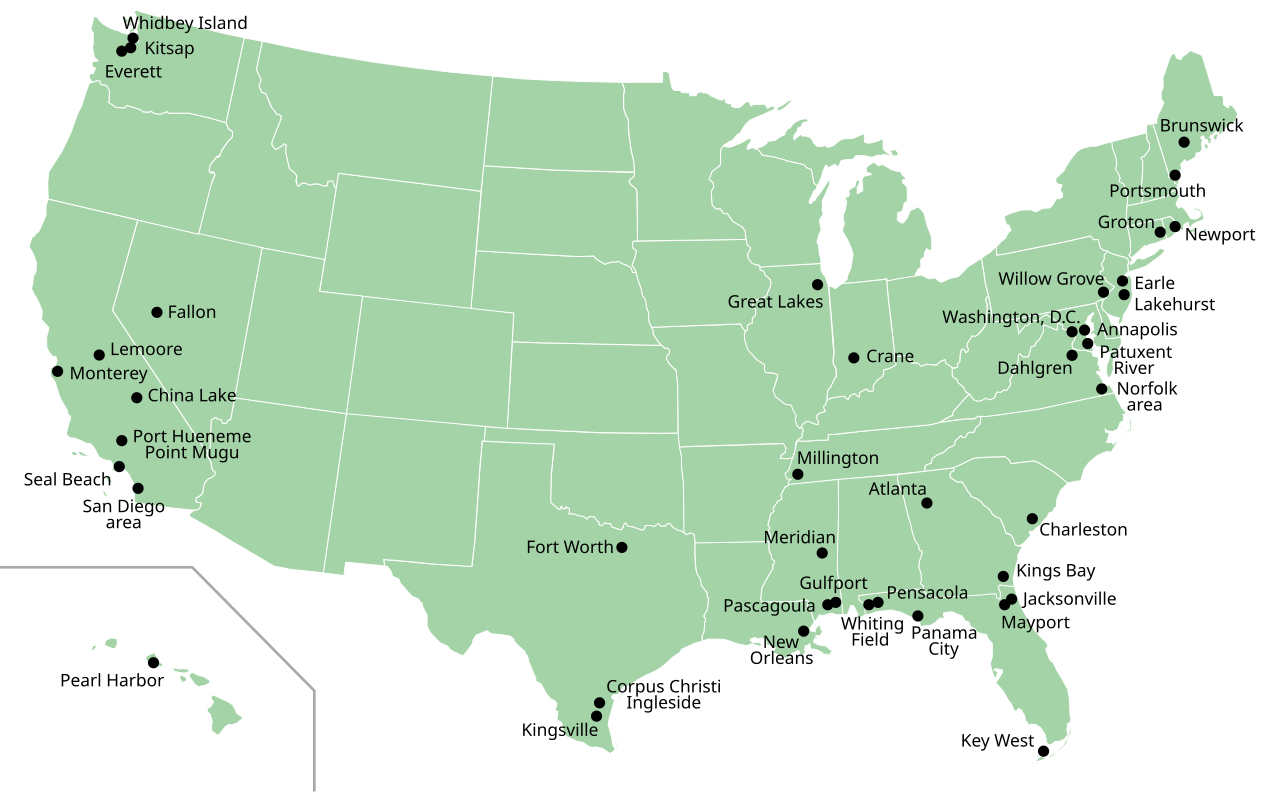
United States Navy bases


The Apex of Naval Power
The United States Navy stands as the preeminent global maritime force, distinguished by its sheer scale and technological sophistication. Its total displacement of 4.5 million tons in 2021 underscores its unmatched capacity. Central to this dominance is its unparalleled aircraft carrier fleet, comprising eleven operational supercarriers, one undergoing sea trials, two advanced carriers under construction (Gerald R.
Ford class), and plans for six more. These vessels are not merely platforms but mobile airbases, projecting air power across vast distances and serving as symbols of American resolve. Beyond carriers, the Navy maintains a formidable array of 299 deployable combat vessels, including guided-missile destroyers, cruisers, attack submarines, and amphibious assault ships.
Complementing this surface and subsurface fleet is an air wing of approximately 4,012 operational aircraft, ranging from fighter jets and electronic warfare planes to helicopters and maritime patrol aircraft. This integrated system allows for synchronized operations across multiple domains, enabling the Navy to conduct complex missions from power projection to humanitarian assistance.
A Legacy Forged in Conflict
The origins of the United States Navy trace back to the Continental Navy, established during the American Revolutionary War to challenge British naval supremacy. Though disbanded and re-established multiple times in its early years, its necessity became undeniable following encounters with Barbary pirates, leading to the Naval Act of 1794 and the construction of six frigates. Throughout American history, the Navy has been a decisive instrument of national policy.
Its blockade during the Civil War was critical to Union victory, and its role in the Pacific theater of World War II, particularly in battles like Midway and Okinawa, was instrumental in defeating Imperial Japan. Emerging from WWII as the world's undisputed naval superpower, the US Navy has since maintained a forward-deployed global presence, operating in strategic regions such as the Western Pacific, the Mediterranean, and the Indian Ocean.
This sustained global posture allows it to deter aggression, reassure allies, and respond rapidly to emerging crises, solidifying its role as a cornerstone of American foreign and military policy.
The Human Factor
The operational effectiveness of the US Navy relies heavily on its 336,978 active-duty personnel and 101,583 in the Ready Reserve. These individuals undergo rigorous training to master a diverse range of skills, from advanced navigation and engineering to complex combat systems and intelligence gathering. The Navy is one of six armed forces within the United States, operating under the Department of the Navy, which also includes the United States Marine Corps as a coequal sister service.
The civilian Secretary of the Navy oversees the Department, which itself falls under the Department of Defense, led by the Secretary of Defense. The highest-ranking naval officer is the Chief of Naval Operations (CNO), who advises military leadership on naval matters. This hierarchical yet specialized structure ensures clear command and control, enabling the vast personnel and technological resources to function cohesively.
Global Presence and Strategic Projection
The United States Navy operates as a quintessential 'blue-water' navy, possessing the inherent capability to conduct sustained operations across the world's oceans, independent of basing rights in many instances. This global reach is not merely about presence; it is about strategic projection of power and influence. By maintaining forward deployments in key maritime theaters-including the vital Indo-Pacific region, the strategically significant Mediterranean, and the resource-rich Indian Ocean-the Navy can effectively deter potential adversaries, reassure allies, and respond with agility to geopolitical shifts and humanitarian emergencies.
Its ability to project power onto the littoral regions of the world allows it to influence events far inland from the coast, making it an indispensable tool for diplomacy and defense. This constant readiness and global engagement underscore the Navy's critical role in maintaining international stability and advancing U.S. interests.
Education and Specialization
The US Navy places a profound emphasis on education and specialized training to maintain its technological and operational edge. Beyond basic recruit training, sailors embark on extensive career paths tailored to specific roles. These range from the highly technical fields of nuclear engineering (for aircraft carriers and submarines), cryptology, and cyber warfare, to operational specialties like aviation (pilots, aircrew), surface warfare (ship command, navigation), and special warfare (SEALs).
Institutions like the U.S. Naval Academy at Annapolis provide foundational officer education, while numerous technical schools and advanced training commands ensure continuous skill development. This commitment to education ensures that personnel are not only proficient in their current roles but are also prepared for future technological advancements and evolving strategic challenges, fostering a culture of lifelong learning essential for a modern, complex military organization.
Go deeper
Frequently Asked Questions
What is the United States Navy?+
How many aircraft carriers does the US Navy have?+
What kinds of ships are in the US Navy fleet?+
How many people work in the US Navy?+
Why was the US Navy created during the American Revolution?+
Based on content from Wikipedia · Licensed under CC BY-SA 4.0