

UEFA Super Cup
Images

Jürgen Klopp, Liverpool vs. Chelsea, UEFA Super Cup 2019-08-14 04
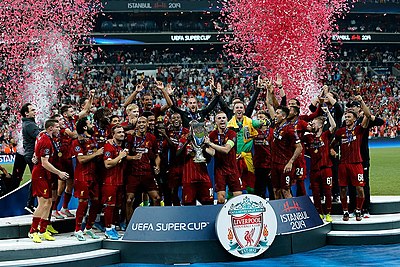


The Apex Clash
The UEFA Super Cup stands as a prestigious annual football match that brings together the victors of the two most significant European club competitions: the UEFA Champions League and the UEFA Europa League. This contest is not merely a friendly; it is a definitive battle for supremacy between the continent's elite. The Champions League represents the zenith of European club football, featuring teams that have navigated the most rigorous qualification stages and knockout rounds.
The Europa League, while considered the secondary competition, still comprises highly competitive clubs that have demonstrated exceptional skill and resilience. The Super Cup serves as the ultimate validation, allowing the champion of the Champions League to face off against the champion of the Europa League, thereby crowning a single, undisputed European club champion for that season. It’s a unique opportunity to witness two distinct paths to glory converge in a single, high-stakes encounter, often setting the narrative for the upcoming footballing year and providing a compelling spectacle for global audiences.
Evolution of a European Tradition
The genesis of the UEFA Super Cup can be traced back to 1972, when it was conceived as the 'Super Competition,' a brainchild of Dutch journalist Anton Witkamp. Its initial aim was to establish a definitive champion between the winners of the European Cup and the Argentine champions, reflecting a broader global footballing ambition. However, the competition quickly evolved, focusing solely on European clubs.
From 1972 to 1999, the format consistently pitted the European Cup/UEFA Champions League winner against the winner of the UEFA Cup Winners' Cup. This era saw legendary clashes and the establishment of the Super Cup as a significant fixture. The discontinuation of the UEFA Cup Winners' Cup in 1999 necessitated a format change, leading to the current structure where the UEFA Champions League winner faces the UEFA Europa League winner.
This transition, formalized with the rebranding to the UEFA Super Cup in 1995, reflects UEFA's strategic efforts to consolidate and enhance its club competitions, ensuring the Super Cup remains a relevant and exciting event in the modern football calendar.
The Strategic Significance
The UEFA Super Cup holds considerable strategic importance for the participating clubs, extending beyond the immediate prestige of lifting the trophy. For the winning team, it serves as a powerful morale booster and a tangible reward for their previous season's success, often marking the beginning of a new campaign with a significant triumph. It reinforces their status as a dominant force in European football and can influence player recruitment and fan expectations.
Furthermore, the Super Cup provides an early-season benchmark against another top-tier European opponent, offering invaluable insights into team performance, tactical approaches, and areas for improvement. For UEFA, the competition acts as a curtain-raiser for the European club season, generating substantial media attention and commercial revenue. It also plays a role in the UEFA coefficient rankings, subtly impacting future Champions League and Europa League seedings.
The match's outcome can shape a club's narrative for the season, influencing their confidence and trajectory in subsequent competitions.
The Mechanics of Supremacy
The UEFA Super Cup is contested as a single, decisive match, typically held at a neutral venue chosen by UEFA, ensuring a level playing field for both finalists. This neutral setting eliminates any home-advantage bias, making the outcome a pure reflection of the teams' abilities. The standard duration of the match is 90 minutes, divided into two 45-minute halves.
In the event that the score is level at the end of regulation time, the match proceeds to extra time. This consists of two additional 15-minute periods, during which the intensity often escalates as teams push for a decisive goal. If the deadlock persists even after extra time, the champion is determined through a penalty shootout.
This dramatic conclusion involves players taking turns to score from the penalty spot against the opposing goalkeeper. It is a test of nerve, skill, and mental fortitude, where the slightest error can lead to defeat, making the penalty shootout a highly anticipated and often nerve-wracking climax to the competition.
A Legacy of Champions
The UEFA Super Cup has witnessed numerous memorable encounters and has been dominated by a select few clubs, etching their names into European football history. Real Madrid stands as the most successful team in the competition's history, having lifted the trophy a remarkable six times. This consistent success underscores their enduring legacy as one of Europe's footballing giants.
Other clubs have also achieved multiple victories, showcasing periods of sustained dominance. For instance, AC Milan and Barcelona have each secured the trophy five times, demonstrating their own rich histories in European club football. These records are not merely statistics; they represent eras of exceptional talent, strategic brilliance, and unwavering determination.
The Super Cup provides a unique platform for these clubs to add to their illustrious trophy cabinets and solidify their place among the all-time greats of European football, often setting the stage for further domestic and continental ambitions.
See also
Frequently Asked Questions
What is the UEFA Super Cup?+
Why is the UEFA Super Cup important for teams?+
How did the UEFA Super Cup start?+
When did the Super Cup change to its current format?+
What does the UEFA Super Cup do for UEFA?+
Based on content from Wikipedia · Licensed under CC BY-SA 4.0