

U-boat
Images

Beached submarine, possibly German U-Boat U131 at Hastings in 1918
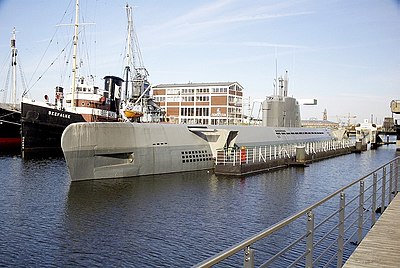


The Genesis and Evolution of the Unterseeboot
The U-boat, an anglicized term derived from the German 'Unterseeboot' (under-sea boat), represents a pivotal element of 20th-century naval warfare, particularly for Germany. First widely deployed in World War I, these submarines were instrumental in Germany's attempts to blockade the United Kingdom by severing its vital maritime supply routes. The initial campaigns of unrestricted submarine warfare in 1915 were temporarily halted due to international outcry, especially from the United States, over the sinking of neutral and passenger vessels.
However, facing a stalemate on the Western Front, Germany resumed this policy in February 1917. This renewed offensive, while initially successful in sinking a high volume of Allied shipping, ultimately proved counterproductive, as it significantly contributed to the United States' entry into World War I, tipping the balance decisively against the Central Powers. The Austro-Hungarian Navy also operated submarines known as U-boats.
The Battle of the Atlantic
In World War II, the U-boat arm, under the command of Karl Dönitz, became a central pillar of German strategy, particularly in the protracted Battle of the Atlantic. Dönitz championed new tactics, focusing on coordinated attacks by 'wolfpacks' of U-boats against Allied convoys. For a significant period, these tactics were devastatingly effective, threatening to cripple Britain's ability to wage war by cutting off its lifeline of supplies from North America and its empire.
Allied naval forces responded with a relentless technological and tactical arms race. Innovations such as High-Frequency Direction Finding (HF/DF), which could locate the radio transmissions of U-boats, radar, sonar (ASDIC), improved anti-submarine weaponry like the Hedgehog mortar, and the widespread implementation of effective convoy systems gradually turned the tide. The period known as 'Black May' in 1943 marked a turning point, where U-boat losses began to significantly outweigh their successes, signaling the beginning of the end for their dominance.
Strategic Significance and Global Impact
The strategic importance of U-boats cannot be overstated. They represented a unique asymmetric threat, allowing a nation with a less powerful surface navy, like Germany, to challenge the global maritime dominance of established powers. Their ability to operate unseen beneath the waves created immense psychological and logistical pressure.
In both World Wars, the success or failure of U-boat campaigns had profound implications for the war's duration and outcome. The threat posed by U-boats necessitated a massive diversion of Allied resources towards anti-submarine warfare, impacting offensive capabilities elsewhere. The eventual Allied victory in the Battle of the Atlantic was crucial, ensuring the flow of troops, equipment, and supplies needed for the eventual liberation of Europe and the defeat of Nazi Germany.
The legacy of the U-boat profoundly influenced the development of submarine technology and naval strategy in the post-war era.
Mechanisms of Subaquatic Warfare
U-boats were complex machines designed for stealth and offensive capability. Their operational effectiveness relied on several key mechanisms. Propulsion systems allowed them to travel both on the surface (often using diesel engines for speed and range) and submerged (using electric motors for quiet running). Their primary offensive armament consisted of torpedoes, launched from bow and stern tubes, capable of sinking heavily armed warships and large merchant vessels. Navigation and detection were critical; while submerged, U-boats relied on periscopes for visual observation, but this required them to be relatively close to the surface.
As the war progressed, Allied advancements in sonar and radar significantly reduced the effectiveness of U-boat stealth. The development of specialized anti-submarine aircraft and escort vessels further increased the risks associated with U-boat operations, forcing them to operate at greater depths and further from their bases, often at the cost of operational efficiency and crew safety.
See also
Frequently Asked Questions
What is a U-boat?+
Why did Germany use U-boats in World War I?+
How did U-boats attack ships in World War II?+
What helped the Allies stop the U‑boats?+
Why were U‑boats important for Germany?+
Based on content from Wikipedia · Licensed under CC BY-SA 4.0