

Turkic Languages: A World of Words!
Images
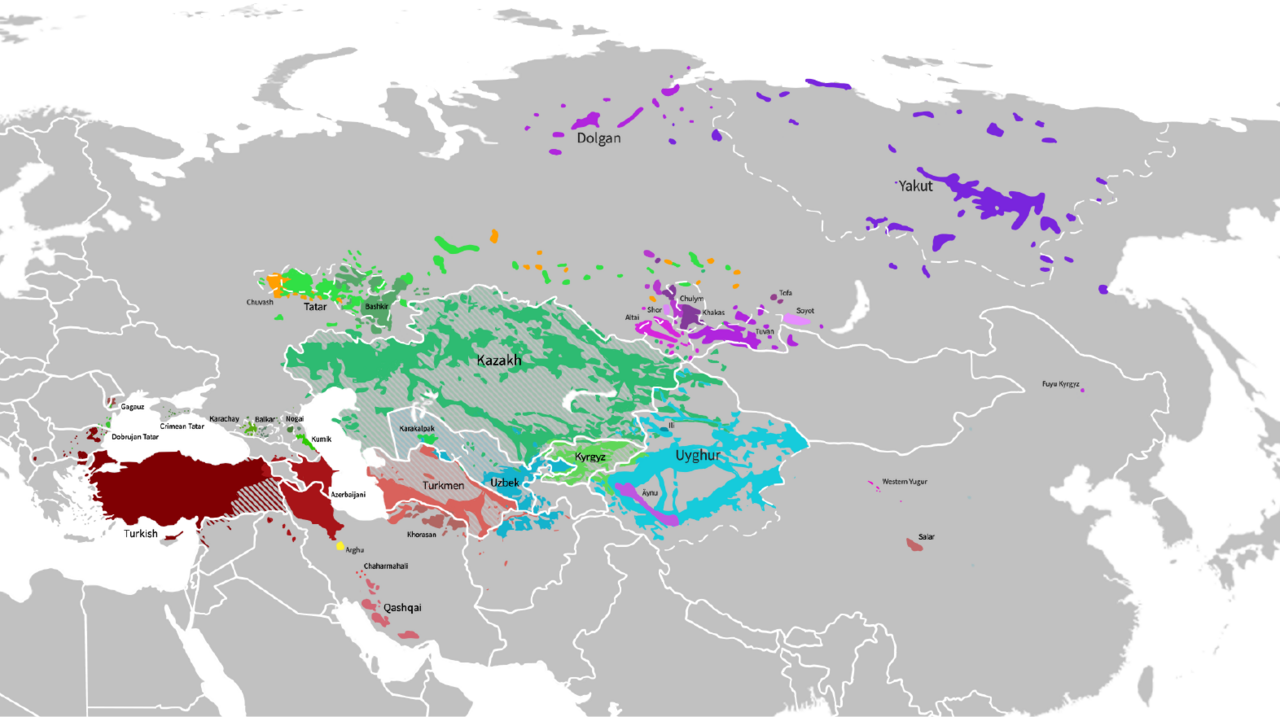
Turkic languages
The Genesis and Diversification of Turkic Languages
The Turkic language family, estimated to comprise between 30 and 40 distinct languages, represents a significant linguistic lineage with deep historical roots. Linguists generally posit a common ancestor, Proto-Turkic, which likely emerged in a region of Central or Eastern Asia thousands of years ago. The subsequent migrations and interactions of Turkic-speaking peoples led to the gradual diversification of this ancestral tongue.
Major branches include the Oghur branch (represented today primarily by Chuvash) and the Common Turkic branch, which further subdivides into groups such as Oghuz (Turkish, Azerbaijani), Kipchak (Kazakh, Tatar), Karluk (Uzbek, Uyghur), and Siberian Turkic. The precise classification and relationships between these branches are subjects of ongoing linguistic research, with some scholars also exploring potential connections to other language families in broader macrofamily hypotheses like Altaic. The historical spread of Turkic languages is closely tied to the rise and fall of various Turkic empires and nomadic confederations, which facilitated linguistic exchange and dominance across vast swathes of Eurasia.
Structural Uniqueness
Turkic languages are renowned for their distinctive structural features, particularly their highly agglutinative nature. This means that grammatical functions and derivations are typically expressed by adding a series of distinct suffixes to a root word, with each suffix generally having a single meaning. For example, in Turkish, the word 'evlerimde' (in my houses) is built from the root 'ev' (house) by adding '-ler' (plural), '-im' (my), and '-de' (in).
This contrasts sharply with fusional languages like English or Spanish, where suffixes often carry multiple meanings. Another hallmark is the consistent verb-final (SOV - Subject-Object-Verb) word order, which influences sentence construction and information flow. Furthermore, vowel harmony is a pervasive phonological phenomenon across most Turkic languages.
This rule dictates that vowels within a word, including suffixes, must share certain phonetic features, typically relating to tongue position (front/back) or lip rounding (rounded/unrounded). This creates a distinct phonetic texture and aids in morphological transparency, making it easier to identify grammatical boundaries.
Historical Trajectories and Linguistic Legacy
The historical trajectory of Turkic languages is a narrative of empires, cultural exchange, and adaptation. Early Turkic inscriptions, such as the Orkhon inscriptions dating back to the 8th century CE, provide invaluable insights into Old Turkic, a common ancestor for many modern languages. The expansion of Turkic peoples led to their languages becoming dominant or influential in regions ranging from Anatolia and the Balkans to Siberia and Central Asia.
The Ottoman Empire, for instance, fostered the development of Ottoman Turkish, a language heavily influenced by Arabic and Persian, which served as the administrative and literary language for centuries. In Central Asia, the Soviet era brought about linguistic policies that standardized certain Turkic languages, often introducing Cyrillic scripts and promoting Russian as a lingua franca, while also fostering national identities tied to distinct languages.
The legacy of these historical processes is evident in the diverse linguistic landscape of Eurasia today.
Contemporary Relevance and Linguistic Study
In the 21st century, Turkic languages continue to be vital instruments of communication, culture, and identity for over 200 million people. Turkish remains a major language of international commerce and diplomacy, given Turkey's strategic location and economic influence. The languages of Central Asia, such as Kazakh, Uzbek, Turkmen, and Kyrgyz, are gaining renewed global attention as these nations assert their independence and engage more actively on the world stage.
The study of Turkic languages is crucial for understanding the political, economic, and cultural dynamics of this vast and historically significant region. Moreover, Turkic languages offer rich data for comparative linguistics, typology, and the study of language change, providing unique perspectives on universal linguistic principles and the mechanisms of language evolution and contact.
Interconnectedness and Future Directions
The Turkic language family exemplifies the interconnectedness of human history and linguistic development. While distinct languages have emerged, a degree of mutual intelligibility exists, particularly among closely related branches like Oghuz or Kipchak. This shared heritage facilitates cross-cultural understanding and cooperation.
Contemporary linguistic research continues to refine our understanding of Turkic language relationships, explore the impact of language contact (especially with Indo-European and Uralic languages), and document endangered Turkic varieties. The digital age also presents new opportunities and challenges, influencing language use, standardization, and preservation efforts. As global interactions intensify, the Turkic languages will undoubtedly continue to evolve, adapt, and play a significant role in shaping the cultural and linguistic map of Eurasia.
Go deeper
Based on content from Wikipedia · Licensed under CC BY-SA 4.0