

Turing Test: Can Computers Talk Like Us?
Images

Turing Test 🍻 Session IPA


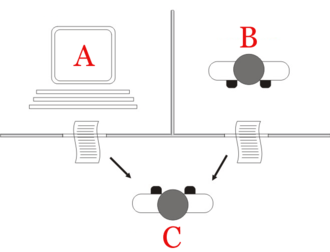


The Genesis of the Imitation Game
The Turing test, originally conceived as the 'imitation game' by Alan Turing in 1949, emerged as a pragmatic approach to the profound question: 'Can machines think?'. Frustrated by the ambiguity inherent in defining 'thinking,' Turing proposed a test focused on observable behavior rather than internal states. His 1950 paper, 'Computing Machinery and Intelligence,' introduced this thought experiment, which involves a human interrogator attempting to distinguish between a human and a machine participant solely through text-based conversation.
The machine passes if the interrogator cannot reliably identify it. This formulation shifted the focus from abstract definitions of intelligence to a performance-based assessment, making the question of machine intelligence empirically addressable.
Evolution and Interpretation of the Test
Turing's initial proposal was elegantly simple: a three-person game where an interrogator seeks to determine the sex of two hidden players. He generalized this to ask if 'imaginable digital computers' could perform well in such an imitation game. The test's strength lies in its generality; it's not limited to specific tasks but assesses a machine's capacity for general intelligent behavior.
Over the decades, the Turing test has been subject to extensive philosophical debate and criticism. Philosophers like John Searle have argued that passing the test does not equate to genuine understanding or consciousness, famously proposing the Chinese Room argument. Despite these critiques, the test remains a foundational concept in AI philosophy.
The Enduring Significance in AI Discourse
The Turing test's significance extends far beyond its initial conception. It has served as a powerful catalyst for research in natural language processing, machine learning, and cognitive science. By setting a high bar for conversational ability, it has driven innovation in AI development.
The test forces us to consider what constitutes human-like intelligence and how we might replicate it. Furthermore, it raises critical questions about the nature of consciousness, personhood, and the ethical implications of creating machines that can convincingly mimic human interaction. Its influence is evident in the ongoing quest to build increasingly sophisticated AI systems.
Mechanics of the Modern Imitation Game
In contemporary interpretations, the Turing test typically involves a human evaluator engaging in free-form, text-based conversations with two hidden entities. One entity is a human, and the other is an AI. The evaluator poses questions and responds to answers, aiming to discern the machine's identity.
The machine's objective is to generate responses that are semantically coherent, contextually relevant, and stylistically indistinguishable from human communication. This requires advanced capabilities in understanding nuance, generating creative text, and maintaining a consistent persona. The test's rigor is often enhanced by setting time limits for conversations and increasing the complexity of the topics discussed.
Contemporary AI and the Turing Test
The mid-2020s have witnessed remarkable advancements in large language models (LLMs) such as ChatGPT. These sophisticated AI systems have demonstrated an unprecedented ability to engage in human-like conversation, leading to several instances where they have reportedly passed rigorous variants of the Turing test. While this achievement is a testament to the progress in AI, it also reignites the philosophical debate about what constitutes true intelligence.
Critics argue that LLMs excel at pattern matching and statistical prediction rather than genuine understanding or sentience. Nevertheless, their success in mimicking human conversation underscores the evolving capabilities of AI and its increasing integration into our lives, prompting ongoing re-evaluation of the Turing test's relevance and limitations.
Go deeper
Based on content from Wikipedia · Licensed under CC BY-SA 4.0