

Turaco
Images

Turaco


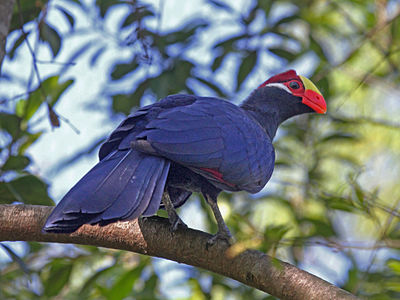


Taxonomic Placement and Geographic Distribution
The family Musophagidae, commonly known as turacos, comprises a distinct group of birds endemic to sub-Saharan Africa. Their taxonomic placement has been a subject of debate, but they are currently recognized as the sole family within the order Musophagiformes. This order is thought to have diverged early in the evolution of Neoaves.
Turacos inhabit a wide range of environments, from dense tropical rainforests and montane forests to savannas and even cultivated areas, demonstrating a degree of ecological adaptability. Their distribution spans across the African continent, with specific species occupying particular niches based on habitat availability and resource abundance. The diversity within the family reflects a long evolutionary history shaped by the varied landscapes of Africa.
Morphological Adaptations and the Enigma of Turacin
Turacos exhibit a range of sizes, from the relatively small White-cheeked Turaco (Tauraco leucotis) to the larger Great Blue Turaco (Corythaeola cristata), with lengths typically between 40 and 75 cm. Morphologically, they are characterized by strong legs and zygodactyl feet (two toes forward, two backward), ideal for arboreal locomotion and perching. Their beaks are robust and often serrated, suited for processing fibrous plant matter.
The most scientifically intriguing feature is the presence of the pigment turacin, a copper-porphyrin compound responsible for the vibrant red coloration in the primary flight feathers and crests of certain species, such as the Red-crested Turaco (Tauraco erythrolophus). Unlike carotenoid-based colors, turacin is chemically unique to Musophagidae and can be washed out by water, a phenomenon that has long fascinated ornithologists and biochemists alike. The evolutionary advantage or origin of this metallic pigment remains an area of active research.
Dietary Ecology and Foraging Strategies
The diet of turacos is predominantly herbivorous, with fruits forming the bulk of their intake. They are opportunistic frugivores, consuming a wide variety of berries, figs, and other fruits, playing a significant role as seed dispersers within their ecosystems. Their foraging strategy involves active searching through the canopy, often moving with agility between branches.
In addition to fruits, they consume leaves, buds, flowers, and occasionally bark. Some species also incorporate insects and other small invertebrates into their diet, particularly during the breeding season to provide essential protein for developing young. This dietary flexibility allows them to thrive in diverse habitats, adapting to seasonal availability of food resources.
Reproductive Biology and Conservation Concerns
Turacos typically form monogamous pairs, constructing simple, cup-shaped nests from twigs and plant material high in trees. Clutch size is usually small, consisting of two to three eggs, which are incubated by both parents for approximately 17-23 days. The altricial young are altricial, requiring extensive parental care for several weeks post-hatching. Vocalizations are diverse, ranging from soft coos to loud, trumpeting calls, serving crucial roles in territorial defense, mate attraction, and intra-group communication.
While many turaco species are currently listed as Least Concern by the IUCN, several face threats from habitat loss and fragmentation due to deforestation and agricultural expansion. Species like the Ruwenzori Turaco (Ruwenzorornis johnstoni) are classified as Vulnerable, highlighting the need for continued conservation efforts to protect these unique avian populations and their habitats.
See also
Frequently Asked Questions
What makes a turaco's red feathers so special?+
Where do turacos live in Africa?+
What do turacos eat?+
How do turacos raise their babies?+
What do turaco calls sound like?+
Based on content from Wikipedia · Licensed under CC BY-SA 4.0