

Tupolev Tu-144: The Super-Fast Soviet Jet!
Images

Tupolev Tu-144

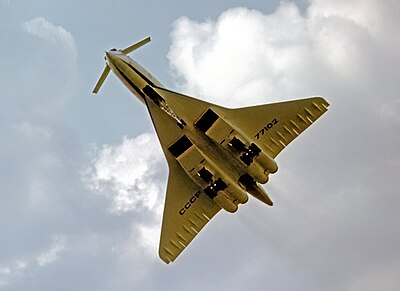


A Soviet First
The Tupolev Tu-144 stands as a monumental achievement in aviation history, representing the Soviet Union's determined pursuit of supersonic passenger transport. Its prototype achieved its first flight on December 31, 1968, a full two months ahead of the Anglo-French Concorde. This feat positioned the Tu-144 as the world's first commercial supersonic transport (SST).
Developed by the Tupolev Design Bureau, an organization led by the esteemed aeronautics pioneer Aleksey Tupolev, the aircraft was manufactured by the Voronezh Aircraft Production Association, with 16 units produced. The Tu-144 was not merely an aircraft; it was a statement of technological prowess and a symbol of Cold War competition in the skies. Its design incorporated advanced aerodynamic principles and powerful jet engines, aiming to revolutionize air travel by drastically reducing flight times between distant cities.
Pushing the Envelope
The Tu-144's operational capabilities were truly extraordinary for its time. It was designed to cruise at an average service altitude of 16,000 meters (52,000 feet), significantly higher than conventional subsonic airliners, allowing it to fly above most atmospheric disturbances and achieve greater efficiency. Its cruising speed was around 2,200 kilometers per hour (1,400 mph), which translates to Mach 2, or twice the speed of sound.
The aircraft first achieved supersonic flight on June 5, 1969, and by May 26, 1970, it had become the world's first commercial transport to exceed Mach 2. These milestones underscored the Tu-144's technological superiority in speed and altitude capabilities, setting new benchmarks for what was possible in passenger aviation.
Navigating the Turbulence
Despite its impressive technical specifications, the Tu-144's journey was fraught with challenges that ultimately curtailed its commercial viability. Persistent reliability issues and complex developmental problems hampered its suitability for regular passenger operations. The program was further impacted by the tragic crash of a Tu-144 at the 1973 Paris Air Show, an event that significantly damaged its public image and international confidence.
Projections of high operating costs, exacerbated by rising fuel prices and growing environmental concerns outside the Soviet Union, deterred potential foreign customers. These factors, combined with inherent technical complexities, led to a limited operational lifespan for the aircraft in passenger service.
A Multifaceted Legacy
The Tu-144's service with Aeroflot, which began with cargo flights in 1975 and passenger flights in 1977, was brief, ending after a crash during a test flight in May 1978. The program was officially cancelled in 1983, after the aircraft had completed 102 flights, with only 55 carrying passengers. However, the Tu-144's story did not end there.
Its advanced airframe and powerful engines proved valuable for other applications. The Soviet space program repurposed the Tu-144 to train pilots for the Buran spacecraft, utilizing its high-speed capabilities to simulate aspects of spaceflight. Furthermore, NASA engaged a Tu-144 in a joint supersonic research program from June 1996 to April 1999, studying its aerodynamic characteristics and noise reduction technologies.
The final flight of a Tu-144 occurred on June 26, 1999, concluding the operational life of this pioneering aircraft, with surviving examples now preserved in museums and collections.
See also
Frequently Asked Questions
What was the Tupolev Tu-144?+
How fast could the Tu-144 fly?+
Why did the Tu-144 stop flying?+
When did the Tu-144 first fly?+
Did the Tu-144 help with space travel?+
Based on content from Wikipedia · Licensed under CC BY-SA 4.0