

Tuning Fork
Images
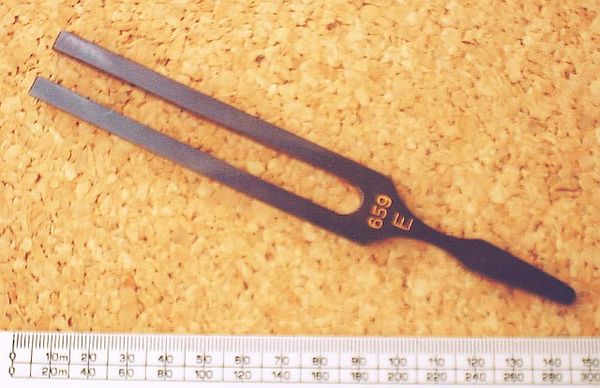
Tuning fork


The Genesis of Standard Pitch
The tuning fork, a device now synonymous with acoustic precision, was formally invented in 1711 by John Shore, a prominent figure in British musical circles. Serving as sergeant trumpeter and lutenist to the royal court, Shore was intimately familiar with the challenges of ensemble performance. The need for a reliable, portable, and consistent source of standard pitch was paramount for ensuring musical harmony.
Prior to Shore's innovation, musicians often relied on less standardized methods, leading to discrepancies in tuning and performance. The tuning fork, with its inherent ability to resonate at a specific, constant frequency, provided an elegant solution. Its U-shaped design, crafted from elastic metal, allowed it to vibrate freely when struck, producing a pure tone once initial transients subsided.
This invention was not merely a technical advancement; it represented a crucial step towards the standardization of musical pitch, a concept that would profoundly influence the development of Western music and its performance practices. The specific pitch of a tuning fork is determined by its physical properties, primarily the length, mass, and cross-sectional area of its tines, making it a predictable and reproducible acoustic tool.
The Physics of Purity
The operation of a tuning fork is a beautiful illustration of fundamental physics principles, particularly resonance and frequency. When the tines are struck, they are displaced from their equilibrium position and, due to the elasticity of the metal, begin to oscillate. This oscillation generates a sound wave.
The frequency of this wave is the tuning fork's fundamental frequency, which is determined by the physical characteristics of the tines: their length, mass, and stiffness. Longer, more massive, or less stiff tines will vibrate at a lower frequency, producing a lower pitch. Conversely, shorter, lighter, or stiffer tines will vibrate at a higher frequency, producing a higher pitch.
A key characteristic of the tuning fork is its production of a relatively pure tone. While any vibrating object produces not only its fundamental frequency but also a series of higher-frequency harmonics or overtones, the tuning fork's design minimizes these overtones. The initial impact excites these higher modes, but they rapidly decay due to damping, leaving the fundamental frequency as the dominant and sustained sound.
This purity of tone is what makes it an ideal reference for tuning, as it clearly defines a single pitch without the complex timbre of many musical instruments.
Tuning the World
The tuning fork's primary and most enduring application is in the realm of music, where it serves as a critical tool for establishing and maintaining standard pitch. Musicians across all genres, from classical orchestras to rock bands, rely on tuning forks to ensure their instruments are accurately tuned. The most common tuning fork produces the note A at 440 Hz (A440), which is the standard concert pitch in many parts of the world.
However, tuning forks are also employed in various scientific and medical contexts. In physics education, they are indispensable for demonstrating concepts such as resonance, sympathetic vibration, and the relationship between frequency and sound. They help students visualize how sound energy can be transferred and amplified.
In audiology, specialized tuning forks are used for diagnostic hearing tests, such as the Weber and Rinne tests. These tests help differentiate between conductive and sensorineural hearing loss by assessing how sound is perceived through bone conduction versus air conduction. The consistent and predictable acoustic output of a tuning fork makes it a reliable instrument for these precise measurements.
The Enduring Legacy
The tuning fork, despite its simple appearance and ancient origins, continues to hold significant relevance in the 21st century. Its invention by John Shore marked a pivotal moment in the history of music, providing a tangible standard for pitch that facilitated greater accuracy and consistency in musical performance. This standardization was not only crucial for the development of complex musical compositions and ensembles but also contributed to the broader scientific understanding of acoustics.
In contemporary physics, tuning forks remain a fundamental pedagogical tool, illustrating core principles of wave mechanics and resonance in a clear and accessible manner. Their application in audiology further underscores their enduring utility; the Weber and Rinne tests, which utilize tuning forks, are still standard procedures for evaluating hearing function. The ability of a tuning fork to produce a pure, specific frequency makes it an invaluable diagnostic instrument, capable of revealing subtle aspects of auditory perception.
Thus, this seemingly modest metal fork bridges the gap between artistic expression and scientific inquiry, a testament to its ingenious design and lasting impact.
See also
Based on content from Wikipedia · Licensed under CC BY-SA 4.0