

The Great Siberian Boom!
Images

Moscow State University Tunguska event 2014-01 1389528722


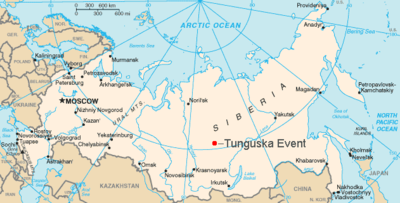


The Siberian Cataclysm of 1908
On the morning of June 30, 1908, an event of unprecedented scale occurred over the remote East Siberian taiga. A celestial body, estimated to be between 50 and 60 meters in diameter, entered Earth's atmosphere and detonated at an altitude of 5 to 10 kilometers. The resulting air burst released an energy equivalent to 3 to 50 megatons of TNT, a force capable of obliterating a major city.
The immediate consequence was the catastrophic flattening of approximately 2,150 square kilometers of forest, felling an estimated 80 million trees in a pattern radiating outwards from the epicenter. Eyewitness accounts from as far as 60 kilometers away described a blinding flash, intense heat, and a series of thunderous explosions. The remote and politically unstable conditions in early 20th-century Russia delayed comprehensive scientific investigation for nearly two decades, allowing the event to become shrouded in mystery and speculation.
Investigating the Absence of a Crater
The most perplexing characteristic of the Tunguska event is the lack of a definitive impact crater. Unlike typical meteorite impacts, where a significant portion of the object survives to strike the surface, the Tunguska object appears to have completely disintegrated in the atmosphere. This phenomenon is attributed to its composition and entry trajectory.
Traveling at an estimated speed of 27 km/s, the object likely experienced immense pressure and heat, leading to its explosive fragmentation. Scientific expeditions, notably those led by Leonid Kulik starting in the 1920s, meticulously surveyed the devastated region. While they found evidence of widespread destruction and even discovered microscopic spherules containing extraterrestrial elements, the absence of a substantial impact crater fueled various hypotheses, ranging from a comet fragment to a natural gas explosion, though the prevailing scientific consensus points to an asteroid air burst.
This event remains the largest recorded impact event on Earth, underscoring the destructive potential of even relatively small near-Earth objects.
Scientific Significance and Modern Relevance
The Tunguska event serves as a critical benchmark for understanding the dynamics of asteroid impacts and their potential consequences. Its scale provides invaluable data for calibrating impact models and assessing the threat posed by similar-sized objects in the future. The event's energy release is comparable to that of a large nuclear weapon, highlighting the existential risk that undetected asteroids could pose to civilization.
Consequently, Tunguska has been instrumental in driving advancements in asteroid detection and tracking programs worldwide. Organizations like NASA and the European Space Agency actively monitor the skies for potentially hazardous objects, employing sophisticated telescopes and analytical tools. The lessons learned from Tunguska inform strategies for planetary defense, including the development of deflection technologies, ensuring that humanity is better prepared for future celestial encounters.
Cultural Impact and Enduring Enigma
Beyond its scientific importance, the Tunguska event has profoundly influenced popular culture and scientific discourse. The sheer mystery surrounding the event, amplified by the lack of definitive physical evidence like a crater, has inspired a wealth of fictional narratives, speculative theories, and even conspiracy theories. It has been depicted in literature, film, and documentaries, often exploring themes of cosmic forces, unknown phenomena, and humanity's place in the universe.
While scientific consensus strongly favors an asteroid air burst, the enduring enigma of Tunguska continues to fascinate researchers and the public alike. It stands as a powerful reminder of the dynamic and often unpredictable nature of our solar system and the vast, unexplored cosmos that surrounds us, prompting ongoing scientific inquiry and a sense of awe at the universe's grand scale.
See also
Based on content from Wikipedia · Licensed under CC BY-SA 4.0