

Tungurahua: Ecuador's Fiery Mountain!
Images

Volcàn Tungurahua


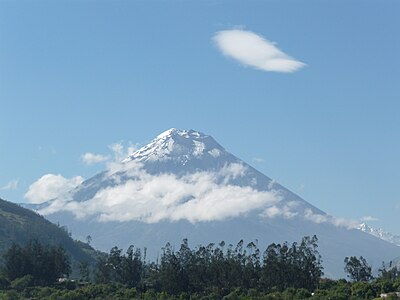


Geographical Context and Naming of Tungurahua
Tungurahua is a prominent active stratovolcano situated within the Cordillera Oriental, a major mountain range forming the eastern boundary of the Andes in Ecuador. Its imposing presence dominates the landscape and has lent its name to the surrounding Tungurahua province, underscoring its regional significance. The name 'Tungurahua' itself is derived from the indigenous Quichua language, translating literally to 'Throat of Fire.' This evocative name perfectly captures the volcano's fiery nature and its potential for dramatic geological displays.
As a stratovolcano, Tungurahua is characterized by its steep, conical shape, built up over millennia through successive eruptions of viscous lava flows, pyroclastic material, and ash, creating distinct layers that give it its structure.
Resumption of Activity and Eruptive Patterns
While Tungurahua has a long geological history, its recent period of heightened activity began notably on August 19, 1999. This marked a significant shift, transitioning the volcano from a period of relative quiet to sustained eruptive phases. Since 1999, Tungurahua has been a consistently active volcano, characterized by frequent, though often moderate, eruptive episodes.
These events have included the emission of ash plumes that can reach considerable altitudes, incandescent avalanches, and incandescent blocks ejected from the crater. The most recent significant eruptive period documented lasted from February 26 to March 16, 2016, showcasing the volcano's ongoing dynamism. Scientists continuously monitor these patterns to understand the underlying magmatic processes and potential hazards.
Volcanological Significance and Hazard Assessment
Tungurahua serves as a crucial natural laboratory for volcanologists studying the mechanics of stratovolcanoes. Its frequent activity provides invaluable data on magma ascent, eruption dynamics, and the resulting geological and atmospheric impacts. The volcano's eruptions, while sometimes posing risks, also contribute to the unique ecological systems of the Andes, enriching soils and influencing local climates. Hazard assessment is a critical aspect of managing Tungurahua's activity.
Scientists employ a suite of monitoring techniques, including seismic networks, GPS measurements, gas analysis, and remote sensing, to detect precursors to eruptions. This information is vital for issuing timely warnings to the approximately 250,000 people living in the surrounding Tungurahua province, enabling evacuation and mitigation strategies to minimize risks to life and property.
The "Throat of Fire"
The term 'Throat of Fire' refers to the conduit system within Tungurahua through which magma travels from its subterranean source to the surface. This magma, originating from the melting of the Earth's mantle and crust, is under immense pressure. When this pressure exceeds the strength of the overlying rock, an eruption occurs.
The composition of the magma influences the type of eruption; andesitic and basaltic magmas are common in subduction zone volcanoes like Tungurahua. The ejected materials, including ash, gases like sulfur dioxide and carbon dioxide, and lava flows, have profound environmental implications, affecting air quality, water resources, and agricultural productivity. Understanding these processes is key to comprehending Tungurahua's role in regional geological evolution and its potential impact on human populations.
See also
Frequently Asked Questions
What is Tungurahua and why is it called the "Throat of Fire"?+
When did Tungurahua start erupting again after being quiet?+
How do scientists know when Tungurahua might erupt?+
What kind of rocks and ash does Tungurahua produce during eruptions?+
Why is Tungurahua important for people living nearby?+
Based on content from Wikipedia · Licensed under CC BY-SA 4.0