

Chopin's Amazing Piano Adventures!
Images
Chop f.op025.01.m0000-0002


The Genesis and Structure of Chopin's Études
Frédéric Chopin's output of 27 études, published in three distinct sets during the 1830s (Op. 10, Op. 25, and the unnumbered set), represents a pivotal moment in piano literature. These were not mere pedagogical exercises but sophisticated musical compositions designed to address specific technical challenges while simultaneously demanding high artistic interpretation. Op. 10, published in 1833, and Op. 25, published in 1837, each contain twelve études, meticulously crafted to develop a pianist's facility in areas such as rapid scales, arpeggiated figures, leaps, and chromaticism.
The subsequent set of three, published posthumously, further expanded this technical and artistic exploration. Chopin's genius lay in his ability to imbue these studies with profound musicality, transforming them from mere drills into compelling concert pieces that continue to captivate audiences and challenge performers.
Revolutionizing Piano Pedagogy and Performance
Prior to Chopin, piano studies often prioritized technical proficiency over musical expression, leading to dry and uninspiring practice material. Chopin fundamentally altered this paradigm. His études, while rigorously demanding, are imbued with the lyrical beauty, harmonic richness, and emotional depth characteristic of his broader compositional style.
This integration of technical mastery and artistic substance elevated the étude from a pedagogical tool to a legitimate form of concert repertoire. By presenting these works as viable performance pieces, Chopin inspired a generation of pianists to approach technical practice with a greater sense of musical purpose and aesthetic appreciation, thereby broadening the scope and ambition of piano education and performance.
Enduring Significance in the Pianistic Canon
The enduring significance of Chopin's études lies in their dual role as cornerstones of piano technique and pinnacles of Romantic musical expression. For students, they offer an unparalleled curriculum for developing advanced pianistic skills, addressing virtually every technical demand a pianist might encounter. Mastery of these études signifies a high level of technical proficiency and musical maturity.
For concert pianists, they remain essential repertoire, allowing for the display of virtuosity alongside profound emotional communication. Their continued presence on recital programs and in conservatory curricula underscores their status as indispensable works that bridge the gap between technical training and artistic realization, shaping the very identity of the modern concert pianist.
Analytical Insights into Technical and Musical Design
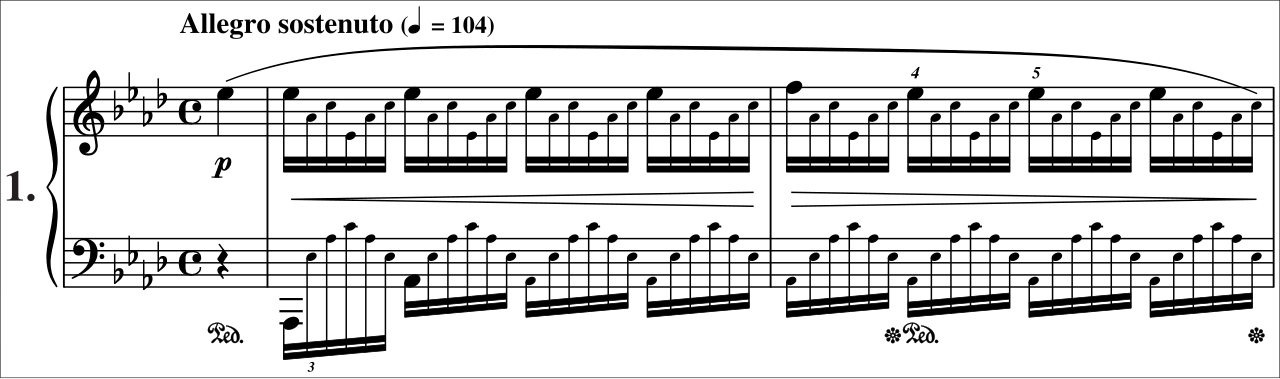
A closer examination of Chopin's études reveals meticulous design and profound insight into the mechanics of piano playing. For instance, the 'Black Key' Étude (Op. 10, No. 5) focuses on dexterity and agility using the black keys, while the 'Revolutionary' Étude (Op. 10, No. 12) demands immense power and speed to convey its dramatic intensity. The Étude in A-flat major, Op. 25, No. 1, known as the 'Aeolian Harp,' emphasizes lyrical legato and flowing arpeggios.
Chopin masterfully exploited the piano's capabilities, pushing the boundaries of finger independence, hand span, and dynamic control. Each étude is a self-contained world, exploring a specific technical challenge within a compelling musical framework, thereby offering a rich field for analytical study by both performers and musicologists.
Chopin's Études in Contemporary Context
In the 21st century, Chopin's études continue to be central to piano performance and education. They serve as benchmarks for evaluating a pianist's technical prowess and interpretive depth. Furthermore, their influence can be seen in the works of later composers who adopted the étude format for exploring new instrumental techniques and musical ideas.
The études also remain a subject of scholarly research, with pianists and academics delving into performance practices, historical context, and analytical interpretations. Their timeless appeal ensures their relevance, not only as historical artifacts of piano development but as vibrant, living works that continue to inspire and challenge musicians and audiences alike.
See also
Based on content from Wikipedia · Licensed under CC BY-SA 4.0