

Trojan Asteroids: Space's Secret Buddies!
Images

Dwarf Planet Ceres




The Stable Embrace
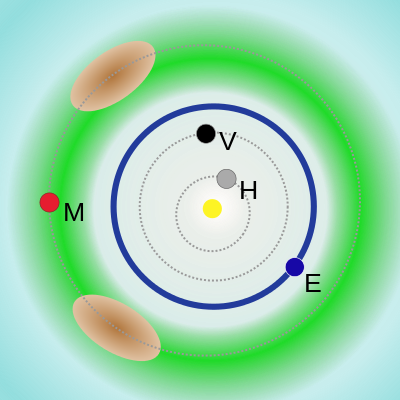
Trojan asteroids are celestial bodies that share an orbit with a planet, specifically congregating at the two triangular Lagrange points, L4 and L5, associated with that planet-Sun system. These points represent stable equilibria where the gravitational forces of the Sun and the planet are balanced, allowing an object to maintain a relatively constant position with respect to both. While Jupiter hosts the most extensive Trojan populations, with thousands of known members forming dense clouds ahead of and behind it, Trojans are also found associated with other planets, including Mars, Neptune, and even Earth.
The discovery of 617 Patroclus in 2001, a Trojan asteroid of Neptune, marked a significant milestone, revealing that these objects can also be binary systems. Their existence is a direct consequence of the gravitational dynamics established during the early formation and subsequent evolution of the solar system, acting as stable reservoirs of primordial material.
Fossilized Beginnings
The prevailing theory suggests that Trojan asteroids are remnants from the protoplanetary disk, the swirling cloud of gas and dust from which the planets formed. During the chaotic early stages of the solar system, the giant planets, particularly Jupiter, underwent significant orbital migration. This migration is believed to have captured a substantial population of planetesimals, the building blocks of planets, into stable resonant orbits at the L4 and L5 points.
These captured objects then evolved over billions of years, with some potentially being ejected, colliding, or undergoing surface modifications due to space weathering. The composition of Trojans, which varies but often includes carbonaceous chondrites, suggests they formed in the colder, outer regions of the solar system. Studying their mineralogy and isotopic ratios can provide direct evidence of the conditions and materials present during the solar system's infancy, offering a unique glimpse into the processes that governed planetary accretion.
Cosmic Archives
Trojan asteroids are invaluable scientific assets, serving as archives of the early solar system. Their relative stability over astronomical timescales means they have preserved compositional and structural information that has been largely erased from more dynamically active bodies. By analyzing their spectral properties and, in the future, their physical samples, scientists can reconstruct the chemical makeup of the protoplanetary disk and understand the distribution of volatile and refractory materials.
Furthermore, the study of Trojan populations helps to validate and refine models of planetary migration, such as the Nice model, which describes the outward movement of the giant planets. Understanding the dynamics of these resonant populations also contributes to our knowledge of orbital mechanics and the long-term stability of planetary systems. They represent a crucial dataset for comprehending the processes that led to the formation of our own solar system and potentially others.
Gravitational Anchors
The enduring presence of Trojan asteroids at the L4 and L5 Lagrange points is a testament to the intricate interplay of gravitational forces. These points are stable equilibrium locations within a three-body system (Sun-Planet-Asteroid). At L4 and L5, the gravitational pull from the Sun and the planet combine to create a net force that acts to restore an object to the equilibrium point if it is slightly perturbed.
This stability is not absolute; over very long timescales, interactions with other planets can cause gradual diffusion of Trojans from these points. However, for the vast majority of their existence, Trojans remain locked in these resonant configurations. The dynamics are complex, involving not only the Sun and the primary planet but also the gravitational influence of other planets, which can lead to secular resonances and long-term orbital evolution.
Understanding these subtle gravitational interactions is key to predicting the long-term fate of Trojan populations and their role in the solar system's evolution.
Beyond Jupiter
While Jupiter's Trojans are the most numerous and well-studied, the search for Trojans around other planets continues to expand our understanding of solar system architecture. The discovery of Neptune Trojans, such as 2008 LC18, and the confirmation of Martian Trojans like 5261 Eureka, demonstrate that these orbital companions are not unique to the gas giants. Even Earth has a candidate Trojan, 2010 TK7, located at its L4 point.
The presence of Trojans around different types of planets suggests that their capture mechanism is a common outcome of planetary formation and migration processes. Future missions and advanced observational techniques are expected to reveal many more Trojan populations, potentially including those around exoplanets, providing a broader context for understanding planetary system diversity and the prevalence of stable resonant configurations throughout the galaxy.
See also
Frequently Asked Questions
What is a Trojan asteroid?+
Where do Trojan asteroids live?+
Why are Trojan asteroids important for science?+
Are there Trojan asteroids around planets other than Jupiter?+
How did Trojan asteroids get there?+
Based on content from Wikipedia · Licensed under CC BY-SA 4.0