

Treadle Power!
Images

Treadle


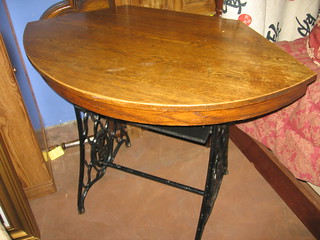
Deconstructing the Treadle
The treadle represents a sophisticated application of mechanical advantage, designed to harness human muscular energy efficiently. At its core, it's a foot-operated lever mechanism. Unlike direct-drive pedals found on bicycles, treadles are typically part of a more complex system.
The fundamental principle involves converting the user's reciprocating foot motion into either rotary or continued reciprocating motion for a machine. This is often achieved through a linkage system connected to a crank. As the user presses down on the treadle, the linkage drives the crank, which then powers the machine's primary function.
In some applications, like treadle looms or pumps, the reciprocating motion generated by the treadle is used directly to actuate components such as heddles or pistons. This indirect drive allows for a degree of mechanical filtering, providing a smoother power delivery and enabling the operator to modulate force and speed with remarkable precision, a key advantage over direct mechanical coupling.
The Treadle's Epoch
The widespread adoption of treadle mechanisms marked a pivotal era in the democratization of powered machinery. Prior to the pervasive availability of electricity, treadles were the most common and accessible means of powering a vast array of tools and devices. This human-powered revolution enabled small-scale manufacturing, artisanal crafts, and domestic tasks to be performed with unprecedented efficiency.
From the iconic Singer treadle sewing machines that transformed garment production and domestic economies, to the agricultural treadle pumps that facilitated irrigation, these devices were instrumental. The treadle's success underscores a period where ingenuity focused on optimizing human input, making complex mechanical operations feasible for individuals and small workshops, thereby laying crucial groundwork for later industrial advancements.
Enduring Significance
The treadle's continued relevance transcends its historical context, offering distinct advantages in modern scenarios. The primary benefit remains the exceptional level of operator control. The direct feedback loop between foot pressure and machine action allows for nuanced adjustments in speed and force, crucial for tasks demanding high precision, such as intricate embroidery, fine woodworking, or delicate pottery shaping.
This intuitive control fosters a deep connection between the operator and the machine, enhancing skill development and creative output. Furthermore, treadles provide a vital pathway to operational autonomy. In regions lacking reliable electrical infrastructure, or during power grid failures, treadle-powered machinery offers a dependable alternative.
This self-sufficiency is invaluable, ensuring continuity for essential services and personal productivity, making the treadle a resilient technology.
Diverse Manifestations
The treadle mechanism manifests in a surprising variety of applications, demonstrating its adaptability. The treadle sewing machine is perhaps the most recognizable, where the rhythmic pumping drives the needle mechanism for continuous stitching. In agriculture and water management, treadle pumps utilize the reciprocating motion to drive pistons, efficiently lifting water without external power sources.
Traditional textile production heavily relied on treadle looms, where foot pedals controlled the 'harnesses' or 'heddles' to create complex warp sheds for weaving. Even in artistic pursuits, the potter's kick wheel, while sometimes a direct-drive system, shares the principle of foot-powered rotation. These diverse examples highlight the treadle's fundamental role in converting human biomechanics into useful mechanical work across different sectors.
Related Mechanisms and the Evolution of Power Transmission
The treadle is part of a broader family of human- and animal-powered mechanisms designed for transmitting force and motion. Related technologies include cranks, which are often integrated with treadles to achieve rotary motion. Treadmills and treadwheels, historically used for larger-scale power generation (e.g., by animals or multiple people), operate on a similar principle of continuous stepping motion driving a mechanism.
Kick wheels, like those used by potters, are another variation, often involving a direct rotational input from the foot. Comparing these mechanisms reveals an evolutionary path in power transmission, from simple levers to more complex systems, all aimed at efficiently converting biological energy into mechanical work. The treadle stands out for its balance of mechanical complexity and intuitive human control.
See also
Based on content from Wikipedia · Licensed under CC BY-SA 4.0