

Tour Saint-Jacques
Images

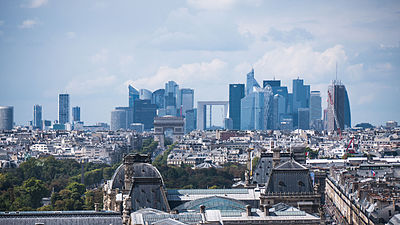
Paris La Défense seen from Tour Saint Jacques 2013-08






Architectural Splendor and Historical Context
Tour Saint-Jacques, standing at 52 meters, is a remarkable example of Flamboyant Gothic architecture, a late medieval style characterized by its elaborate, flame-like decorative elements and intricate stonework. Located in the 4th arrondissement of Paris, it is the sole surviving component of the former Church of Saint-Jacques-de-la-Boucherie. This church, whose name reflects its proximity to a medieval meat market, underwent significant reconstruction in the 16th century, during which the tower was likely completed.
The Flamboyant style, prevalent in the late 15th and early 16th centuries, sought to push the boundaries of Gothic design with its dynamic forms and detailed ornamentation, making the tower a prime specimen of this artistic period. Its survival offers a rare, tangible connection to the architectural ambitions and religious fervor of pre-modern Paris.
The Crucible of Revolution and Demolition
The tower’s existence is a testament to its survival through one of France's most turbulent periods. In 1797, amidst the fervor of the French Revolution, the Church of Saint-Jacques-de-la-Boucherie was demolished. The revolutionary government often viewed such religious structures as symbols of the old regime, leading to widespread destruction.
The stones of the church were repurposed, treated as a literal quarry to provide building materials for new projects. The decision to preserve the tower, however, highlights a growing appreciation for historical and artistic heritage, even during times of radical change. It stands as a solitary sentinel, a stark reminder of the grand church that once dominated the skyline and the dramatic societal shifts that led to its demise.
Significance as a National Historic Landmark
Designated as a national historic landmark, Tour Saint-Jacques is protected for its profound cultural and historical importance. Its preservation is crucial for understanding the evolution of Parisian urbanism and architecture. The tower provides invaluable data for architectural historians studying Gothic styles and the construction techniques of the Renaissance.
Furthermore, its solitary presence in a modern urban landscape prompts reflection on the layers of history embedded within a city. It serves as an educational tool, offering insights into medieval life, religious practices, and the impact of major historical events like the French Revolution on the physical fabric of a nation.
Urban Integration and Enduring Appeal
Situated at the intersection of Rue de Rivoli and Rue Nicolas-Flamel, the tower is now integrated into the bustling urban fabric of contemporary Paris. This juxtaposition of ancient architecture against the backdrop of modern city life creates a unique visual and historical dialogue. While interior access is generally restricted, its exterior presence is a significant draw for tourists and locals alike.
The tower’s enduring appeal lies not only in its architectural beauty but also in its narrative of resilience. It embodies the spirit of survival, standing as a proud monument that has witnessed centuries of Parisian history unfold around it, from royal decrees to revolutionary fervor and the daily rhythms of modern life.
A Legacy of Stone and Story
The Tour Saint-Jacques is more than just a historical artifact; it is a symbol of continuity and memory in a constantly changing world. Its survival underscores the complex relationship between destruction and preservation throughout history. The tower’s story is a compelling case study in how architectural heritage can endure even in the face of profound societal upheaval.
It continues to inspire awe, provoke historical inquiry, and serve as a powerful reminder of the rich, multifaceted past that shapes the present-day identity of Paris and France.
See also
Frequently Asked Questions
What is the Tour Saint-Jacques?+
Why is the tower called "Flamboyant" Gothic?+
How did the Tour Saint‑Jacques survive the French Revolution?+
Where can I see the Tour Saint‑Jacques today?+
Why is the tower important for history and architecture?+
Based on content from Wikipedia · Licensed under CC BY-SA 4.0