

Totenkopf: The Spooky Skull Symbol!
Images

File:Braunschweigisches Husaren-Regiment Nr. 17 Totenkopf Paradehelm Cut out.jpg




The Totenkopf
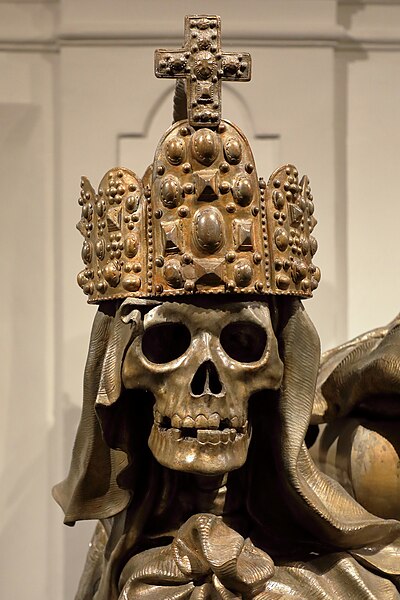
The Totenkopf, a German term literally translating to 'dead person's head,' is a potent and internationally recognized symbol. It primarily depicts a human skull, often presented frontally, though profile views with or without the mandible also exist. Frequently, it is accompanied by two crossed long bones, commonly femurs, forming the classic 'skull and crossbones' imagery.
This symbol transcends simple representation; it is a powerful signifier of death, the defiance of death, inherent danger, the deceased, and historically, has been associated with piracy and toxicity. While the standard German word for skull is 'Schädel,' the 'Totenkopf' carries a distinct cultural and historical weight, often imbued with deeper symbolic meaning beyond its literal anatomical reference.
Evolution of a Symbol
The use of skull imagery as a symbol of mortality and the ephemeral nature of life, a concept known as 'memento mori' (remember you must die), has deep roots in Western culture, appearing in art and religious contexts for centuries. The Totenkopf, as a specific stylized representation, gained significant prominence in the 19th and 20th centuries, particularly within German military traditions. It was adopted by various elite military units, such as the Prussian Hussars and later by the SS Panzer divisions during the Nazi era.
This historical association, especially with the latter, has indelibly marked the symbol, lending it connotations of aggression, fear, and a specific, often controversial, historical period. The 'Schädel' remains the neutral term for skull in medical and scientific contexts, devoid of these charged associations.
The Semantics of the Skull
The profound significance of the Totenkopf lies in its capacity to embody a spectrum of potent, often contradictory, meanings. On one hand, it serves as an unambiguous warning symbol for toxicity and extreme danger, a visual shorthand that immediately commands caution. On the other, it has been powerfully employed to represent defiance, a courageous confrontation with mortality, and an unyielding spirit in the face of ultimate peril.
For military personnel, it could symbolize a hardened resolve and a willingness to face death unflinchingly. This inherent duality allows the Totenkopf to function as a complex emblem that can evoke fear, respect, and a deep contemplation of life and death, making it a compelling subject of study in semiotics and cultural history.
Manifestations of the Totenkopf
The Totenkopf's presence is evident across numerous historical and cultural landscapes. Its most prominent and widely recognized application in the 20th century was as a distinctive insignia for Nazi Germany's SS Panzer divisions, a visual identity that remains deeply unsettling due to the atrocities committed by these units. Prior to this, it was used by other military formations, signifying elite status or a fearsome reputation.
Beyond its military context, the skull and crossbones motif is universally understood as a warning for poisonous substances, a critical safety symbol. Furthermore, it permeates popular culture, appearing in literature, film, art, and fashion, often evoking themes of rebellion, the macabre, or a gothic aesthetic, demonstrating its enduring and adaptable symbolic power.
Beyond the Image
The Totenkopf's legacy is complex and deeply intertwined with historical events and cultural perceptions. Its association with militarism, particularly in Germany, has led to its appropriation by extremist groups, further complicating its interpretation. However, the symbol's fundamental resonance with themes of mortality, danger, and defiance ensures its continued relevance.
It prompts discussions about the nature of fear, courage, and the human confrontation with death. Understanding the Totenkopf requires acknowledging its multifaceted origins, its historical applications, and the diverse, sometimes conflicting, meanings it has accumulated over time, making it a fascinating case study in the power of visual symbolism.
See also
Frequently Asked Questions
What is a Totenkopf?+
Why do people think the Totenkopf is spooky?+
Where do we see the Totenkopf symbol?+
What does the Totenkopf mean to different people?+
Is the Totenkopf safe to look at?+
Based on content from Wikipedia · Licensed under CC BY-SA 4.0