

Theodolite
Images

Theodolite



Key Facts
Meet the Angle Finder!
Imagine you want to know exactly how much to turn a toy car to make it go in a straight line, or how high a kite is in the sky. A theodolite is a special tool that helps grown-ups do just that, but for much bigger things! It's like a super-smart measuring stick for angles.
It has a telescope you look through, and special dials that show you exactly how much something has turned left or right, or how high up it is. It’s a bit like a fancy compass that can also look up!
Where Did This Clever Tool Come From?
People have been trying to measure angles for a very, very long time. The first real theodolites started appearing a long time ago, maybe even before your grandparents were born! Early versions were made of wood and brass, and they looked a bit like a telescope sitting on a stand.
These early tools were super important for drawing maps and figuring out where to build roads and buildings. They helped explorers see farther and measure land more accurately than ever before.
Why Are Theodolites So Cool?
Theodolites are like the secret helpers for building amazing things! When engineers build bridges that go over rivers, or skyscrapers that touch the clouds, they need to be super precise. A theodolite helps them make sure everything is straight and at the right angle.
It’s also used to make really accurate maps of the land. Without these tools, our cities might look a bit wobbly, and our maps wouldn't be as helpful for finding our way around!
How Does This Angle Finder Work?
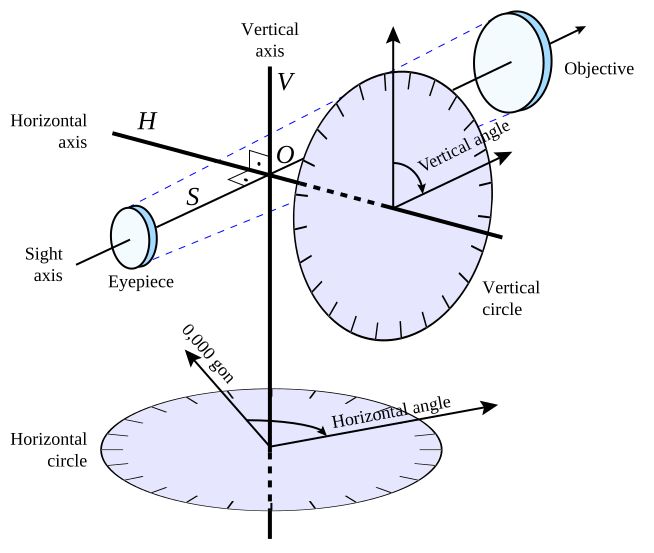
A theodolite has a few main parts that work together. There's a telescope that you point at what you want to measure. This telescope can move up and down, and also spin around.
Around the telescope are special circles with tiny marks on them. When you move the telescope, these circles move too, and the marks show exactly how many degrees you've turned or tilted. It’s like having a protractor that can spin and look at things far away!
Based on content from Wikipedia · Licensed under CC BY-SA 4.0