

Tectonic Plates: Earth's Giant Puzzle Pieces!
Images
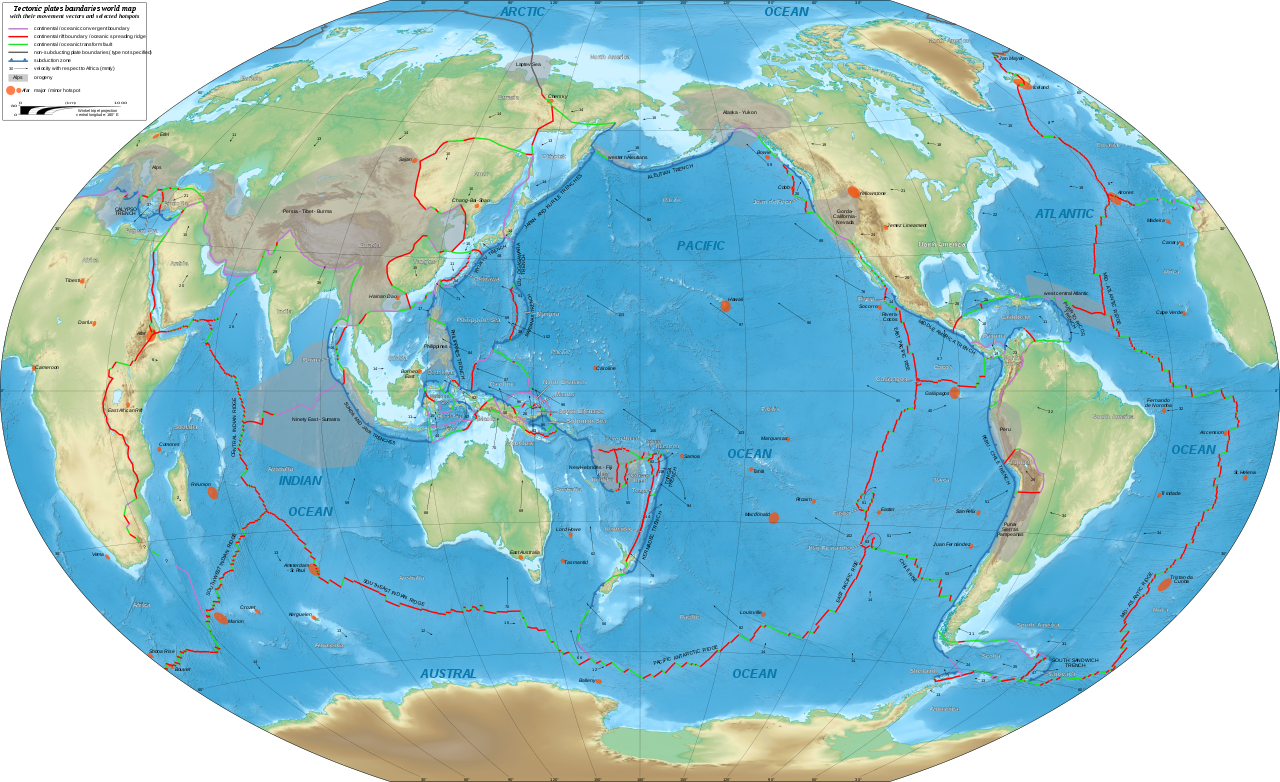
Tectonic plates boundaries physical World map Wt 180degE centered-en


The Lithospheric Plates
The Earth's outermost layer, the lithosphere, is not a continuous shell but is fractured into numerous large and small tectonic plates. These plates are rigid, brittle structures composed of both the crust (continental and oceanic) and the uppermost part of the mantle. They float and move upon the underlying asthenosphere, a hotter, weaker, and more ductile layer of the mantle.
The movement of these plates, driven primarily by mantle convection currents, is the fundamental process of plate tectonics. Convection involves the slow circulation of heat within the Earth's mantle, where hotter, less dense material rises and cooler, denser material sinks, creating a drag force on the overlying lithospheric plates. This slow, relentless motion dictates the planet's geological landscape over vast timescales.
Historical Development of Plate Tectonics Theory
The concept of moving continents began with Alfred Wegener's theory of continental drift in the early 20th century, supported by evidence like matching coastlines, fossil distribution, and geological formations across oceans. However, Wegener lacked a convincing mechanism to explain how continents moved. The crucial breakthrough came in the mid-20th century with the exploration of the ocean floor.
Discoveries of mid-ocean ridges, seafloor spreading, and the age of oceanic crust provided the missing pieces. The theory of plate tectonics emerged, unifying these observations and explaining how new oceanic crust is generated at divergent boundaries and consumed at convergent boundaries, effectively driving continental movement and shaping Earth's surface.
Plate Boundaries
The interactions at the edges of tectonic plates, known as plate boundaries, are responsible for most of Earth's seismic and volcanic activity. Divergent boundaries occur where plates move apart, leading to the creation of new lithosphere, such as at the Mid-Atlantic Ridge. Convergent boundaries are where plates collide.
This can result in subduction, where one plate dives beneath another, forming deep ocean trenches and volcanic arcs (e.g., the Andes Mountains), or continental collision, which creates extensive mountain ranges like the Himalayas. Transform boundaries are where plates slide horizontally past each other, generating significant earthquakes, exemplified by the San Andreas Fault.
Geodynamic Significance and Global Impact
Plate tectonics is the unifying theory of geology, explaining a vast array of Earth processes. It is responsible for the formation and destruction of crust, the creation of mountains, the opening and closing of ocean basins, and the distribution of earthquakes and volcanoes. This dynamic system influences long-term climate patterns by altering ocean currents and atmospheric circulation, and it plays a critical role in the rock cycle and the distribution of mineral and hydrocarbon resources.
Understanding plate tectonics is essential for hazard assessment, resource exploration, and comprehending the planet's evolutionary history and its ongoing transformation.
Beyond Earth
While Earth is the only planet in our solar system known to have active, large-scale plate tectonics, evidence suggests similar processes may have occurred or are occurring on other celestial bodies. For instance, Venus exhibits some features that could be interpreted as related to lithospheric recycling, though its surface is dominated by extensive volcanism and tectonic deformation without clear plate boundaries. Moons like Jupiter's Io are extremely volcanically active due to tidal heating, a process related to gravitational forces rather than plate tectonics.
Studying plate tectonics on Earth provides a crucial baseline for understanding planetary evolution and the potential for geological activity on exoplanets.
Go deeper
Frequently Asked Questions
What are tectonic plates?+
How do tectonic plates move?+
What happens at divergent plate boundaries?+
Why do earthquakes happen at transform boundaries?+
How does plate tectonics affect Earth's mountains?+
Based on content from Wikipedia · Licensed under CC BY-SA 4.0