

Surface Gravity: The Big Pull!
Images
Surface gravity


From Falling Apples to Spacetime Curvature
The concept of surface gravity, while seemingly straightforward, is deeply rooted in centuries of scientific inquiry. Sir Isaac Newton's groundbreaking formulation of the Law of Universal Gravitation in the late 17th century provided the first quantitative description of this force. He posited that every particle of matter in the universe attracts every other particle with a force proportional to their masses and inversely proportional to the square of the distance between their centers.
This law allowed for precise predictions of planetary orbits and the behavior of objects on Earth's surface. However, Newton's theory described gravity as an instantaneous force acting at a distance. It wasn't until Albert Einstein's theory of General Relativity in the early 20th century that our understanding evolved dramatically.
Einstein proposed that gravity is not a force in the traditional sense, but rather a manifestation of the curvature of spacetime caused by mass and energy. Massive objects warp the fabric of spacetime around them, and what we perceive as gravitational pull is simply objects following the straightest possible paths (geodesics) through this curved spacetime. This relativistic view is essential for understanding phenomena like gravitational lensing and the behavior of gravity in extreme environments like black holes.
The Critical Role of Surface Gravity in Planetary Dynamics and Habitability
Surface gravity is a pivotal parameter in planetary science, profoundly influencing a celestial body's formation, evolution, and potential for habitability. For terrestrial planets, surface gravity dictates the planet's ability to retain an atmosphere. A higher surface gravity allows a planet to hold onto lighter gases, which is crucial for maintaining atmospheric pressure, shielding the surface from harmful radiation, and potentially supporting liquid water.
For instance, Earth's gravity is sufficient to retain a substantial atmosphere, while Mars, with its lower surface gravity (about 38% of Earth's), has struggled to maintain a thick atmosphere over geological timescales. Furthermore, surface gravity influences geological processes; higher gravity can lead to more compact planetary interiors and affect volcanic activity and tectonic plate movement. It also plays a role in the formation of planetary rings and the stability of moons in orbit.
The precise measurement and understanding of surface gravity are therefore fundamental to assessing a planet's suitability for life as we know it.
A Cosmic Spectrum
The range of surface gravity across different celestial bodies is astonishing, offering a stark contrast that highlights the diversity of the cosmos. On Earth, our familiar surface gravity is defined as 1 g. However, this is just one point on a vast spectrum.
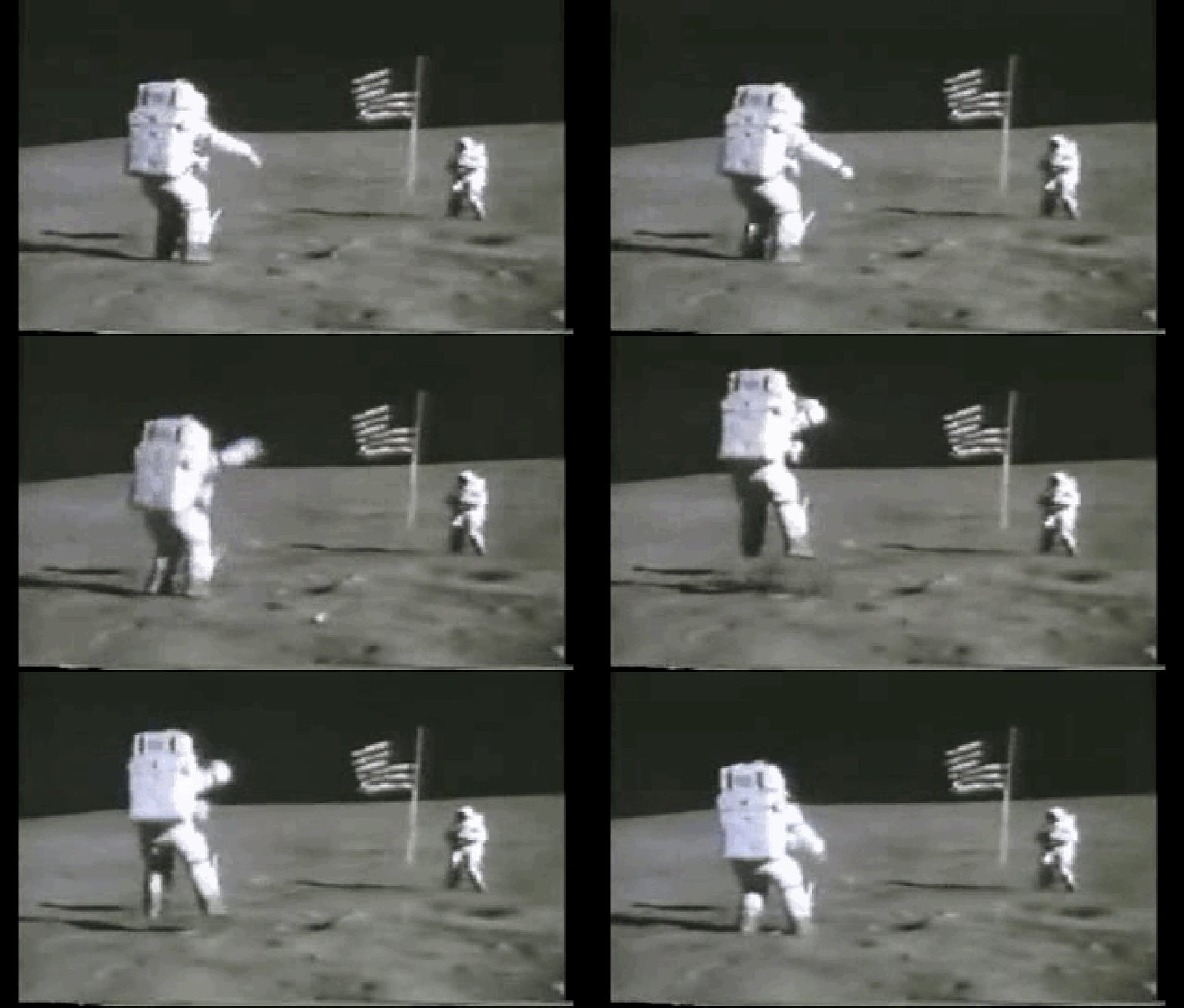
For example, the Moon's surface gravity is approximately 0.165 g, which is why astronauts could perform those iconic high leaps during the Apollo missions. Jupiter, a gas giant, boasts a surface gravity of about 2.53 g, meaning an object weighing 100 pounds on Earth would feel like it weighed over 250 pounds there. Even within our solar system, the variations are significant. Mercury, the smallest planet, has a surface gravity of about 0.38 g.
Beyond our solar system, the surface gravities of exoplanets can vary even more wildly, depending on their mass, radius, and composition. Understanding these values is crucial for astronomers studying exoplanet atmospheres, internal structures, and potential habitability zones.
Beyond Newtonian Physics
While Newton's law provides an excellent approximation for most everyday scenarios and planetary motion, modern astrophysics delves into more complex aspects of surface gravity, particularly through the lens of General Relativity. For extremely massive or dense objects like neutron stars and black holes, the concept of 'surface' gravity becomes more nuanced. Neutron stars, for instance, possess incredibly strong gravitational fields, with surface gravities billions of times that of Earth.
For black holes, the event horizon represents a boundary where gravity is so intense that nothing, not even light, can escape. Observational evidence for relativistic gravity, and thus its implications for surface gravity, comes from phenomena like the bending of starlight around massive objects (gravitational lensing), the precise orbits of Mercury, and the detection of gravitational waves – ripples in spacetime caused by cataclysmic cosmic events. These advanced concepts underscore that surface gravity is not merely a static property but a dynamic aspect of the universe's fundamental structure.
Go deeper
Based on content from Wikipedia · Licensed under CC BY-SA 4.0