

Starling
Images

Starling




Morphology, Phylogeny, and Global Distribution
The common starling (Sturnus vulgaris) is a passerine bird belonging to the family Sturnidae. Its morphology is characterized by a compact body, short tail, pointed wings, and a slender, pointed bill that is dark in winter and yellow in summer. The plumage is predominantly black, but highly iridescent, displaying metallic greens and purples, with buff-colored spots that are more prominent in juveniles and in fresh winter plumage.
This iridescence is a result of the feather structure interacting with light. Phylogenetically, starlings are part of a diverse family with a wide distribution across Eurasia and Africa. Their success in colonizing new continents, particularly North America, Australia, and New Zealand, is a classic case study in avian introductions.
These introductions, often driven by cultural sentiment or perceived ecological benefits, have resulted in starlings becoming widespread and, in many regions, ecologically disruptive invasive species. Their ability to adapt to a broad range of habitats, from natural landscapes to highly urbanized environments, underscores their behavioral plasticity and competitive prowess.
Behavioral Ecology
Starlings are renowned for their sophisticated vocalizations, which extend far beyond simple territorial songs. They are highly accomplished mimics, capable of learning and reproducing a vast repertoire of sounds from their environment. This includes the calls of other bird species, mammalian sounds, and even artificial noises such as car alarms, doorbells, and human speech.
The function of this mimicry is multifaceted, likely playing roles in mate attraction, social communication within flocks, and potentially even as a form of eavesdropping on predator calls. Socially, starlings are highly gregarious, forming large flocks, particularly during the non-breeding season. These flocks are crucial for foraging efficiency and predator avoidance.
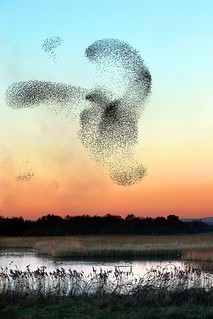
The phenomenon of murmuration, where thousands or even millions of starlings fly in coordinated, dynamic aerial formations, is a spectacular manifestation of their social behavior. These complex maneuvers are thought to confuse predators, such as falcons, by creating a 'confusion effect' that makes it difficult for a predator to target an individual bird within the dense, rapidly moving flock.
Dietary Adaptations and Foraging Strategies
The starling's diet is highly opportunistic and varies seasonally, reflecting its adaptability. During spring and summer, insects form a significant portion of their diet, making them valuable predators of agricultural pests like locusts, caterpillars, and earthworms. They employ a foraging technique known as 'gaping,' where they insert their beaks into soft ground or crevices and open them to widen the opening, exposing hidden invertebrates.
As autumn approaches, their diet shifts towards fruits and seeds. This dietary flexibility allows them to exploit a wide range of food resources throughout the year and across different environments. While their insectivorous habits can benefit agriculture, their consumption of fruits and grains can also lead to significant crop damage, positioning them as a dual-edged sword in agricultural landscapes.
Their ability to digest a variety of food types is key to their widespread success.
Ecological Impacts and Human Management
The ecological impact of the common starling is substantial, particularly in regions where it has been introduced. As an invasive species, it competes aggressively with native bird species for food resources and, critically, for nesting cavities. Their rapid breeding rate and territorial behavior can lead to the displacement of indigenous birds, impacting local biodiversity.
In agricultural settings, large starling flocks can cause considerable economic losses by damaging crops of fruits, berries, and grains. Management strategies vary widely, ranging from non-lethal deterrents like visual and auditory repellents to more direct control methods, though these are often controversial due to ethical concerns and potential impacts on non-target species. The starling's story serves as a potent reminder of the complex ecological consequences that can arise from species introductions and the ongoing challenges of managing widespread, adaptable avian populations in human-dominated landscapes.
See also
Frequently Asked Questions
What does a starling look like?+
How do starlings make their amazing sounds?+
Why do starlings fly in huge groups called murmuration?+
What do starlings eat during the year?+
Where can we find starlings?+
Based on content from Wikipedia · Licensed under CC BY-SA 4.0