

Starburst galaxy
Images

Starburst galaxy




The Phenomenon of Extreme Star Formation
Starburst galaxies represent a phase in a galaxy's life where the rate of star formation is dramatically elevated, often by orders of magnitude compared to quiescent galaxies. This intense burst can convert a significant fraction of a galaxy's interstellar gas into stars over a relatively short cosmic timescale, typically millions to a few hundred million years. The luminosity of these galaxies is dominated by massive, young, hot O and B type stars, which are short-lived but extremely luminous and energetic.
This high star formation rate is not sustainable indefinitely; it represents a transient phase driven by specific conditions. The energy output from these young stars, including intense ultraviolet radiation and stellar winds, can significantly impact the surrounding interstellar medium, sometimes even driving powerful outflows of gas from the galaxy.
Galactic Interactions and Internal Processes
The primary drivers for initiating a starburst are typically external gravitational perturbations. Galactic mergers are the most potent trigger, where the tidal forces during the interaction can funnel gas towards the galactic center, creating dense conditions conducive to rapid star formation. Close flybys and tidal distortions can also induce starbursts without a full merger.
Internally, processes like galactic bars can channel gas inward, potentially leading to starburst activity, though usually less intense than merger-induced events. Some theories also propose that internal instabilities within gas-rich galaxies could trigger localized starbursts. The specific morphology and gas content of the interacting galaxies play a crucial role in determining the intensity and duration of the resulting starburst.
Cosmic Significance
Starburst galaxies are critical engines of cosmic chemical enrichment. The massive stars born during these bursts have short lifespans and end their lives as supernovae. These cataclysmic events are the primary sites for the nucleosynthesis of elements heavier than iron and are responsible for dispersing these newly synthesized elements, along with pre-existing heavy elements, into the interstellar medium.
This process seeds subsequent generations of stars and planets with a richer elemental composition. Furthermore, the energy and momentum injected by supernovae and stellar winds from starburst regions constitute powerful feedback mechanisms that can regulate further star formation, heat the interstellar gas, and even expel gas from the galaxy, influencing its long-term evolution and structure.
Observational Signatures and Examples
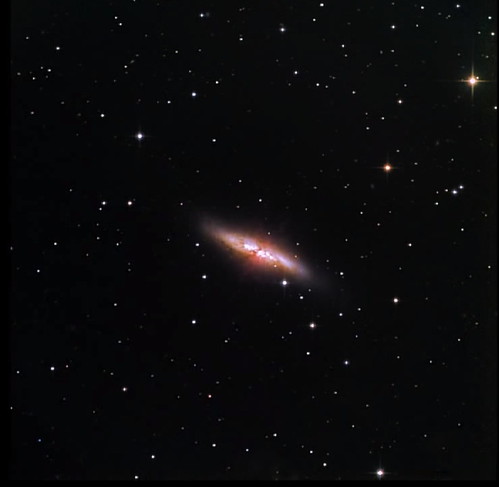
Starburst galaxies are identified through various observational signatures. Their spectra are dominated by emission lines from ionized gas excited by hot young stars, and they exhibit strong infrared emission due to dust heated by these stars. Messier 82 (M82) is a classic example of a starburst galaxy, known for its prominent bipolar outflows driven by intense star formation in its core.
NGC 4945 is another well-studied starburst galaxy, notable for its high star formation rate and active galactic nucleus. Studying these galaxies provides crucial insights into galaxy evolution, the life cycle of stars, and the production of elements essential for life.
Evolutionary Pathways and Future Research
Starburst phases are considered a key evolutionary stage for many galaxies, particularly those that have undergone mergers. Understanding the frequency, duration, and impact of starbursts is fundamental to building accurate models of galaxy formation and evolution across cosmic time. Current research focuses on detailed observations of starburst populations, the dynamics of gas flows, the properties of supernovae within these environments, and the interplay between starburst activity and active galactic nuclei.
Investigating the role of starbursts in the formation of massive black holes and the reionization of the universe are also active areas of study.
See also
Based on content from Wikipedia · Licensed under CC BY-SA 4.0