

Star Clusters: Sparkly Neighborhoods in Space!
Images

Star cluster


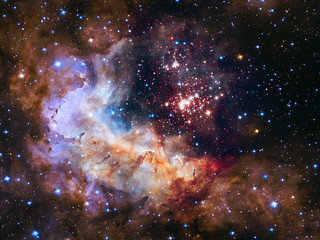


The Mechanics of Stellar Aggregation
Star clusters represent fundamental building blocks in galactic structure, defined by the gravitational cohesion of their constituent stars. They are broadly categorized into two primary types: globular clusters and open clusters. Globular clusters are ancient, spherical collections, typically containing tens of thousands to millions of stars with ages often exceeding 10 billion years.
Their high stellar density and strong self-gravitation allow them to persist as gravitationally bound entities for cosmological timescales. Open clusters, conversely, are younger, less densely populated groups, usually comprising a few hundred stars. They are found predominantly in the galactic disk, a region characterized by active star formation.
The relative weakness of their gravitational binding makes them susceptible to disruption by external tidal forces and interactions with galactic structures like giant molecular clouds. This evolutionary difference dictates their distribution and observable characteristics within galaxies.
Dynamical Evolution and Galactic Interactions
The long-term fate of a star cluster is intricately linked to its initial conditions and its environment. Open clusters, with their lower stellar mass and looser binding energy, undergo rapid dynamical evolution. Over millions of years, encounters between stars within the cluster and interactions with external gravitational fields, particularly from massive molecular clouds and the galactic tidal field, can lead to the ejection of stars and the eventual dissolution of the cluster.
What remains are often stars that continue to move together in a common trajectory, forming stellar associations or moving groups, which are remnants of disrupted clusters. Globular clusters, due to their immense mass and deep potential wells, exhibit much slower dynamical evolution. While they can experience internal processes like mass segregation and core collapse, they are far more resilient to external disruptive forces, allowing them to survive for the majority of the universe's age.
Their stability makes them invaluable probes of galactic history and evolution.
Star Clusters as Astrophysical Laboratories
The significance of star clusters extends far beyond their visual appeal; they are indispensable tools for astrophysical research. Because stars within a cluster form at approximately the same time from the same primordial material, they share similar ages and initial chemical compositions. This homogeneity allows astronomers to study stellar evolution by observing how stars of different masses evolve along the main sequence and subsequently transition to later evolutionary phases.
By analyzing the color-magnitude diagrams of clusters, scientists can precisely determine their ages and metallicities, providing critical data points for understanding galactic chemical evolution and the history of star formation. Globular clusters, in particular, are crucial for studying the early universe, the formation of the first stars, and the assembly of galactic halos. Open clusters, on the other hand, are vital for understanding the physics of star formation, protoplanetary disk evolution, and the initial mass function.
Observational Manifestations and Cosmological Context
The observable universe is populated by a diverse array of star clusters, many of which have captivated human observers for centuries. Open clusters like the Pleiades (M45) and the Hyades are prominent naked-eye objects, serving as accessible entry points into astronomical observation and study. Their relative proximity and brightness make them ideal for detailed photometric and spectroscopic analysis.
Globular clusters, such as Messier 13 (M13) in Hercules or 47 Tucanae, are often visible as fuzzy patches to the unaided eye under dark skies and resolve into dense stellar populations with even modest telescopes. These ancient systems are not uniformly distributed; they typically reside in the halos and bulges of galaxies, suggesting their formation occurred during the early, chaotic phases of galactic assembly. Their study provides direct evidence for the hierarchical formation of galaxies and the processes that shaped the large-scale structure of the cosmos.
Go deeper
Frequently Asked Questions
What is a star cluster?+
What are the two main types of star clusters?+
Why do open clusters break apart over time?+
How do scientists use star clusters to learn about the universe?+
Where can we find open clusters in our galaxy?+
Based on content from Wikipedia · Licensed under CC BY-SA 4.0