

Spinosaurus: The Giant Sail-Backed Hunter!
Images

Spinosaurus aegyptiacus


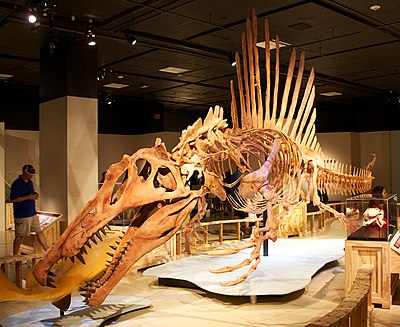


The Anatomy of a Cretaceous River King
Spinosaurus, scientifically classified as Spinosaurus aegyptiacus, represents a genus of exceptionally large spinosaurid theropods that inhabited North Africa during the Cenomanian stage of the Late Cretaceous period, approximately 100 to 94 million years ago. It stands as one of the largest known terrestrial carnivores, with recent estimates placing its length at around 14 meters (46 feet) and its body mass near 7.4 metric tons (8.2 short tons). Its cranial morphology is particularly distinctive, featuring a long, low, and narrow skull reminiscent of modern crocodilians, equipped with straight, conical teeth devoid of significant serrations, ideal for grasping fish.
The forelimbs were robust, bearing three-fingered hands with a notably enlarged claw on the first digit. The most iconic feature, the dorsal sail, comprised elongated neural spines from the vertebrae, reaching at least 1.65 meters (5.4 feet) in length, likely covered by skin. While its exact function is debated, theories include thermoregulation, sexual display, or intimidation.
Evidence for a Semi-Aquatic Existence
The ecological niche occupied by Spinosaurus is a subject of intense scientific interest, with mounting evidence pointing towards a predominantly semi-aquatic lifestyle. Its habitat consisted of humid environments characterized by tidal flats and mangrove forests, rich in aquatic life. The diet of Spinosaurus primarily consisted of fish, as evidenced by fossilized stomach contents and tooth morphology.
However, it also likely preyed on other aquatic vertebrates and potentially smaller terrestrial animals. Key anatomical adaptations support this lifestyle: Spinosaurus possessed osteosclerosis, a high bone density in its leg bones, which would have aided in buoyancy control, allowing it to submerge more easily. Furthermore, its tail was significantly deepened by tall, thin neural spines and elongated chevrons, forming a flexible, paddle-like structure that would have been highly effective for propulsion through water.
This combination of features suggests Spinosaurus was a highly specialized aquatic predator.
A Fragmented History and Ongoing Discoveries
The paleontological journey of Spinosaurus began with the discovery of its remains in Egypt in 1912, described by German paleontologist Ernst Stromer in 1915. Tragically, these original fossils were lost during World War II, creating a significant gap in our understanding. However, the early 21st century witnessed a resurgence of research with new fossil discoveries, particularly from the Kem Kem beds in Morocco.
These finds have been crucial in reconstructing the dinosaur's anatomy and ecology. The taxonomic status of Spinosaurus remains a topic of ongoing debate, with questions about whether one or two species are represented in the fossil record. The type species, S. aegyptiacus, is well-documented, while potential species like S. maroccanus are considered dubious by many.
Other genera, such as Sigilmassasaurus and Oxalaia, have also been linked to Spinosaurus, further complicating its classification and highlighting the dynamic nature of paleontological research.
Ecological Significance and Evolutionary Implications
Spinosaurus occupied a unique apex predator role within its Cretaceous ecosystem, distinct from other large theropods that were primarily terrestrial hunters. Its specialization for aquatic predation suggests a complex food web where large predators could exploit diverse resources. The dorsal sail's potential functions, including thermoregulation, could offer insights into how large ectothermic or mesothermic animals managed their body temperature in ancient environments.
If used for display, it highlights the importance of visual signaling in dinosaur social behavior. The existence of such a specialized large predator also underscores the evolutionary pressures that led to diverse adaptations within the theropod lineage. Spinosaurus challenges our traditional perceptions of dinosaur behavior and ecology, demonstrating that these ancient reptiles occupied a far wider range of ecological niches than previously imagined, including that of a formidable aquatic hunter.
See also
Frequently Asked Questions
What did the Spinosaurus's sail look like?+
How big was the Spinosaurus?+
What did Spinosaurus eat?+
Where did Spinosaurus live?+
Why do scientists think Spinosaurus liked water?+
Based on content from Wikipedia · Licensed under CC BY-SA 4.0