

Spice trade
Images
Spice trade
The Genesis of Global Commerce
The spice trade represents one of the earliest and most enduring forms of global commerce, connecting disparate civilizations across vast continents and oceans. From antiquity, spices such as cinnamon, cassia, cardamom, ginger, pepper, nutmeg, star anise, clove, and turmeric were not merely flavor enhancers but highly prized commodities. Their origins lay primarily in Asia, particularly Southeast Asia and the Indian subcontinent.
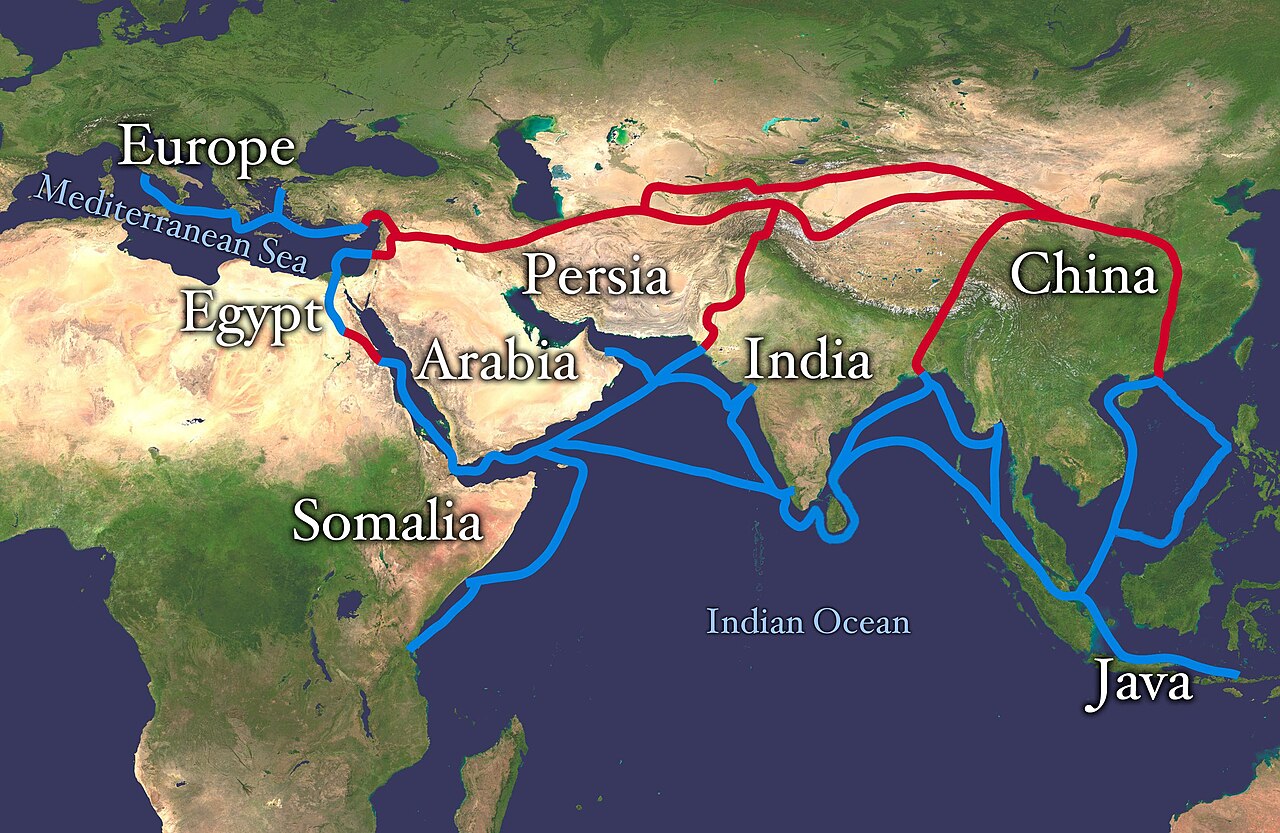
Early trade was characterized by secrecy surrounding their sources, with fantastic tales often used to obscure the true origins and protect lucrative monopolies. The maritime aspect was pioneered by Austronesian peoples, who established sophisticated sea routes from Southeast Asia to Sri Lanka and India as early as 1500 BC. These goods were then channeled overland towards the Near East and the Greco-Roman world via networks like the Incense Route and Roman-India routes, facilitated by Indian and Persian traders.
Empires, Religions, and the Shifting Sands of Control
The control of spice routes became a perpetual source of power and wealth, leading to the rise and fall of numerous kingdoms and empires. The Kingdom of Axum, for instance, dominated the Red Sea route before the 1st century AD, with Ethiopians later becoming a major maritime trading power in the region. The rise of Islam in the 7th century AD saw Arab traders assume dominance over the western Indian Ocean maritime routes.
They became the primary conveyors of spices to the Levant, from where Venetian merchants distributed them throughout Europe. This established a pattern where control of key transit points, whether overland or maritime, dictated economic fortunes. The Seljuk Turks and later the Ottoman Turks exerted significant influence, controlling overland routes and impacting European access, thereby fueling a desire for alternative passages.
The Spice Trade as a Catalyst for Exploration and Colonialism
The immense profitability of the spice trade was a primary driver for the European Age of Discovery. European powers, frustrated by the high prices and limited access dictated by intermediaries like the Italian maritime republics of Venice and Genoa, actively sought direct sea routes to the spice-producing regions. The Portuguese explorer Vasco da Gama's successful circumnavigation of Africa to reach India in 1498 was a watershed moment, opening the Cape Route and fundamentally altering global trade dynamics.
This led to intense competition and conflict as European nations vied for dominance. The Spanish established the trans-Pacific Manila Galleon route, connecting Asia and the Americas, while the Dutch developed direct ocean routes to Indonesia, bypassing traditional ports and challenging existing powers. This era of intense competition laid the foundation for European colonialism in Asia.
Economic Transformation and Cultural Exchange
The spice trade was far more than a simple exchange of goods; it was a powerful engine for economic transformation and profound cultural diffusion. The demand for spices spurred advancements in shipbuilding, navigation, and cartography. The establishment of trade routes facilitated not only the movement of commodities but also the exchange of ideas, technologies, religions, and languages.
Regions like the Bay of Bengal served as crucial bridges for interaction between diverse cultures. The wealth generated by the spice trade funded burgeoning European economies and fueled artistic and intellectual movements during the Renaissance. Conversely, the demand for spices also led to the exploitation of labor and resources in producing regions, leaving a complex legacy.
Enduring Legacy
The historical spice trade's influence continues to resonate today. While the geopolitical landscape and trade mechanisms have evolved dramatically, the fundamental desire for diverse flavors remains. The routes pioneered centuries ago laid the groundwork for modern global supply chains.
The struggle for control over spices shaped international relations, contributed to the development of global capitalism, and left an indelible mark on the cuisines and cultures of the world. Understanding the spice trade provides critical insight into the interconnectedness of human history, demonstrating how seemingly small commodities could drive monumental global change, from the discovery of new continents to the shaping of modern economies and culinary traditions.
Go deeper
Frequently Asked Questions
What spices were traded in ancient times?+
Why did people want to trade spices?+
How did spices travel from Asia to Europe before the Age of Discovery?+
Who were the first people to sail across oceans to bring spices?+
Why did European explorers like Vasco da Gama look for new sea routes to spices?+
Based on content from Wikipedia · Licensed under CC BY-SA 4.0