

Space Shuttle Discovery
Images
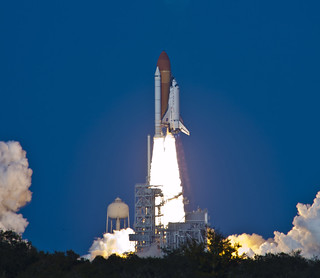
Space Shuttle Discovery STS-133


The Quintessential Orbiter
Space Shuttle Discovery, designated OV-103, stands as a monumental achievement in aerospace engineering and a testament to the ambition of the Space Shuttle program. As the third operational orbiter to join NASA's fleet, it was meticulously designed for versatility and longevity. Its operational life spanned from its maiden voyage, STS-41-D in 1984, to its final mission, STS-133 in 2011, accumulating an unparalleled 39 spaceflights.
This record signifies not only the orbiter's durability but also the program's commitment to pushing the boundaries of space exploration. Discovery's design incorporated advanced materials and systems, including approximately 25,000 thermal protection tiles, crucial for withstanding the extreme temperatures encountered during atmospheric re-entry. Its modular structure allowed for various payloads, from scientific instruments and satellites to modules for the burgeoning International Space Station.
The orbiter's ability to function as both a launch vehicle component and a glider upon return represented a paradigm shift in reusable spacecraft technology, though the complexity and cost of refurbishment remained significant challenges for the program.
Ascent, Orbit, and Descent
The Space Shuttle Discovery's journey to and from orbit was a complex ballet of physics and engineering. Liftoff was powered by the synergistic thrust of three primary propulsion systems: the orbiter's three Space Shuttle Main Engines (SSMEs) fueled by liquid hydrogen and oxygen from the massive external tank, and two five-segment Solid Rocket Boosters (SRBs). The SRBs, providing the bulk of the initial thrust, burned for approximately two minutes before separating and descending via parachute for recovery and refurbishment.
The external tank, a single-use component, was jettisoned and designed to disintegrate upon atmospheric re-entry. Once in orbit, the orbiter could maneuver using its Orbital Maneuvering System (OMS) engines and perform its mission objectives. The return to Earth involved a de-orbit burn, followed by a high-speed atmospheric re-entry where the orbiter's aerodynamic shape and thermal protection system were paramount.
The final phase was a unpowered, controlled glide to a runway landing, demanding precise piloting skills and a deep understanding of atmospheric dynamics. This intricate process underscored the technological sophistication required for routine space access.
Discovery's Enduring Impact
The significance of Space Shuttle Discovery's missions resonates deeply within the scientific community and beyond. Its role in deploying the Hubble Space Telescope was transformative, revolutionizing observational astronomy and providing humanity with breathtaking insights into the cosmos. Hubble's discoveries, facilitated by Discovery's precise orbital insertion, have reshaped our understanding of the universe's age, expansion, and composition.
Furthermore, Discovery was a critical component in the assembly of the International Space Station (ISS). Its numerous missions delivered vital modules and components, enabling the construction of this unprecedented multinational research outpost. The ISS continues to serve as a platform for cutting-edge research in microgravity, benefiting fields ranging from medicine and materials science to fundamental physics.
Beyond its scientific contributions, Discovery's resilience, particularly after the Challenger and Columbia tragedies, made it a powerful symbol of human perseverance and the unwavering pursuit of knowledge in the face of adversity, inspiring future generations of scientists and engineers.
From Conception to Museum
The development of Space Shuttle Discovery was not an act of discovery but a deliberate, multi-year engineering and manufacturing process undertaken by NASA and its contractors. As the third orbiter to be completed, following Columbia and Challenger, Discovery benefited from the lessons learned during the initial phases of the program. Its construction represented a significant investment in reusable spaceflight technology, a concept aimed at making space access more routine and economical than expendable rockets.
The orbiter's operational career was marked by its status as the oldest surviving orbiter after the loss of Challenger and Columbia. This placed an immense responsibility on Discovery to carry the torch of the shuttle program, embodying both the triumphs and the inherent risks of human spaceflight. Its final mission, STS-133, concluded in 2011, marking the end of an era for the shuttle program.
Today, preserved at the Steven F. Udvar-Hazy Center, Discovery serves as a tangible link to this pivotal period in space exploration, offering invaluable educational opportunities and a poignant reminder of human ingenuity and ambition.
The Broader Implications
The Space Shuttle program, with Discovery as a central figure, had profound implications that extended beyond its immediate missions. Technologically, it spurred advancements in materials science, computer systems, avionics, and propulsion, many of which found applications in terrestrial industries. The rigorous demands of spaceflight necessitated innovations in areas like thermal management, life support, and robotics, contributing to a broader technological ecosystem.
Societally, the shuttle program captured the public imagination, fostering a sense of national pride and global interest in space exploration. The images and discoveries transmitted back to Earth through missions like Discovery's inspired countless individuals to pursue careers in STEM fields. However, the program also highlighted the inherent risks and complexities of human spaceflight, prompting critical discussions about safety protocols, program management, and the long-term vision for space exploration.
The retirement of the shuttle fleet, including Discovery, marked a transition towards new paradigms in space access, such as commercial crew programs, building upon the foundational knowledge and experience gained over decades of shuttle operations.
Go deeper
Frequently Asked Questions
What was Space Shuttle Discovery and how many times did it fly?+
How did Discovery help launch the Hubble Space Telescope?+
Why did Discovery have so many thermal protection tiles?+
How did Discovery return to Earth after a mission?+
What role did Discovery play in building the International Space Station?+
Based on content from Wikipedia · Licensed under CC BY-SA 4.0