

Southeastern Iberian script
Images
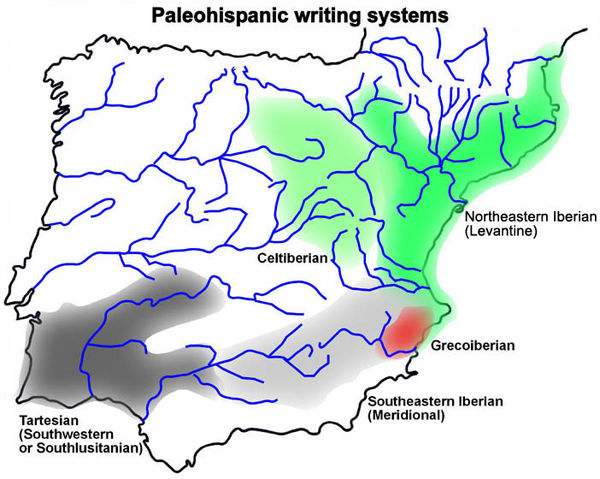
Southeastern Iberian script
The Southeastern Iberian Script
The Southeastern Iberian script, also known as Meridional Iberian, represents a crucial, albeit incompletely understood, facet of written communication in ancient Iberia. It served as one of the primary vehicles for the Iberian language, existing alongside the more prevalent Northeastern Iberian script and the Hellenistic-influenced Greco-Iberian alphabet. The relationship between the Northeastern and Southeastern variants is a subject of ongoing scholarly discussion.
While they share a common origin, they are not identical; notably, the same signs can carry different phonetic values. The prevailing hypothesis posits that the Northeastern script evolved from the Southeastern variant, positioning the latter as a foundational element in the development of Iberian writing systems. This intricate lineage underscores the dynamic nature of script evolution and the challenges in tracing precise historical connections between ancient writing forms.
Morphological Parallels and Divergences
A significant aspect of the Southeastern Iberian script is its striking morphological and phonetic similarity to the Southwestern Iberian script, employed for the enigmatic Tartessian language. This resemblance extends to the visual forms of the signs and their assigned values, suggesting a deep historical or cultural connection between these two scripts and the languages they represent. However, a key distinguishing feature lies in their internal structure.
Unlike the Northeastern Iberian script, which exhibits vocalic redundancy in its syllabic signs (where a vowel is often inherently present or explicitly marked), the Southeastern script appears to lack this characteristic. This difference is critical for epigraphers and linguists attempting to reconstruct the phonology and morphology of Iberian languages, as it points to distinct conventions in representing sound. The absence of this redundancy might indicate a more alphabetic tendency or a different syllabic structure compared to its Northeastern counterpart.
The Imperfectly Unlocked Past
The decipherment of the Southeastern Iberian script presents a formidable challenge, far more so than its Northeastern counterpart. While significant progress has been made, a substantial number of signs remain ambiguous, with scholars unable to reach a consensus on their phonetic values or meanings. This lack of definitive interpretation limits our ability to fully reconstruct the Iberian language and the cultural context in which it was used.
Historically, it was believed that the script did not differentiate between voiced and unvoiced occlusives (like 'b' vs. 'p', or 'd' vs. 't'). However, recent scholarship, such as the work by Ferrer i Jané (2010), has proposed the existence of a dual system for these sounds within the Southeastern script as well. This ongoing debate highlights the provisional nature of decipherment and the potential for new discoveries to reshape our understanding of ancient scripts.
Significance and Broader Implications for Historical Linguistics
The Southeastern Iberian script holds immense significance for historical linguistics and the study of ancient Mediterranean cultures. Its decipherment, even in its partial state, provides invaluable data for understanding the Iberian language family and its place within the broader linguistic landscape of pre-Roman Europe. The script's relationship with the Southwestern script also opens avenues for comparative linguistic analysis, potentially shedding light on the connections between different ancient peoples of the peninsula.
Furthermore, the ongoing efforts to interpret its symbols contribute to the methodology of decipherment itself, offering case studies in how scholars approach unknown writing systems. The script serves as a tangible link to the past, allowing us to engage directly with the written records of a civilization whose full story is still emerging from the shadows of history.
See also
Frequently Asked Questions
What is the Southeast Iberian script?+
How is the Southeast Iberian script different from the Northeastern Iberian script?+
Why do scholars think the Northeastern script came from the Southeast script?+
What does the Southeast Iberian script look like?+
Is the Southeast Iberian script fully understood?+
Based on content from Wikipedia · Licensed under CC BY-SA 4.0