

The Very Bottom of the World!
Images
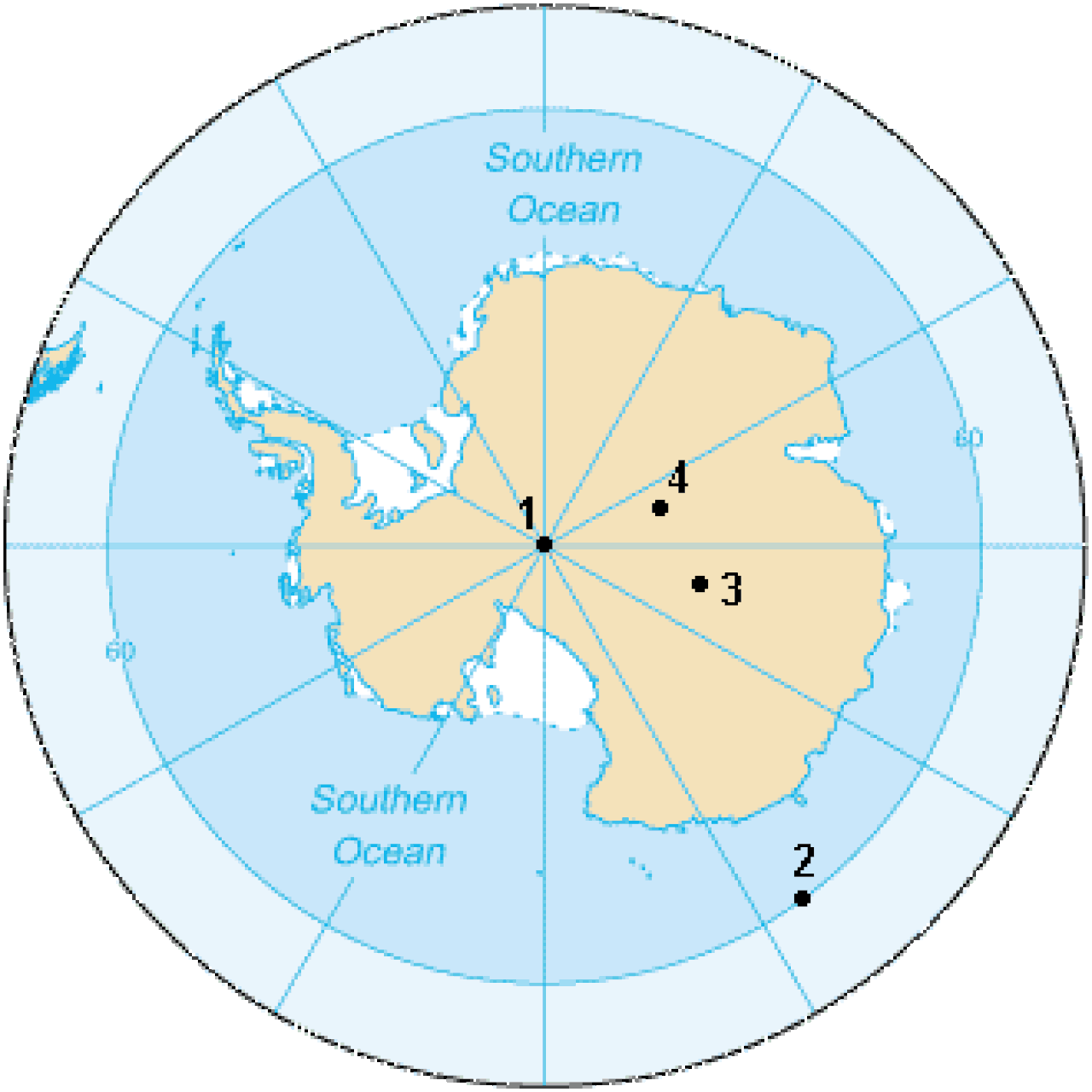
South Pole
Defining the Terrestrial South Pole
The Geographic South Pole, also known as the Terrestrial South Pole, represents a singular point on Earth's surface: the intersection of the planet's axis of rotation with the Southern Hemisphere. This definition establishes it as the southernmost point on the globe, diametrically opposite the North Pole. Its significance extends to cartography and navigation, as it defines geodetic latitude 90° South.
All lines of longitude converge here, rendering traditional longitude measurements arbitrary; any degree value can be assigned. This convergence creates a unique directional reality where every horizontal direction points north. The absence of a defined time zone means that local time is often adopted based on logistical needs, typically aligning with the time zone of the primary supply route, such as McMurdo Station's time.
The Dynamic Ice Sheet and its Implications
The South Pole is situated atop a colossal ice sheet in Antarctica, a continental ice mass with an average thickness of approximately 3.2 kilometers (2.0 miles). This immense volume of ice is not static; it is a dynamic entity that slowly flows and deforms under its own weight. This glacial movement has profound implications for the precise location of the geographic pole.
Consequently, the physical marker designating the South Pole must be relocated annually, typically by several meters, to maintain accuracy relative to the Earth's rotational axis. Furthermore, the extreme cold, with average annual temperatures far below freezing, prevents the accumulation of meltwater. Instead, snow continuously accumulates, gradually burying structures and requiring ongoing efforts to clear access and maintain facilities.
A Legacy of Exploration and a Hub for Science
The history of the South Pole is intrinsically linked to the heroic age of Antarctic exploration, with figures like Roald Amundsen and Robert Falcon Scott famously racing to be the first to reach it. The establishment of the Amundsen–Scott South Pole Station in 1956 marked a new era of sustained human presence and scientific inquiry. This United States facility has been continuously staffed since its inception, serving as a critical base for research across numerous disciplines.
Its location provides unparalleled opportunities for astronomy and astrophysics due to the clear, dry atmosphere and long periods of darkness. It also facilitates studies in atmospheric physics, seismology, and the analysis of ice cores, which provide invaluable data about Earth's past climate.
Navigating the Pole
Human presence at the South Pole is marked by distinct points of reference. The official geographic marker is moved annually to account for the ice sheet's drift. Adjacent to this, the Ceremonial South Pole offers a more permanent and visually symbolic representation, typically adorned with flags of nations that have signed the Antarctic Treaty. This area serves as a focal point for visitors and a testament to international cooperation in the region.
The unique temporal landscape of the South Pole, devoid of a mandated time zone, highlights its isolation and the practical adaptations required for life and work in such an extreme environment. The choice of time often reflects the operational rhythms of the scientific community and logistical support.
Scientific Significance and Future Outlook
The South Pole's extreme conditions offer unique advantages for scientific research. Its high altitude, dry air, and lack of light pollution make it an ideal location for astronomical observations, particularly for telescopes like the South Pole Telescope (SPT) and the BICEP Array, which study the cosmic microwave background radiation. The ice itself acts as a natural archive, preserving layers of snow that contain historical climate data, allowing scientists to reconstruct past atmospheric conditions.
Furthermore, the study of neutrinos, elusive subatomic particles, is conducted using detectors like IceCube, which utilizes the Antarctic ice sheet as its detection medium. The ongoing operation and potential expansion of research facilities at the South Pole underscore its enduring importance for understanding our planet and the universe.
Go deeper
Frequently Asked Questions
What is the South Pole and why is it special?+
Why do the directions at the South Pole all point north?+
How do scientists keep the South Pole marker in the right place?+
Why is there no time zone at the South Pole?+
What kinds of science are done at the South Pole?+
Based on content from Wikipedia · Licensed under CC BY-SA 4.0