

Solar eclipse
Images
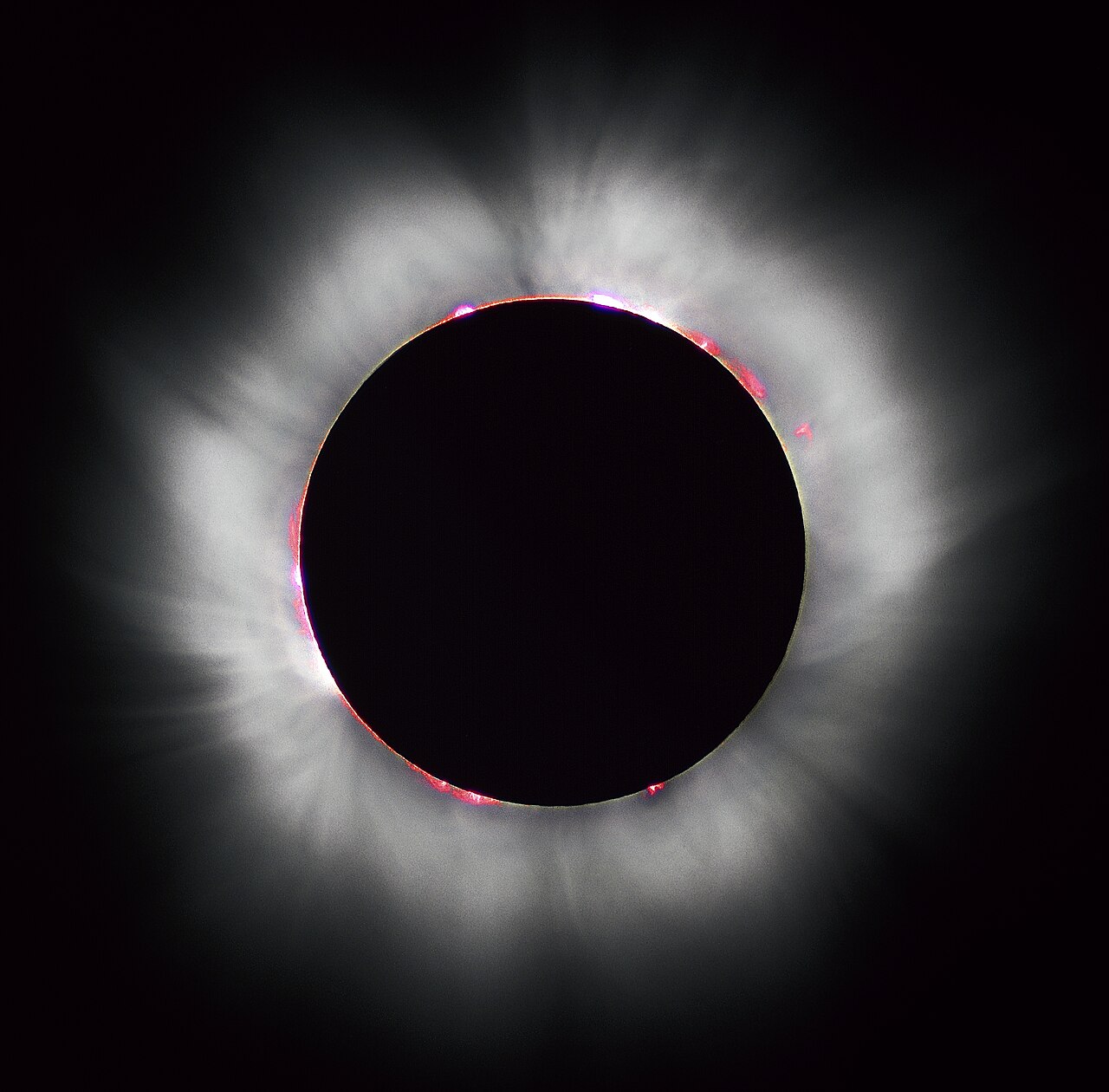
Solar eclipse


Orbital Dynamics and the Rarity of Totality
The occurrence of a solar eclipse is a fascinating interplay of orbital mechanics. Earth orbits the Sun, and the Moon orbits Earth. However, the Moon's orbit is tilted by approximately 5.1 degrees relative to Earth's orbital plane (the ecliptic). Consequently, most new moons pass above or below the Sun, resulting in no eclipse.
A solar eclipse can only happen when a new moon occurs near one of the two points where the Moon's orbit intersects the ecliptic, known as the orbital nodes. Even then, the alignment must be precise enough for the Moon's shadow to reach Earth. The path of totality, where the umbra sweeps across the Earth's surface, is a narrow track, typically only about 100 miles wide.
This geometric constraint makes total solar eclipses a rare and localized event for any given observer, contributing to their sense of wonder and the historical significance attributed to them.
Historical Perspectives and the Dawn of Predictability
Throughout human history, solar eclipses have been potent symbols, often interpreted through the lens of mythology and superstition. Ancient cultures, lacking the framework of modern astronomy, frequently viewed these events as harbingers of doom or divine pronouncements. The Babylonians, Chinese, and Greeks, however, began to observe and record eclipses, noticing patterns that hinted at predictability.
The development of sophisticated calendars and astronomical models, particularly by the Greeks, allowed for the prediction of eclipses with increasing accuracy. This shift from fear to understanding marked a crucial step in the scientific revolution, demonstrating humanity's growing capacity to decipher the cosmos through observation and mathematical reasoning. The ability to predict these events fostered a sense of control and intellectual mastery over the celestial realm.
Scientific Exploitation
Solar eclipses offer a unique and invaluable natural laboratory for studying the Sun. The most significant scientific benefit of a total solar eclipse is the opportunity to observe and analyze the Sun's corona. This extremely hot, tenuous outer atmosphere, typically obscured by the Sun's brilliant photosphere, becomes visible as a faint, ethereal halo.
During eclipses, scientists can measure the corona's temperature, density, and magnetic field, providing crucial data for understanding solar flares, coronal mass ejections (CMEs), and the solar wind. These phenomena have profound impacts on Earth's magnetosphere, technological systems (like satellites and power grids), and even long-term climate. Historically, observations made during eclipses, such as the confirmation of Einstein's theory of general relativity during the 1919 eclipse, have been pivotal in advancing our understanding of physics.
Types of Solar Eclipses and Their Characteristics
Solar eclipses are categorized based on the degree to which the Sun is obscured and the apparent sizes of the Sun and Moon. A total solar eclipse occurs when the Moon completely covers the Sun, revealing the corona. This happens when the Moon is relatively close to Earth in its elliptical orbit, making its apparent size large enough to obscure the Sun entirely.
A partial solar eclipse occurs when the Moon only covers a portion of the Sun. This happens when the observer is within the penumbra of the Moon's shadow. An annular solar eclipse occurs when the Moon is farther from Earth in its orbit, making its apparent size smaller than the Sun's.
In this case, the Moon appears as a dark disk in front of the Sun, leaving a bright ring, or 'annulus,' of sunlight visible around its edges. A rare hybrid solar eclipse transitions between annular and total phases along its path.
Go deeper
Frequently Asked Questions
What is a solar eclipse?+
Why does a solar eclipse only happen sometimes?+
Where does the path of totality go?+
How do scientists use solar eclipses?+
What is the difference between a total, partial, and annular eclipse?+
Based on content from Wikipedia · Licensed under CC BY-SA 4.0