

Soil liquefaction
Images
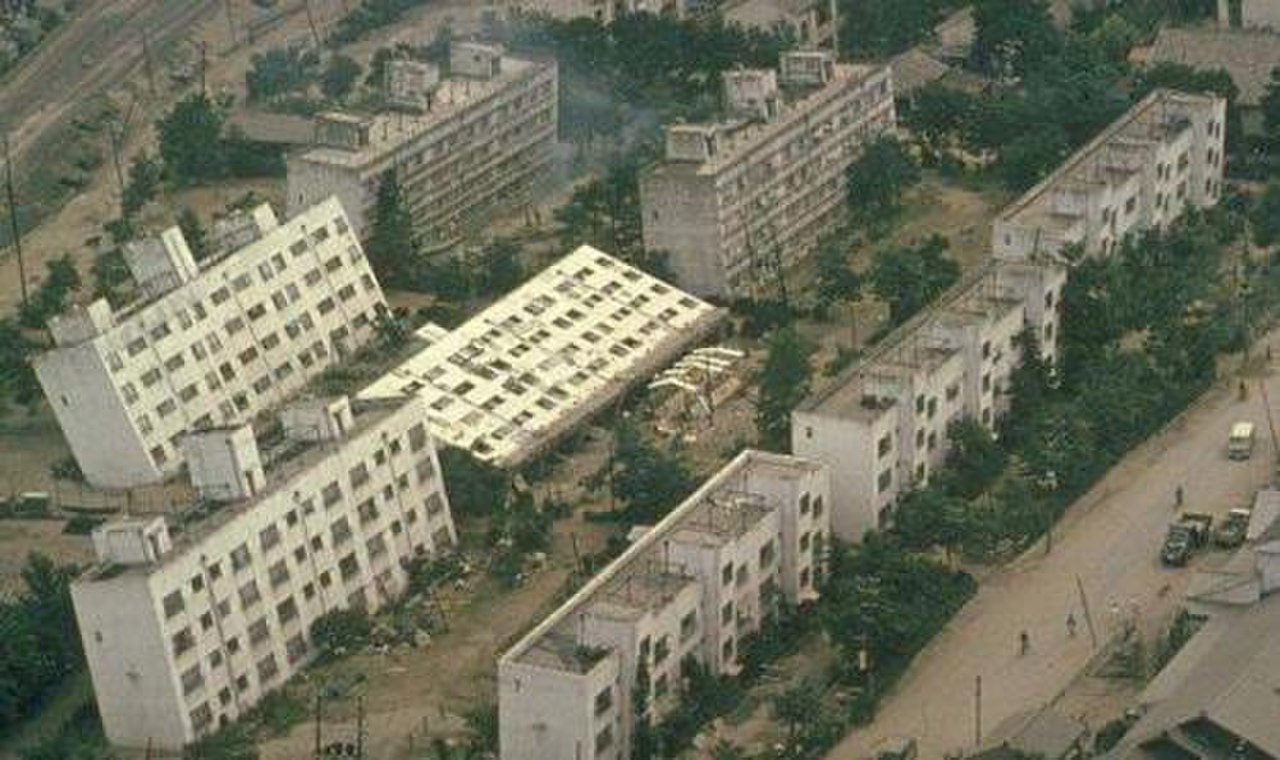
Soil liquefaction
The Geotechnical Genesis of Ground Failure
Soil liquefaction is a complex geomechanical phenomenon occurring when saturated or partially saturated cohesionless soils experience a substantial loss of shear strength and stiffness in response to applied stress. This transformation is most prevalent in loose, granular soils like sands and silts, characterized by low relative density and high water content. The critical factor is the pore water pressure.
During seismic shaking, the rapid cyclic loading causes the soil particles to attempt to rearrange into a denser configuration. In saturated conditions, the water within the pore spaces cannot dissipate quickly enough to accommodate this volume reduction. Consequently, the pore water pressure increases, reducing the effective stress between soil grains.
Effective stress is the force transmitted through the soil skeleton, responsible for its strength and ability to support loads. When pore water pressure rises to equal the total overburden pressure, the effective stress drops to near zero. At this point, the soil loses its intergranular contact forces and behaves as a viscous fluid, a state termed liquefaction.
This can lead to phenomena such as flow failures, lateral spreading, ground settlement, and the ejection of water and sediment (sand boils) onto the ground surface, posing severe risks to infrastructure.
A Chronicle of Catastrophe
The destructive potential of soil liquefaction has been recognized for decades, with early observations documented following dam failures. Allen Hazen's description of the 1918 Calaveras Dam failure, likening the soil behavior to quicksand due to high pore water pressure, marked an early understanding of the mechanism. However, it was the devastating 1964 Alaska earthquake and the concurrent Niigata earthquake in Japan that brought soil liquefaction to the forefront of geotechnical engineering concerns.
These events provided extensive field evidence of widespread liquefaction and its profound impact on urban infrastructure, including the collapse of buildings and bridges. Subsequent major earthquakes, such as the 1989 Loma Prieta earthquake in San Francisco's Marina District and the 1995 Great Hanshin earthquake in Kobe, Japan, further reinforced the critical need to consider liquefaction in seismic design. More recent events, like the 2010-2011 Canterbury earthquakes in New Zealand and the 2018 Central Sulawesi earthquake in Indonesia, where entire residential areas were inundated by liquefied soil and mud, underscore the persistent and devastating threat that liquefaction poses to modern communities and highlight ongoing challenges in mitigation and preparedness.
The Multifaceted Impact
The significance of soil liquefaction extends far beyond mere geotechnical curiosity; it is a primary driver of seismic hazard and a critical consideration in urban planning and infrastructure resilience. Liquefaction-induced ground deformation can lead to differential settlement, causing buildings to tilt or collapse, and can sever underground utilities like water, gas, and sewer lines, crippling essential services. Bridges and their abutments are particularly vulnerable, as liquefaction can undermine their foundations, leading to catastrophic failure.
The phenomenon also contributes to lateral spreading, where large blocks of land can move horizontally, damaging structures and infrastructure across significant distances. In densely populated urban areas situated on susceptible soil deposits, the potential for widespread damage and economic loss is immense. Consequently, building codes in many seismically active regions mandate liquefaction hazard assessments for new developments.
Engineers employ various techniques, from ground improvement methods like compaction and deep soil mixing to designing deep foundations that bypass liquefiable layers, to mitigate these risks. Understanding and addressing liquefaction is paramount for building resilient cities capable of withstanding seismic events.
The Physics of Flow
The fundamental physics governing soil liquefaction revolves around the concept of effective stress and the dynamic behavior of pore water pressure under cyclic loading. In a saturated granular soil, the total stress is the sum of the effective stress and the pore water pressure. The effective stress is what provides the soil skeleton with its strength and stiffness, dictating its ability to resist deformation and support loads.
During seismic excitation, the cyclic shear stresses imposed on the soil cause particles to attempt to rearrange into a denser packing. In undrained conditions, which are typical during rapid seismic events, the water trapped within the pore spaces acts as a fluid cushion. As the soil attempts to densify, it tries to reduce its volume, but the incompressible water prevents this.
This resistance to volume change leads to a rapid increase in pore water pressure. If the cyclic loading is sufficiently intense and prolonged, the pore water pressure can rise to a level where it equals the total overburden pressure. At this critical juncture, the effective stress approaches zero.
The soil particles lose their interlocking and frictional resistance, and the soil mass loses its ability to transfer shear stresses, behaving as a fluid. This state of near-zero effective stress is the hallmark of liquefaction, enabling the dramatic ground deformations observed.
Case Studies in Cataclysm
The historical record is replete with stark examples of soil liquefaction's destructive power. The 1964 Niigata earthquake saw entire apartment buildings tilt and sink into liquefied ground, with some structures appearing to float. In San Francisco during the 1989 Loma Prieta earthquake, the Marina District, built on reclaimed land, experienced extensive liquefaction, leading to widespread structural damage, lateral spreading, and the eruption of sand boils.
The 2010 and 2011 Canterbury earthquakes in New Zealand inflicted immense damage on Christchurch, with liquefaction being a major contributor to the destruction of residential properties and critical infrastructure, necessitating extensive and costly ground remediation efforts. Perhaps one of the most visually dramatic and tragic instances occurred in 2018 in Central Sulawesi, Indonesia, where a magnitude 7.5 earthquake triggered massive liquefaction that buried the suburbs of Balaroa and Petobo under several meters of mud, transforming them into a landscape of devastation and leading to significant loss of life.
These case studies consistently demonstrate the vulnerability of loose, saturated soils and underscore the imperative for rigorous liquefaction assessment and mitigation strategies in seismic hazard zones.
See also
Frequently Asked Questions
What is soil liquefaction?+
Why does soil become like jelly during an earthquake?+
How can soil liquefaction hurt buildings and roads?+
When did people first learn about soil liquefaction?+
What can people do to protect against soil liquefaction?+
Based on content from Wikipedia · Licensed under CC BY-SA 4.0