

Smooth newt
Images

Тритон обыкновенный / Lissotriton vulgaris / Smooth newt / Малкият гребенест тритон (Обикновен тритон) / Teichmolch




Morphological Plasticity and Habitat Adaptation
The smooth newt (Lissotriton vulgaris) exemplifies remarkable phenotypic plasticity, particularly in its cutaneous physiology. On terrestrial excursions, its skin adopts a dry, velvety texture, likely an adaptation to reduce evaporative water loss and provide camouflage within leaf litter and soil. This contrasts sharply with its aquatic phase, where the skin becomes smooth and moist, facilitating efficient locomotion and gas exchange in water.
Males exhibit pronounced sexual dimorphism during the breeding season, developing a conspicuous dorsal crest and more vibrant coloration, a visual signal for mate attraction. This seasonal dimorphism underscores the species' ability to adjust its morphology in response to environmental cues and reproductive demands. Their adaptability allows them to inhabit a wide array of environments, from dense woodlands and agricultural field edges to urban parks and gardens, provided suitable breeding sites are accessible.
This ecological flexibility is a cornerstone of their widespread distribution across Europe and western Asia.
Nocturnal Predation and Trophic Dynamics
As a predominantly nocturnal predator, the smooth newt plays a significant role in regulating invertebrate populations within its habitat. Its diet is diverse, comprising a wide range of small arthropods, annelids, and other invertebrates encountered during its terrestrial foraging. This opportunistic feeding strategy allows it to exploit available resources effectively.
However, the smooth newt occupies a precarious position in the food web. It serves as a crucial prey item for various predators, including fish (especially in aquatic environments), various avian species, and snakes. The introduction of non-native predatory fish into their breeding ponds poses a particularly acute threat, disrupting the delicate balance of predator-prey dynamics and potentially leading to localized population declines.
Understanding these trophic interactions is vital for assessing the species' ecological impact and vulnerability.
Complex Reproductive Strategies and Ontogenetic Shifts
The reproductive cycle of the smooth newt is characterized by intricate courtship rituals and a distinct ontogenetic shift. During the spring and summer breeding season, males perform elaborate underwater displays, involving tail-fanning and body undulations, to attract females. Following successful courtship, females meticulously deposit individual eggs, typically on submerged aquatic vegetation, often folding leaves over them for protection.
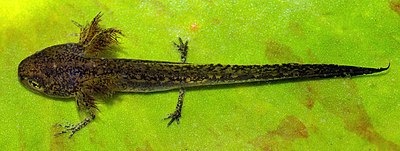
The embryonic development period lasts approximately 10 to 20 days, after which aquatic larvae hatch. These larvae possess external gills and undergo a significant metamorphosis over roughly three months, developing lungs and limbs while their gills recede. Upon completion of metamorphosis, they emerge as terrestrial juveniles, termed efts, marking their transition to a semi-terrestrial existence.
They typically reach sexual maturity within two to three years, initiating the cycle anew.
Conservation Status and Anthropogenic Pressures
The smooth newt is currently classified as 'Least Concern' by the IUCN due to its extensive range and large population size. However, this broad assessment masks significant localized threats. Habitat loss and fragmentation, driven by agricultural intensification, urbanization, and infrastructure development, are primary concerns, diminishing the availability of both terrestrial refugia and essential breeding ponds.
Furthermore, the introduction of invasive species, particularly predatory fish and signal crayfish, can have devastating impacts on newt populations by preying on eggs, larvae, and even adults. In response to these pressures, the smooth newt is afforded legal protection under international agreements such as the Berne Convention, highlighting the recognized need for its conservation across Europe. Effective conservation strategies must address habitat restoration, pond management, and the control of invasive species to ensure the long-term viability of this adaptable amphibian.
Taxonomic Relationships and Evolutionary Context
The taxonomic history of the smooth newt is complex, reflecting ongoing research into amphibian phylogeny. Originally described by Carl Linnaeus, it has undergone several reclassifications. The current genus, Lissotriton, was established to accommodate species previously placed in Triturus.
The smooth newt forms part of a species complex, alongside closely related taxa such as the Carpathian newt and formerly recognized subspecies that are now elevated to distinct species (e.g., L. kosswigi, L. schmidtleri). Genetic and morphological evidence supports these distinctions, although hybridization can still occur between some members of the complex. This intricate evolutionary history underscores the dynamic nature of species diversification and the importance of molecular data in refining our understanding of biodiversity.
See also
Frequently Asked Questions
What is a smooth newt?+
How does a smooth newt's skin change between water and land?+
Why do male smooth newts have a crest and bright colors during the breeding season?+
Where do smooth newts live and what do they eat?+
How do smooth newts reproduce and grow from eggs to adults?+
Based on content from Wikipedia · Licensed under CC BY-SA 4.0