

Slave and Free States: A Tale of Two Americas
Images

Dick Dowling Statue, Hermann Park, Houston, Texas 0429101150BW


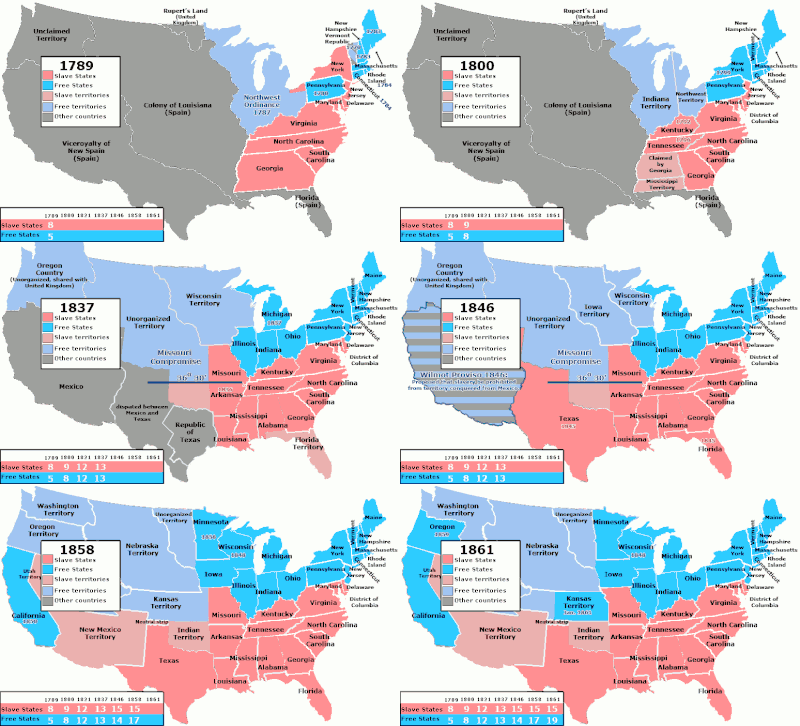


The Genesis of Division
The dichotomy of slave and free states was not a mere administrative or geographic split; it represented fundamentally divergent visions for the nascent United States. In the South, the institution of slavery became deeply interwoven with the region's economic structure, social hierarchy, and political identity. The profitability of cash crops like cotton, fueled by the forced labor of millions, created an economic system that many in the South saw as essential to their prosperity and way of life.
Conversely, the North, while not immune to racism and economic exploitation, developed economies less dependent on chattel slavery. Industrialization, wage labor, and a growing moral opposition to slavery, articulated by abolitionist movements, fostered a distinct regional identity. This ideological clash manifested in constant political friction, particularly concerning the expansion of slavery into new territories acquired through westward expansion.
Each new state admitted to the Union threatened to upset the delicate balance of power in Congress, intensifying sectional tensions and making compromise increasingly difficult.
Political Maneuvering and Failed Compromises
The U.S. Constitution itself contained compromises that implicitly acknowledged and protected slavery, such as the Three-Fifths Compromise, which counted enslaved people as three-fifths of a person for representation purposes, thereby increasing the political power of slaveholding states. As the nation grew, maintaining this precarious balance became a central political objective. Landmark legislative efforts like the Missouri Compromise of 1820, the Compromise of 1850, and the Kansas-Nebraska Act of 1854 were attempts to manage the issue by admitting states in pairs (one slave, one free) or by allowing territories to decide the slavery question through popular sovereignty.
However, these compromises often proved temporary and even inflammatory, as seen in the violence that erupted in 'Bleeding Kansas.' The Dred Scott decision by the Supreme Court in 1857 further exacerbated the crisis, ruling that African Americans were not citizens and that Congress could not prohibit slavery in the territories, effectively nullifying previous compromises and enraging abolitionists.
The Inevitable Collision
The persistent conflict between slave and free states created an irreconcilable divide that ultimately led to the American Civil War. The election of Abraham Lincoln in 1860, representing the Republican Party which opposed the expansion of slavery, was perceived by Southern states as an existential threat to their institution. Believing their way of life and economic system were under direct assault, eleven Southern states seceded from the Union, forming the Confederate States of America.
The ensuing Civil War (1861-1865) was a brutal and transformative conflict, costing hundreds of thousands of lives. The war's outcome fundamentally reshaped the United States, leading to the abolition of slavery through the 13th Amendment and ushering in a new era of Reconstruction, though the struggle for racial equality would continue for generations.
Socioeconomic Realities and Resistance
The lived experiences within slave and free states presented stark contrasts. In slave states, society was rigidly stratified, with enslavers at the apex and enslaved people at the bottom, subjected to brutal conditions, constant surveillance, and the perpetual threat of family separation. Resistance took many forms, from subtle acts of defiance and sabotage to organized revolts and the perilous journeys undertaken via the Underground Railroad. In free states, while legal slavery was absent, racial prejudice was pervasive, limiting opportunities for Black Americans and often requiring them to fight for basic civil rights.
The Fugitive Slave Act of 1850 was a particularly contentious piece of legislation that extended federal power into free states, compelling citizens to assist in the capture of escaped enslaved people and intensifying Northern opposition to slavery by making its reach undeniable.
Legacy and Modern Relevance
The legacy of the slave and free state division continues to resonate in contemporary American society. The economic disparities, racial injustices, and regional identities forged during this period have had lasting impacts. Debates over states' rights, federal power, and systemic inequality can often be traced back to the fundamental disagreements that characterized the antebellum United States.
Understanding this historical division is crucial for comprehending the ongoing struggles for civil rights, social justice, and the complex tapestry of American identity. It serves as a powerful reminder of how deeply ingrained institutions and ideologies can shape a nation's trajectory and the enduring fight for a more equitable future.
See also
Frequently Asked Questions
What is the difference between slave states and free states?+
Why did the U.S. have the Three-Fifths Compromise?+
How did the Missouri Compromise try to solve the slavery problem?+
What happened in Bleeding Kansas?+
Why did the Civil War happen?+
Based on content from Wikipedia · Licensed under CC BY-SA 4.0