

Ski flying
Images
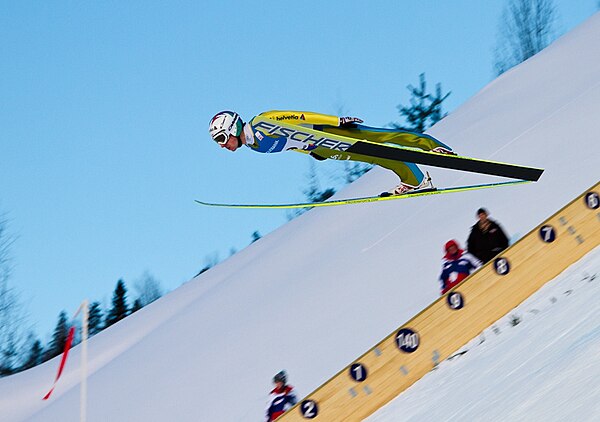
Ski flying
The Pinnacle of Ski Jumping
Ski flying represents the apex of ski jumping disciplines, distinguished by its pursuit of extreme distances. While sharing fundamental principles with ski jumping-namely, an athlete descending a ramp, launching into the air, and gliding-ski flying is engineered for significantly greater flight lengths. This is made possible by specialized 'flying hills,' which are considerably larger and steeper than standard ski jumping hills.
These structures are meticulously designed to enable athletes to achieve higher speeds on the in-run and generate the necessary lift for flights that can extend up to 66% further than those in regular ski jumping. The sport demands an exceptional level of aerodynamic proficiency, where athletes must precisely control their body position and ski configuration to harness air currents effectively. The increased speed and flight duration inherently introduce a greater element of risk, demanding peak physical conditioning, mental fortitude, and advanced technical skill from competitors.
It is a discipline where the margin for error is minuscule, and the rewards are spectacular displays of human flight.
A Legacy Forged in Altitude
The genesis of ski flying can be traced to the 1930s, emerging from a collective ambition within the ski jumping community to explore the outer limits of jump distances. The pivotal moment arrived with the construction of the first dedicated ski flying hill in Yugoslavia in 1934. This pioneering effort catalyzed further development, leading to the establishment of similar colossal structures in Germany and Austria by the 1950s. Norway and the United States followed suit in subsequent decades, creating a network of these specialized venues.
The period from the 1960s to the 1980s witnessed a vibrant, albeit friendly, rivalry among these European sites, fostering an environment of continuous innovation. This era was marked by regular world record progressions, significant hill upgrades, and the refinement of flying techniques aimed at maximizing distance. The formal recognition of ski flying as a distinct championship event came with the inaugural FIS Ski Flying World Championships in 1972.
Today, the sport's heartland remains in Norway and Slovenia, countries that have consistently produced world-class athletes and hosted record-breaking performances since the mid-1980s, cementing ski flying's unique historical narrative.
The Physics of Flight
The mechanics of ski flying are a sophisticated interplay of physics, biomechanics, and environmental factors. Athletes initiate their flight by accelerating down a steep in-run, reaching speeds often exceeding 100 km/h (62 mph). The takeoff is a critical phase, requiring explosive power and precise timing to transition from vertical descent to horizontal propulsion.
Once airborne, the flyer adopts a highly optimized aerodynamic posture. The skis are typically held in a wide 'V' formation, increasing the surface area exposed to the airflow, which generates significant lift. The body is leaned forward, minimizing drag and further enhancing the lift-to-drag ratio.
This controlled glide phase is where the athlete's skill in manipulating air currents is paramount. Judges evaluate not only the distance achieved but also the style, which includes the stability of the flight path, body posture, and the execution of a safe and controlled landing on the steeply sloped outrun. The landing requires immense strength and technique to dissipate the kinetic energy accumulated during the flight, often at speeds that would be perilous on flatter terrain.
The Allure of the Extreme
Ski flying holds a unique and compelling position within the landscape of winter sports, often lauded as the 'Super Bowl of winter sports' due to its inherent drama and spectacle. Its significance stems from several factors: the sheer, awe-inspiring distances achieved by athletes, which push the perceived limits of human capability; the heightened element of danger that adds a palpable tension to every competition; and the exclusivity of the sport, with only a handful of purpose-built hills existing globally.
These factors combine to create an event that captivates audiences and commands respect within the athletic community. The sport's appeal is amplified by its direct connection to world records, making each competition a potential historical moment. Furthermore, ski flying serves as a powerful showcase for technological advancements in equipment and training methodologies, as well as the psychological resilience required to perform under extreme conditions.
It represents a pure, unadulterated test of an athlete's courage, skill, and mastery over the forces of nature.
See also
Frequently Asked Questions
What is ski flying?+
How do ski flying hills differ from regular ski jumping hills?+
Why do skiers need to control their body position in ski flying?+
When did ski flying start and where are the biggest hills now?+
What makes ski flying risky?+
Based on content from Wikipedia · Licensed under CC BY-SA 4.0