

Sino-Soviet Split: When Two Big Friends Stopped Being Friends
Images

The Iraqi MiG F-7A kill (1/17/91) of Cdr Mark Fox during Desert Storm in a McDonnell Douglas (now Boeing) F/A-18C-25-MC 'Hornet' (BuNo 163508) of VFA-81


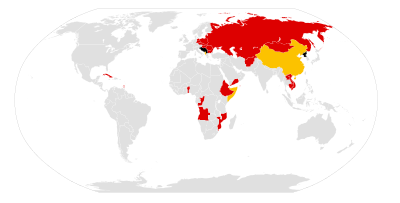


The Unraveling of the Communist Bloc
The Sino-Soviet split, a gradual deterioration of relations between the People's Republic of China (PRC) and the Union of Soviet Socialist Republics (USSR) from the late 1950s through the 1960s, represented a profound ideological and geopolitical rupture. At its core, the split stemmed from divergent interpretations and applications of Marxism-Leninism, heavily influenced by their distinct geopolitical contexts during the Cold War.
The Soviet Union, under Nikita Khrushchev, initiated de-Stalinization in 1956, denouncing Stalin's personality cult and advocating for 'peaceful coexistence' with the Western Bloc. This policy was viewed with deep suspicion by Chinese leadership, particularly Mao Zedong, who perceived it as a betrayal of revolutionary fervor and a capitulation to capitalist imperialism, labeling it 'revisionism.' China, having recently undergone its own revolution and facing different external pressures, favored a more confrontational approach towards the West.
This ideological chasm widened as debates over the interpretation of orthodox Marxism evolved into specific disputes over Soviet foreign policy. The PRC's rejection of peaceful coexistence and its embrace of a more belligerent stance towards the West marked a critical divergence, signaling the fracturing of the seemingly monolithic communist alliance and setting the stage for intense rivalry.
The Competition for Global Communist Leadership and Spheres of Influence
Beyond abstract ideological differences, the Sino-Soviet split was a fierce competition for leadership of the global communist movement. Both nations sought to position themselves as the vanguard of international revolution, attracting the allegiance of communist parties worldwide. The Soviet Union, as the established superpower, expected deference, but China, emboldened by its revolutionary success and unique revolutionary model, challenged this hierarchy. Beijing resented Moscow's growing ties with India, particularly given the Sino-Indian border dispute, viewing it as a strategic affront.
Conversely, Moscow feared China's perceived recklessness regarding nuclear warfare, a concern amplified by the potential for catastrophic global consequences. By 1961, the ideological differences had become so intractable that the PRC formally denounced Soviet communism as the work of 'revisionist traitors' and labeled the USSR 'social imperialist.' This competition for influence meant that communist parties and nations had to navigate a complex landscape, choosing between Soviet or Chinese patronage for political advice, financial aid, and military assistance, thereby fragmenting the Eastern Bloc and creating new power dynamics.
From Border Skirmishes to Nuclear Brinkmanship
The Sino-Soviet split was not merely a war of words; it escalated to the brink of armed conflict. Border disputes, particularly the contentious Sino-Indian border issue that strained relations between China and the USSR, added a tangible layer of animosity. The most dramatic manifestation of this tension occurred during the Zhenbao Island Incident in 1969, a series of armed clashes along the Ussuri River.
This confrontation brought the two nuclear-armed powers perilously close to war. Reports indicate that the Soviet Union seriously considered launching a large-scale nuclear strike against China, a terrifying prospect that led to the evacuation of Chinese leadership, including Mao Zedong, from Beijing. While full-scale war was averted through diplomatic channels, the incident underscored the extreme hostility and the dangerous potential for escalation.
This period of intense confrontation solidified the division and demonstrated the fragility of the communist alliance when faced with competing national interests and deep-seated mistrust.
Reshaping the Global Order
The Sino-Soviet split fundamentally altered the geopolitical landscape of the Cold War, transforming it from a bipolar struggle between the United States and the Soviet Union into a tri-polar system involving the PRC, USSR, and USA. This rivalry provided Mao Zedong with the strategic opening to pursue Sino-American rapprochement, a move that culminated in President Richard Nixon's historic visit to China in 1972. This development was a masterstroke of Realpolitik, allowing China to leverage its relationship with the US to counter Soviet influence and create an anti-Soviet front.
The emergence of 'triangular diplomacy' and 'linkage' as key foreign policy concepts in the West highlighted this new dynamic. Like the earlier Tito-Stalin split, the Sino-Soviet rift significantly weakened the notion of monolithic communism, revealing the internal ideological fissures and nationalistic ambitions within the communist world. Despite their rivalry, both China and the USSR continued to support North Vietnam during the Vietnam War, illustrating the complex interplay of competition and cooperation in this new tri-polar era, which Maoists connected to the 'Three Worlds Theory'.
See also
Based on content from Wikipedia · Licensed under CC BY-SA 4.0