

Simple Harmonic Motion: The Wiggle and Wobble Science!
Images
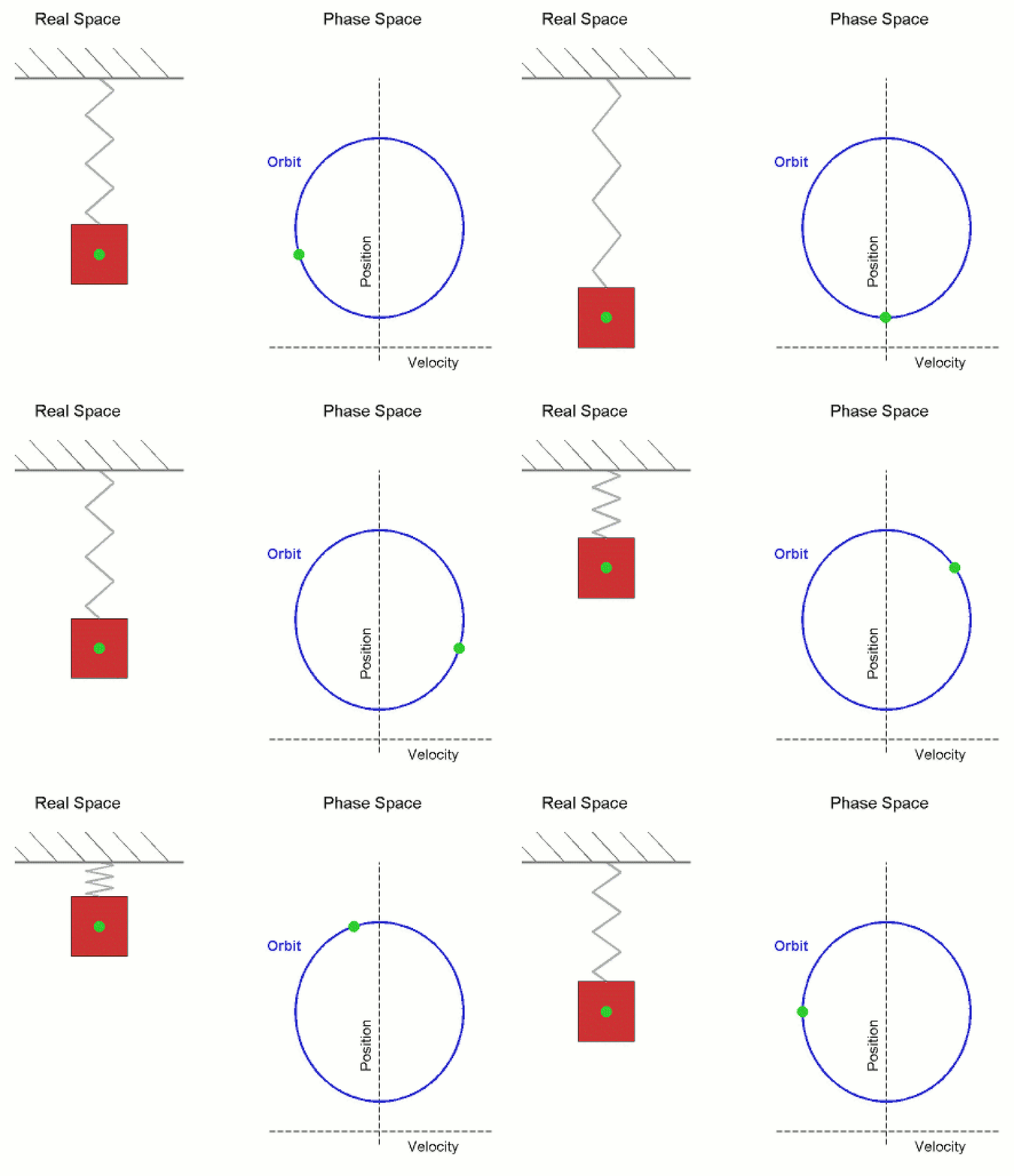
Simple harmonic motion


The Essence of Oscillatory Behavior
Simple harmonic motion (SHM) is a fundamental concept in physics describing a specific type of periodic motion. It occurs when an object is displaced from its equilibrium position, and a restoring force acts upon it, proportional to the displacement and directed towards the equilibrium. Mathematically, this relationship is often expressed by Hooke's Law in the form F = -kx, where F is the restoring force, k is a positive constant (the spring constant or equivalent), and x is the displacement from equilibrium.
The negative sign indicates that the force always opposes the displacement, driving the object back towards its stable equilibrium point. This continuous interplay between the restoring force and the object's inertia results in a smooth, sinusoidal oscillation.
Historical Trajectory
The study of SHM has a rich history, beginning with empirical observations. Galileo Galilei's meticulous study of pendulums in the late 16th and early 17th centuries was pivotal. He observed that the period of a pendulum's swing was largely independent of its amplitude, a key characteristic of SHM. This insight, though initially qualitative, laid the groundwork for quantitative analysis.
Later, Isaac Newton's formulation of his laws of motion and universal gravitation provided the theoretical framework to understand the forces driving such oscillations. The development of calculus by Newton and Leibniz was instrumental in deriving the differential equations that precisely describe SHM, transforming it from an observed phenomenon into a rigorously defined physical model.
The Ubiquitous Significance of SHM
The significance of simple harmonic motion cannot be overstated; it serves as a foundational model for a vast array of physical phenomena. It is the basis for understanding wave mechanics, including sound waves, light waves, and electromagnetic waves, all of which involve oscillatory behavior. In mechanical systems, SHM governs the vibration of springs, the oscillation of masses, and the behavior of musical instruments.
In atomic and molecular physics, the vibrations of atoms within molecules can often be approximated as SHM, crucial for understanding chemical bonding and spectroscopy. Furthermore, the concept of resonance, where a system's response is amplified when driven at its natural frequency (often determined by SHM), is vital in engineering for designing structures, circuits, and systems that either avoid or exploit such amplification.
The Dynamics
The motion of an object undergoing SHM can be described by a second-order linear homogeneous differential equation: d²x/dt² + ω²x = 0, where x is the displacement, t is time, and ω (omega) is the angular frequency (ω = √(k/m), where m is the mass). The general solution to this equation is x(t) = A cos(ωt + φ), where A is the amplitude (maximum displacement) and φ (phi) is the phase constant, determined by initial conditions. Energy in an SHM system continuously transforms between kinetic energy (due to motion) and potential energy (stored in the restoring force, e.g., in a spring).
At equilibrium, kinetic energy is maximum and potential energy is zero. At maximum displacement, kinetic energy is zero and potential energy is maximum. The total mechanical energy remains constant in an ideal system without damping.
Applications and Extensions
Simple harmonic motion finds practical application across numerous fields. In electronics, LC circuits exhibit oscillations analogous to SHM, forming the basis of radio tuners and oscillators. In seismology, the ground motion during earthquakes can be modeled using principles related to SHM and wave propagation.
In biomedical engineering, the rhythmic beating of the heart and the movement of cilia are examples of biological systems exhibiting oscillatory behavior. While ideal SHM assumes no energy loss (no damping), real-world systems often experience damping, leading to decaying oscillations, or are driven by external forces, leading to forced oscillations and resonance. Understanding these extensions is critical for analyzing complex real-world systems.
Go deeper
Frequently Asked Questions
What is simple harmonic motion?+
Why does a spring always push back toward its center?+
How does a pendulum show simple harmonic motion?+
What happens to the energy when something is swinging in SHM?+
Where can we see simple harmonic motion in everyday life?+
Based on content from Wikipedia · Licensed under CC BY-SA 4.0