

Your Amazing Body's Super Senses!
Images

Illu sensory systems-02


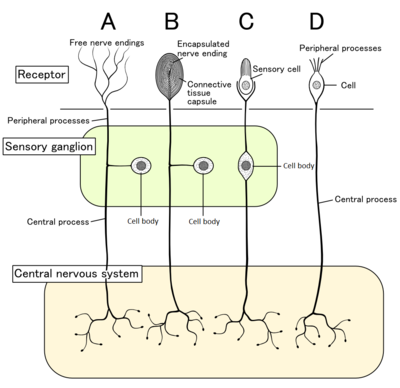


Mechanisms of Sensory Transduction and Neural Processing
The sensory nervous system is a marvel of biological engineering, responsible for detecting a vast array of stimuli and relaying this information to the central nervous system for interpretation. This process begins with sensory transduction, where specialized sensory receptors convert physical or chemical energy into electrical signals, known as action potentials. For example, photoreceptors in the retina convert light energy into neural signals, while mechanoreceptors in the skin respond to pressure and vibration.
These signals are then transmitted along afferent (sensory) neurons, which form complex pathways leading to specific processing centers in the brain. Different sensory modalities are processed in distinct cortical areas, such as the visual cortex for sight, the auditory cortex for sound, and the somatosensory cortex for touch, temperature, and pain. Crucially, the brain doesn't just passively receive this data; it actively filters, integrates, and interprets it, creating our conscious perception of the world and enabling us to make informed decisions and react appropriately to our environment.
This intricate interplay between peripheral receptors and central processing is fundamental to our experience of reality.
Evolutionary Trajectories of Sensory Systems
The evolution of sensory systems is a testament to the power of natural selection in shaping organisms to better interact with their environments. From the simplest light-sensitive spots in early life forms to the highly complex eyes and ears of vertebrates, sensory organs have undergone remarkable diversification. The development of specialized sensory modalities conferred significant survival advantages, enabling organisms to locate food, detect predators, find mates, and navigate their habitats more effectively.
For instance, the evolution of olfaction (smell) allowed animals to detect chemical cues over distances, while the development of echolocation in bats and dolphins provided a sophisticated means of sensing in environments where vision is limited. In humans, the refinement of vision and auditory processing, coupled with complex touch and proprioception, has been critical for our species' adaptability, enabling tool use, intricate social communication, and the development of complex cultures. Understanding these evolutionary pathways reveals the deep-seated importance of sensory input for life's persistence and complexity.
The Indispensable Role of Sensory Input in Human Function
The sensory nervous system is not merely an accessory for experiencing the world; it is foundational to virtually all aspects of human function and well-being. Beyond facilitating basic survival needs like finding sustenance and avoiding danger, our senses are integral to learning, memory, and cognitive development. Early sensory experiences shape neural pathways, laying the groundwork for higher-order thinking.
Furthermore, sensory input is crucial for motor control and coordination, allowing us to interact physically with our surroundings with precision. The richness of human experience, from appreciating art and music to forming social bonds, is profoundly dependent on the sophisticated processing of sensory information. Impairments in sensory function can lead to significant challenges in daily life, highlighting the system's critical role in maintaining independence, social engagement, and overall quality of life.
The continuous flow of sensory data allows us to adapt to changing conditions and maintain homeostasis.
Neural Integration and Perception
The brain's role in the sensory system extends far beyond simple signal reception; it is an active constructor of our perceived reality. Through a process known as neural integration, the brain combines information from various sensory modalities, as well as internal bodily states, to create a coherent and unified experience. For example, when you eat an apple, your brain integrates visual information (its color and shape), olfactory cues (its scent), gustatory signals (its taste), and tactile sensations (its texture and temperature) to form a complete perception of the fruit.
This integration allows for more robust and accurate interpretation of the environment than any single sense could provide alone. Furthermore, top-down processing, where prior knowledge, expectations, and attention influence how sensory information is interpreted, plays a significant role. This means our perception is not a direct, objective reflection of the external world but rather a dynamic, subjective construction shaped by our internal state and experiences.
See also
Based on content from Wikipedia · Licensed under CC BY-SA 4.0